
NOTE: This final part resolves the emotional consequences of the entire history and shows the narrator’s daughter growing up with truth rather than inherited secrecy, bringing the family’s long conflict to a peaceful conclusion.
Years passed before my daughter understood why the old stone basin mattered.
By then, the courtyard looked nothing like it had on the afternoon when the brick fell.
The wall had been rebuilt.
The cracks were gone.
The stones had been cleaned.
Flowers grew around the basin.
We planted lavender along one side and small white flowers along the other.
Lily loved the courtyard.
She played there after school.
She read books beneath the tree.
She learned to ride her first bicycle there.
She grew up without remembering the fear that had once filled the same space.
That was exactly what I had wanted.
I didn't want her childhood to be defined by something she had never understood.
But I also didn't want to erase the truth.
When she was old enough, I began telling her small pieces.
Not the frightening details.
Not the names of every person involved.
Just enough for her to understand that families sometimes carry complicated histories.
One afternoon, when she was sixteen, she sat beside the basin and asked me directly.
“Mom, what happened here?”
I sat beside her.
“Something fell.”
“A brick?”
“Yes.”
“Did it hurt someone?”
“Almost.”
She looked at me.
“Was that why Grandma was crying in the old photograph?”
I realized she had found the picture in the archive.
“Yes.”
“Why?”
“Because there were secrets in the family.”
She frowned.
“About what?”
“The house.”
“And money?”
“Yes.”
“And Grandpa?”
“Yes.”
She looked thoughtful.
“Was Grandpa bad?”
I smiled sadly.
“I don't think people are that simple.”
“What did he do?”
“He made mistakes.”
“Big ones?”
“Yes.”
“Did he love you?”
“Yes.”
She nodded.
“Then how can both be true?”
I looked at her.
“Because loving someone doesn't make every decision they make correct.”
She thought about that for a long time.
Then she asked:
“Did Grandma lie?”
“Yes.”
“Why?”
“She was afraid.”
“Was she bad?”
“No.”
Lily smiled.
“People really are complicated.”
“Yes.”
She looked at the basin.
“Then why keep it?”
I knew exactly what she meant.
Why keep the stone basin?
Why keep the photograph?
Why keep the documents?
Why keep reminders of a difficult past?
I answered honestly.
“Because forgetting can make us repeat things.”
She nodded.
“But remembering doesn't mean being afraid.”
“No.”
“That part I understand.”
I smiled.
She had understood more than I expected.
The family archive had become part of our lives.
Not something we visited every day.
Not something we used to reopen old wounds.
It was simply there.
A record.
A reminder.
A collection of facts that no longer depended on one person's memory.
My daughter eventually read my father's letter.
She read my mother's explanation.
She read the legal documents.
She read the final statement from Robert.
Then she asked me:
“Do you hate Grandpa?”
“No.”
“Do you forgive him?”
“I did.”
“Why?”
“Because I wanted to stop carrying anger that wasn't helping anyone.”
She considered that.
“Does forgiving mean you think what he did was okay?”
“No.”
“Then what does it mean?”
“It means I can remember what happened without letting it control my life.”
She smiled.
“I like that.”
“So do I.”
My mother lived long enough to see Lily become an adult.
That mattered to her.
She often sat in the courtyard with her granddaughter.
Sometimes they talked.
Sometimes they didn't.
One afternoon, I heard Lily ask her:
“Grandma, were you scared a lot?”
My mother was silent for a moment.
Then she answered:
“Yes.”
“Why?”
“Because I thought I had to protect everyone.”
“Did you?”
“No.”
“What changed?”
“I learned that people need truth more than protection from truth.”
Lily nodded.
I stood in the doorway listening.
My mother looked at me.
She knew I had heard.
There was no embarrassment.
No need to hide.
That was how far we had come.
My husband and I remained together.
Our marriage wasn't perfect.
It never had been.
But we had learned something valuable.
Secrets rarely disappear when you refuse to discuss them.
They grow.
They change shape.
They enter ordinary conversations.
They influence decisions.
They create suspicion.
The solution isn't always a dramatic confession.
Sometimes it is simply telling the truth when the opportunity first appears.
We tried to live that way.
If we were worried, we spoke.
If we were wrong, we admitted it.
If we didn't know something, we said we didn't know.
It sounded simple.
It wasn't.
But it was worth practicing.
The old legal dispute eventually became history.
The documents were preserved.
The financial matters were settled.
The house remained ours.
We repaired every remaining part of the courtyard.
The old basin became a garden feature.
The brick that had fallen was never thrown away.
I kept it in the archive.
Lily once asked why.
“Because it reminds me that something small can reveal something much bigger.”
She laughed.
“Like a detective story.”
“Exactly.”
“Did you solve it?”
I smiled.
“We solved enough.”
She looked at me.
“What's the difference?”
“Some questions have answers. Others have lessons.”
She seemed satisfied with that.
Then she ran outside.
Years later, she had a daughter of her own.
My granddaughter was born in spring.
The first time I held her, I thought about Lily as a baby.
Then I thought about that terrible afternoon.
The brick.
The basin.
My mother.
The phone.
The accusation.
The fear.
And then I looked down at the tiny child in my arms.
History had a strange way of returning through ordinary moments.
A new baby.
A family gathering.
A kitchen.
A birthday.
The details changed.
The feeling remained.
But this time, there were no secrets.
We celebrated openly.
My daughter told everyone when she was worried.
Her husband told her when something frightened him.
My mother was gone by then.
But her lessons remained.
Not the lessons she intended to teach.
The lessons she learned too late.
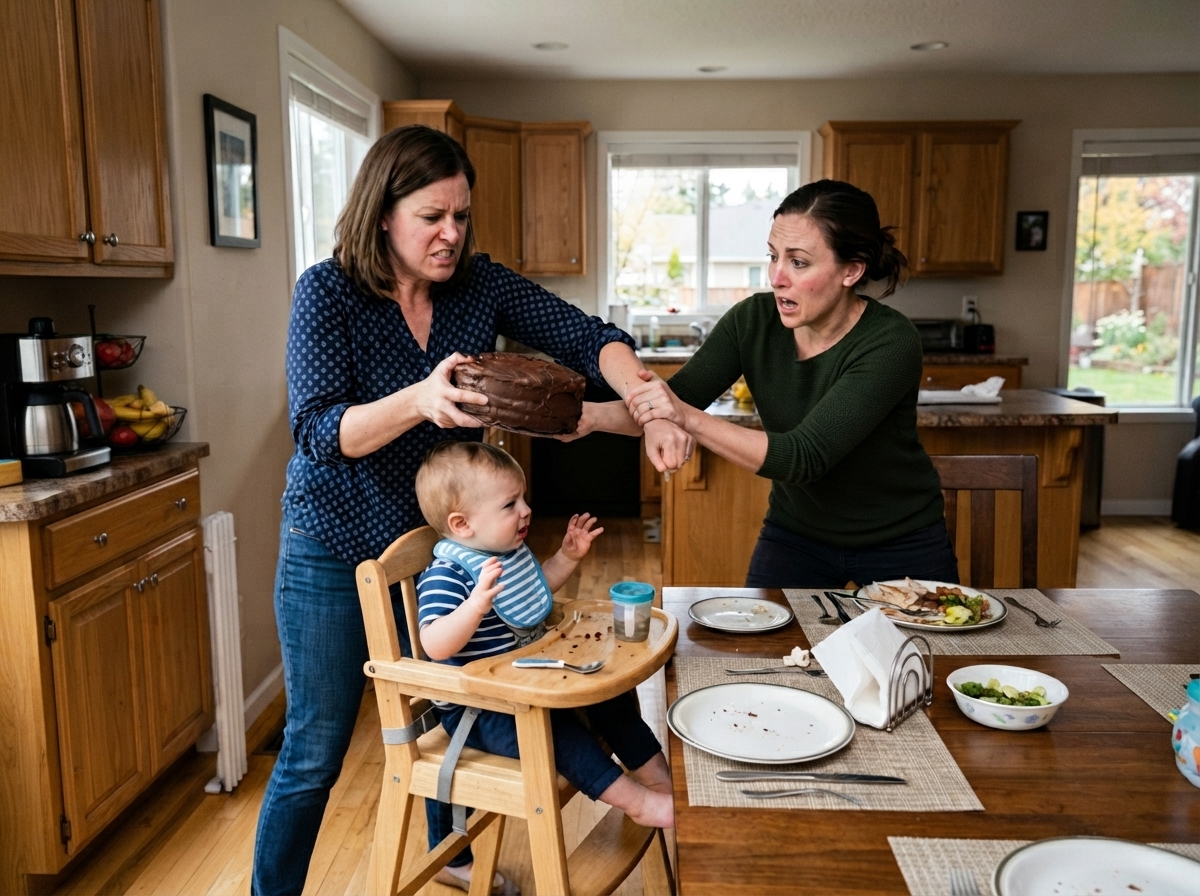
One evening, we gathered in the courtyard for my granddaughter's birthday.
The cake sat on the table.
Chocolate.
My granddaughter reached for it.
Everyone laughed.
My daughter looked at me.
“You okay?”
I smiled.
“Yes.”
“You're thinking about the old story.”
“I am.”
She laughed.
“I knew it.”
I looked at the cake.
Then at my granddaughter.
Nothing happened.
No brick fell.
No phone rang.
No accusation interrupted the celebration.
There was simply laughter.
The child blew out her candles.
Everyone clapped.
And I realized that this was the true ending.
Not that the past had been erased.
Not that everyone involved had become friends.
Not that every wound had disappeared.
The ending was that the next generation could live differently.
My daughter didn't inherit our fear.
She inherited our understanding.
That was enough.
After everyone left, I walked into the courtyard alone.
The moonlight touched the repaired wall.
The basin was filled with flowers.
I rested my hand against the stone.
I remembered the day the brick fell.
At the time, I thought the danger was the object itself.
I was wrong.
The brick was only a symptom.
The real danger had been everything hidden behind it.
The secrets.
The lies.
The fear.
The belief that protecting people meant controlling what they were allowed to know.
The years of uncertainty.
The assumptions.
The silence.
Once we began removing those layers, the truth became much less frightening.
Not easy.
Not painless.
But clear.
I had once wished I could erase the afternoon.
Now I was grateful we had survived it.
Not because suffering was necessary.
It wasn't.
But because what followed forced us to become more honest than we had ever been.
My father had left behind mistakes.
My mother had left behind fear.
My uncle had left behind deception.
Robert had left behind manipulation.
Daniel had left behind resentment.
My husband and I had nearly inherited all of it.
Instead, we chose something different.
We chose to talk.
We chose to verify.
We chose to apologize.
We chose to forgive where forgiveness was possible.
And when forgiveness wasn't immediate, we allowed time to do its work.
The old courtyard remained.
So did the basin.
So did the wall.
But the place no longer frightened me.
It had become a reminder.
Broken things can be repaired.
Damaged trust can be rebuilt.
Families can survive difficult truths.
And children don't have to inherit the mistakes of adults.
I went inside.
My daughter was waiting at the kitchen door.
“You're still thinking about it?”
“Yes.”
“What do you think about?”
I looked at her.
“That you turned out all right.”
She laughed.
“That's a strange conclusion.”
“It's the one I'm happiest with.”
She hugged me.
“Mom?”
“Yes?”
“Thank you for telling me.”
I closed my eyes.
Those four words meant more to me than she could know.
For most of my life, people had believed love meant protecting someone from the truth.
I had finally learned something different.
Love could mean telling the truth carefully.
Love could mean admitting fear.
Love could mean saying, “I don't know.”
Love could mean allowing someone to make their own decisions once they knew the facts.
And sometimes love meant standing beside someone while they discovered that the family history they had inherited wasn't the family history they had to repeat.
My daughter squeezed my hand.
“Come inside.”
I smiled.
“Okay.”
We walked through the doorway together.
Behind us, the courtyard remained quiet.
The old wall stood firm.
The basin was covered in flowers.
The brick that had once nearly changed everything rested in its box inside the archive.
It was only a brick.
The phone was only a phone.
The house was only a house.
None of them had ever been the true story.
The true story was what happened when people finally stopped hiding.
And that was the inheritance I chose to leave my daughter.
Not a perfect family.
Not a perfect past.
Not a life without fear.
Just the courage to ask questions.
The freedom to know the truth.
And the understanding that when something breaks, you don't always have to hide the pieces.
Sometimes you put them on the table.
You look at every crack.
You admit what happened.
And then, together, you decide what to build next.
The End
Read more original stories on Feel Every Story.
My Baby Started Crying Beside the Old Stone Basin, but It Was the Phone in My Mother’s Hand That Made My Husband Stop Mid-Step
Part 8 of 8

