
NOTE: This part brings the story into the next generation, showing how the family chooses to pass down the truth without passing down the fear, secrecy, or shame that once surrounded it.
Mia was four when she first asked about the photograph.
She stood in front of the fireplace holding a picture book.
“Mommy?”
“Yes?”
“Who is that lady?”
I looked at Rachel's photograph.
The question I had imagined for years had finally arrived.
“That is your great-great-grandmother.”
Mia frowned.
“What's her name?”
“Rachel.”
“Was she nice?”
I smiled.
“I think she was.”
“Did you know her?”
“No.”
“Why not?”
Because she died before I was born.
Because people lied.
Because families were afraid.
Because adults made choices that changed generations.
I couldn't tell her all of that.
Not yet.
So I said, “She lived a long time ago.”
Mia nodded.
Then she pointed at another photograph.
“Who's that?”
“Anna.”
“Was she your grandma?”
“Not exactly.”
Mia thought about it.
“Was she family?”
“Yes.”
She accepted that.
Children often did something adults struggled to do.
They accepted complicated truths without immediately demanding that everything fit into one category.
Later that evening, I called David.
“We need to talk.”
He knew immediately.
“What happened?”
“Mia asked about Rachel.”
He smiled.
“She did?”
“Yes.”
“What did you tell her?”
“Enough.”
He nodded.
“Good.”
“But I think we need to decide how we'll explain everything when she's older.”
He came home early.
We sat together.
The house was quiet.
We had learned that truth needed preparation.
Not because truth was dangerous.
Because information carried weight.
We wrote down the family history.
Not the sensational version.
Not the version with dramatic language.
Just facts.
Rachel had twins.
Anna disappeared.
The second child was hidden.
David's father altered records.
Marcus helped maintain the deception.
Eleanor knew more than she admitted.
The family remained silent.
Decades passed.
The hidden bloodline eventually returned to us.
Mia became the person who forced the truth into the open.
We wrote it carefully.
Then we wrote what we didn't know.
That part was important.
Unknown.
Unconfirmed.
Disputed.
We would never teach Mia that every mystery had a perfect answer.
Some didn't.
A few months later, we visited the memorial where Rachel's name had finally been restored.
Mia carried flowers.
“Who are they for?”
“Rachel.”
“Why?”
“Because she was family.”
Mia placed the flowers down.
Then she looked at me.
“Did she have children?”
“Yes.”
“Are they me?”
I smiled.
“No. But you're connected to them.”
She seemed satisfied.
Then she ran toward David.
I watched her.
The story was changing.
For years, I had thought the past was something behind us.
Now I understood it was something we carried forward.
The question was what we carried.
We could carry fear.
We could carry shame.
We could carry silence.
Or we could carry knowledge.
I chose knowledge.
David chose it too.
Eleanor did as well.
She became surprisingly honest with Mia as she grew older.
When Mia asked difficult questions, Eleanor didn't invent answers.
“I don't know.”
Sometimes that was her answer.
And sometimes it was exactly the answer Mia needed.
One afternoon, Mia asked her grandmother why the old fireplace had been rebuilt.
Eleanor looked at me.
I nodded.
“Because people once hid things in this house.”
Mia's eyes widened.
“What things?”
“Documents.”
“Why?”
“Because they were afraid.”
“Of what?”
“Of the truth.”
Mia frowned.
“Why be scared of the truth?”
Eleanor looked at me.
Then she answered.
“Because sometimes the truth means you have to admit you were wrong.”
Mia considered this.
“Were you wrong?”
Eleanor swallowed.
“Yes.”
“Did you say sorry?”
“Yes.”
“Did they forgive you?”
Eleanor looked at me.
“I don't know.”
Mia turned toward me.
“Did you?”
I answered honestly.
“Some days I feel like I have.”
“And other days?”
“Other days I still feel hurt.”
Mia nodded.
“That's okay.”
Eleanor smiled.
“Yes.”
The simplicity of her answer stayed with me.
Children didn't always need complicated explanations.
Sometimes they only needed permission to feel two things at once.
Love and anger.
Forgiveness and disappointment.
Trust and caution.
Years passed.
Mia became curious about family history.
She asked for photographs.
She wanted to know who everyone was.
We showed her.
We never hid the difficult ones.
We never removed people because their names made us uncomfortable.
Instead, we explained.
“This person made a serious mistake.”
“This person lied.”
“This person tried to fix what they had done.”
“This person never apologized.”
“This person helped.”
This person was afraid.
This person was brave.
This person was both.
The family history became less frightening as it became more complete.
When Mia was twelve, she read the entire account.
She sat quietly afterward.
Then she came to me.
“Mom.”
“Yes?”
“Grandpa wasn't a hero.”
“No.”
“But he wasn't completely bad.”
“No.”
“And Grandma lied.”
“Yes.”
“And Marcus did terrible things.”
“Yes.”
“And Rachel was hurt.”
“Yes.”
Mia looked at me.
“Why didn't anybody just tell the truth?”
I smiled sadly.
“That is the question.”
She thought about it.
“Maybe they thought hiding it would make the problem smaller.”
“Maybe.”
“Did it?”
“No.”
She nodded.
“I don't want to do that.”
Neither did I.
At sixteen, Mia asked to visit Anna's grave.
We went together.
She stood there for a long time.
“She never knew?”
“Not everything.”
“That's sad.”
“Yes.”
Mia placed flowers down.
“I wish she had known.”
“So do I.”
On the drive home, she asked another question.
“Do you regret finding all this out?”
I thought about it.
There had been nights when I wished the letter had never appeared.
There had been moments when ignorance seemed almost peaceful.
But peace built on falsehood was fragile.
“No,” I said.
“Why?”
“Because I would rather know who I am.”
She smiled.
“I think I would too.”
That was the moment I knew we had broken the pattern.
The secret had once been passed from one generation to another.
Now the truth was being passed instead.
Not because the truth was always comfortable.
Because it belonged to us.
Years later, David and I attended Mia's graduation.
Eleanor was there.
Daniel was there.
Clara came too.
We took a family photograph.
Everyone stood together.
There were empty spaces where certain people should have been.
But the photograph was still complete.
No one had been erased.
The people who had died remained part of the story.
The people who had caused harm remained part of it too.
But the future belonged to the living.
Afterward, Mia gave me a small envelope.
“What is this?”
“Open it.”
Inside was a copy of Rachel's photograph.
On the back, Mia had written:
“Truth belongs in the light.”
I looked at her.
“You wrote this?”
“Yes.”
I hugged her.
She laughed.
“You're squeezing too hard.”
“I know.”
David came over.
“What did she give you?”
I showed him.
He smiled.
“She gets it.”
“She does.”
That evening, the four of us sat beside the fireplace.
Eleanor looked around.
“This house feels different.”
“It is different.”
She smiled.
“Because nobody is hiding anything.”
I looked at the family photographs.
“That took a long time.”
“Yes.”
“But we did it.”
Eleanor nodded.
“We did.”
The fire crackled softly.
For years, that sound had made me remember the old fear.
Now it reminded me of something else.
Survival.
Truth.
Family.
Choice.
Mia leaned against David.
I watched her.
She had grown up knowing her history.
But she had not grown up trapped inside it.
That was the difference.
We could not change what happened to Rachel.
We could not restore Anna's lost childhood.
We could not undo the decisions made by David's father.
We could not erase Eleanor's lies.
We could not change what Marcus had done.
But we could refuse to pass the same damage forward.
That was our choice.
And perhaps that was the only ending that truly belonged to us.
Click Here to continue read next: PART8: When the Last Secret Was Finally Spoken Aloud, I Realized Our Family Had Never Needed a Perfect Past, Only the Courage to Stop Hiding It
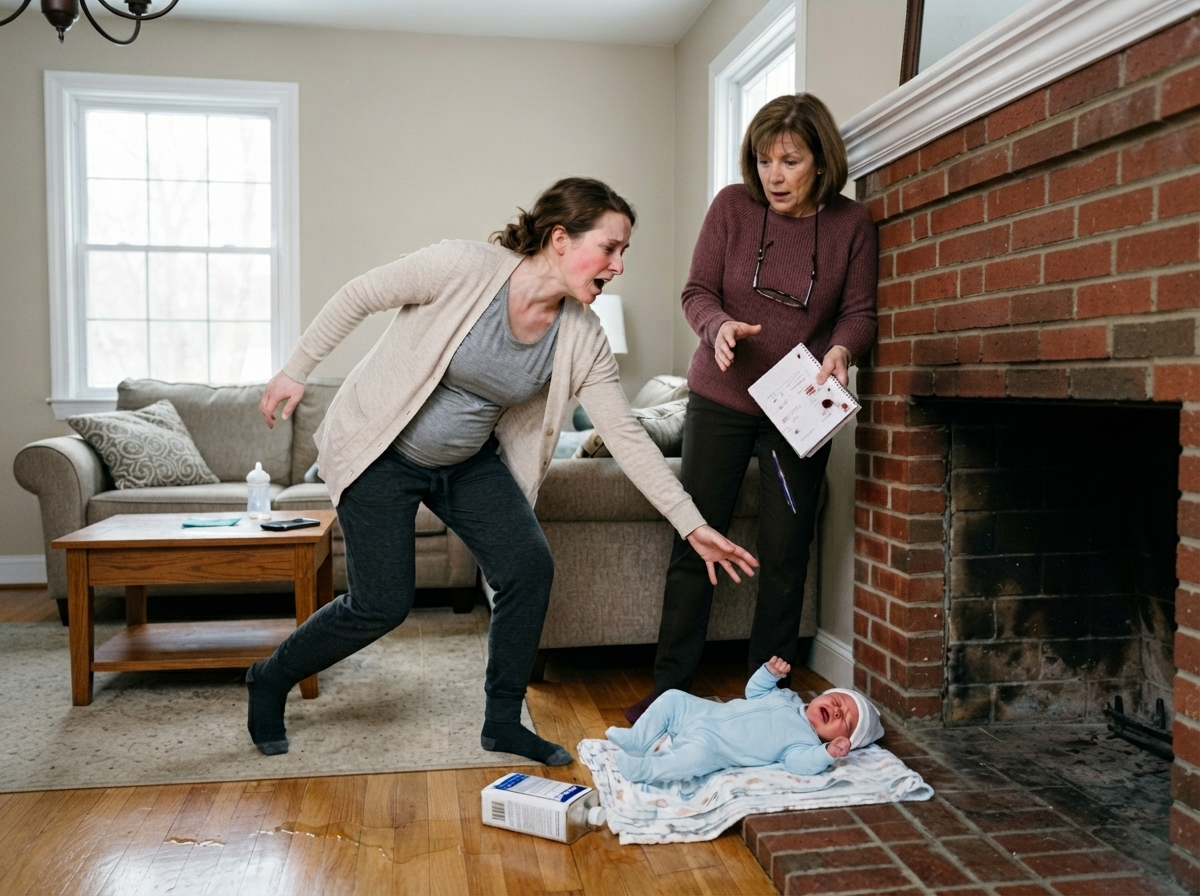
My Baby Began Crying Beside the Fireplace, but the Blood on the Letter in My Mother-In-Law’s Hand Made Me Forget Everything Else
Part 7 of 8

