
NOTE: This final part resolves the emotional consequences of the entire story, shows the family's long-term healing, and closes with the meaning of truth, responsibility, forgiveness, and protection.
Years later, I still kept the photograph.
It remained beside the fireplace.
The picture of my father holding me as a child.
The old house behind us.
The place where so much of our family's pain had begun.
Sometimes Lily would ask about it.
Sometimes Ben would tell his sister the story.
And every time, we told it a little more simply.
Not because we wanted to hide anything.
Because children grew into the truth gradually.
When they were old enough, we gave them more.
When they were younger, we gave them what they could understand.
That was different from lying.
I finally understood the difference.
Protection was not silence.
Protection was knowing what someone could safely carry and refusing to burden them with what they could not.
But when the time came, we told the truth.
Always.
Ben became an adult.
Lily followed close behind.
Daniel and I grew older.
My mother became fragile.
The family changed again.
People moved.
People married.
People had children.
The house became louder.
Then quieter.
Life did what life always does.
It continued.
One evening, Ben came home from college.
He found me sitting beside the fireplace.
"You're still here."
I smiled.
"Where else would I be?"
He sat down.
"Mom, can I ask you something?"
"Of course."
"Do you regret telling me everything?"
"No."
"Even though it scared me?"
I thought about it.
"Yes, I regret that you ever had to be scared."
He nodded.
"But not the truth."
"Never the truth."
He looked at the photograph.
"I've been thinking about Grandpa."
"Why?"
"Because I used to think people were either good or bad."
"And now?"
"Now I think people are responsible for what they choose, even when I understand why they chose it."
I smiled.
"That's a hard lesson."
"It is."
He leaned back.
"I think that's why I want to work with kids."
"Still?"
"Still."
He had been volunteering with young people for years.
He wanted to become a counselor.
He wanted children to have adults who listened.
I understood why.
His childhood had taught him how frightening silence could become.
He wanted to make sure other children had another option.
"That's a good reason."
He smiled.
"Thanks."
My mother joined us later.
She carried tea.
She looked at the photograph.
"I remember that day."
"Which day?"
"The day your father took it."
"What do you remember?"
"You were crying."
I laughed.
"Apparently I cried a lot."
"You did."
She smiled.
Then her expression became serious.
"I wish I could go back."
I shook my head.
"You can't."
"I know."
"But you can live differently now."
She nodded.
"I am trying."
That was all I needed her to say.
Not that she could erase it.
Not that everything was forgiven.
Only that she was trying.
My mother died two years later.
Her funeral was small.
Daniel spoke.
I spoke.
Ben spoke.
He didn't describe her as perfect.
He didn't describe her as terrible.
He described her honestly.
"She made mistakes that hurt people," he said.
"But she eventually learned that telling the truth was more important than protecting a secret."
I looked at him.
He was no longer a child.
He was a man.
And I realized that the story had outgrown all of us.
It no longer belonged only to me.
It belonged to the lessons we had carried forward.
After the funeral, Ben asked whether I wanted to remove my mother's photograph from the family wall.
"No."
"Why?"
"Because she was part of our family."
"Even after everything?"
"Especially after everything."
He understood.
We left the photograph there.
Not as approval.
As history.
Years later, the old legal records became public.
Researchers contacted us.
They wanted interviews.
I declined most of them.
Not because I was ashamed.
Because our pain wasn't entertainment.
I would tell the story when it could help someone.
I wouldn't tell it simply because people were curious.
That distinction mattered.
One organization asked Ben to speak about childhood trust.
He accepted.
I attended.
He stood in front of a room filled with parents and educators.
He didn't tell them every detail.
He talked about listening.
He talked about children who become frightened when adults tell them not to speak.
He talked about boundaries.
He talked about the difference between privacy and secrecy.
Then he said something that stayed with me.
"A child shouldn't have to choose between protecting an adult and telling the truth."
I looked down.
I remembered the boy he had been.
The boy who had once been afraid to speak.
The boy who had eventually told us what was happening.
His honesty had changed everything.
After the speech, he came over.
"You okay?"
I laughed.
"I'm proud of you."
"Thanks."
"Very proud."
He hugged me.
"I learned it from you."
I shook my head.
"No."
He looked surprised.
"You learned it from what happened."
He thought about that.
"Maybe."
Then he smiled.
"Either way, I'm glad we made it."
So was I.
The fireplace remained.
We had replaced it once.
Then again.
Technology changed.
The house changed.
But I kept the photograph.
One winter evening, I sat alone.
Snow fell outside.
The house was quiet.
I looked at my father's face.
For years, I had wanted him to give me an explanation.
Now I realized he couldn't.
He had made choices.
Some were courageous.
Some were fearful.
Some protected us.
Some harmed us.
He was human.
That was the hardest conclusion.
Not hero.
Not villain.
Human.
My mother had been human too.
So had Richard.
So had Robert.
So had Daniel.
So had I.
The difference between us was not whether we made mistakes.
It was what we did after making them.
Robert had chosen deeper deception.
My mother eventually chose confession.
Daniel chose honesty.
I chose to listen.
Ben chose to speak.
And Lily grew up knowing that no adult had the right to demand silence from her when she was frightened.
That was the legacy.
Not the fire.
Not the money.
Not the identities.
Not the investigation.
The choice that came afterward.
One spring morning, Lily asked me to tell her the whole story.
She was old enough.
So I did.
We sat beside the fireplace.
She listened.
She asked questions.
Some were difficult.
I answered.
When I finished, she looked at the photograph.
"Grandpa made mistakes."
"Yes."
"Grandma did too."
"Yes."
"Did Dad?"
"Yes."
She laughed.
"Did you?"
"Many."
She smiled.
"Okay."
"What?"
"I thought you were going to say everyone else made mistakes."
I laughed.
"No."
She looked at the photograph again.
"Do you forgive them?"
I took a long breath.
"Some things."
"All of it?"
"No."
"Why?"
"Because forgiveness isn't the same as pretending nothing happened."
She nodded.
"Then what is it?"
"Sometimes it's deciding you won't let anger control the rest of your life."
She thought about that.
"That's difficult."
"Very."
"But worth it?"
I looked at her.
"I think so."
She smiled.
Then she reached for my hand.
"Come outside."
"Why?"
"I want to show you something."
We walked into the backyard.
She had planted flowers near the fence.
"I did these myself."
"They're beautiful."
"I know."
I laughed.
She laughed.
And for a moment, there was nothing else.
No old house.
No secret.
No fire.
No missing documents.
Just a daughter showing her mother something she was proud of.
That was what the past had ultimately given us.
Not happiness.
The past could not give that.
But perspective.
The ability to recognize peace.
The ability to understand what mattered.
The ability to know when a quiet house was safe.
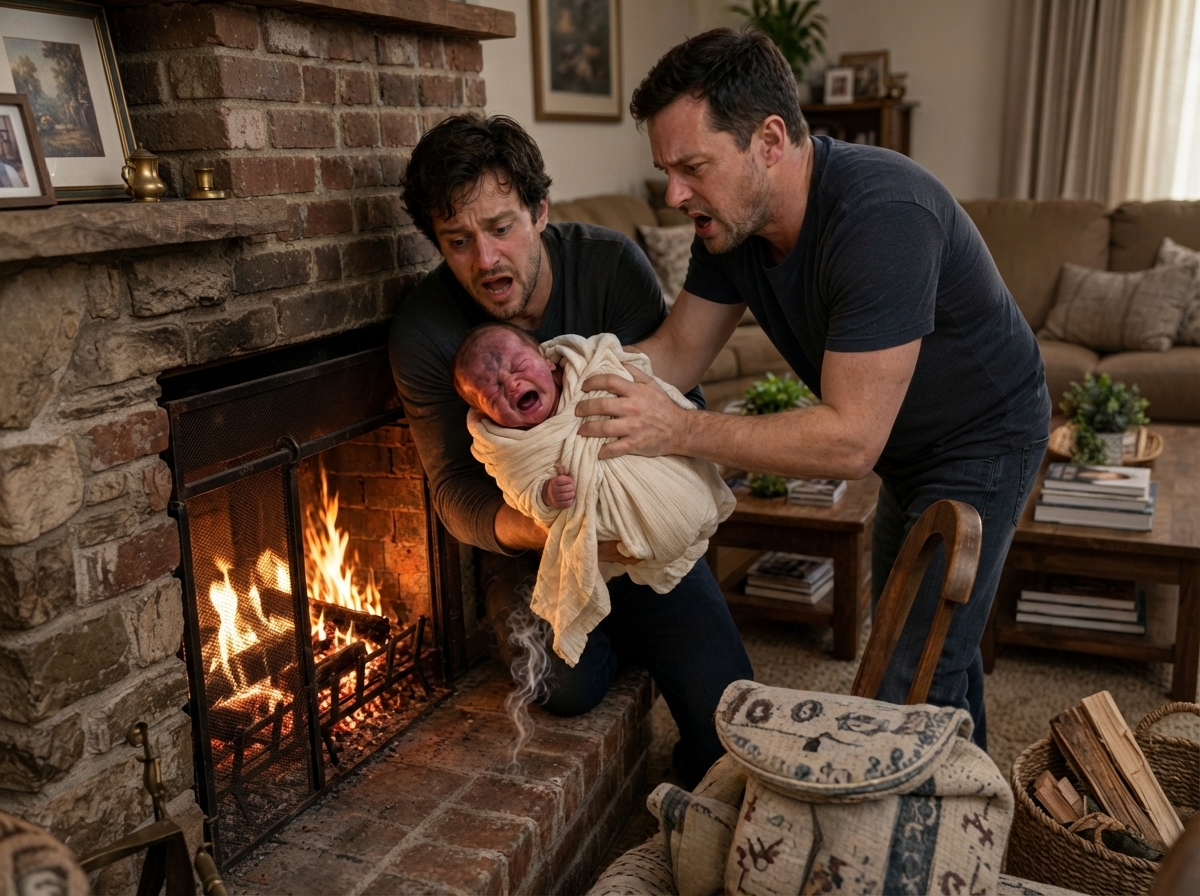
Years earlier, my brother had run into our living room carrying my crying newborn.
Smoke had filled the air.
A fireplace had become a threat.
A secret had nearly destroyed what remained of our family.
But the danger had eventually led us to the truth.
The truth had forced us to confront people we loved.
It had forced us to acknowledge what they had done.
It had forced us to accept that consequences and compassion could exist together.
Most importantly, it taught us that protecting someone does not mean protecting them from reality forever.
Sometimes protection means telling the truth early enough that they have a chance to choose differently.
I looked at the photograph one final time that evening.
My father was holding me.
I was crying.
He was smiling.
Behind us, the old fireplace stood quietly.
I used to think that photograph represented everything I had lost.
Now I saw something else.
It represented the beginning.
The beginning of a life.
The beginning of a family.
The beginning of mistakes.
And eventually, the beginning of honesty.
I left the photograph where it had always been.
Beside the fire.
Not hidden.
Not worshiped.
Simply remembered.
The flames burned steadily.
No smoke.
No danger.
Just light.
Claire came into the room.
"Are you coming to bed?"
"In a minute."
She kissed my forehead.
Then she left.
I sat for another moment.
I thought about Ben.
About Lily.
About Daniel.
About my mother.
About my father.
About all the people who had tried to protect one another and had sometimes made things worse.
Then I understood what my father had wanted me to learn.
The goal was never to create a family without mistakes.
That family did not exist.
The goal was to create a family where mistakes could be admitted before they became secrets.
Where fear could be spoken instead of hidden.
Where children could ask questions.
Where adults could say, "I was wrong."
Where forgiveness could be offered without erasing accountability.
Where love did not require silence.
I stood.
I turned off the light.
The photograph remained beside the fireplace.
And the house became quiet again.
But this time, the quiet was different.
It wasn't the silence of people hiding something.
It was the silence of people who had nothing left to hide.
The End
Read more original stories on Feel Every Story.
My Brother Burst Through the Door With My Newborn in His Arms, but the Strange Smoke Behind Him Made Me Realize Something Was Terribly Wrong
Part 8 of 8

