
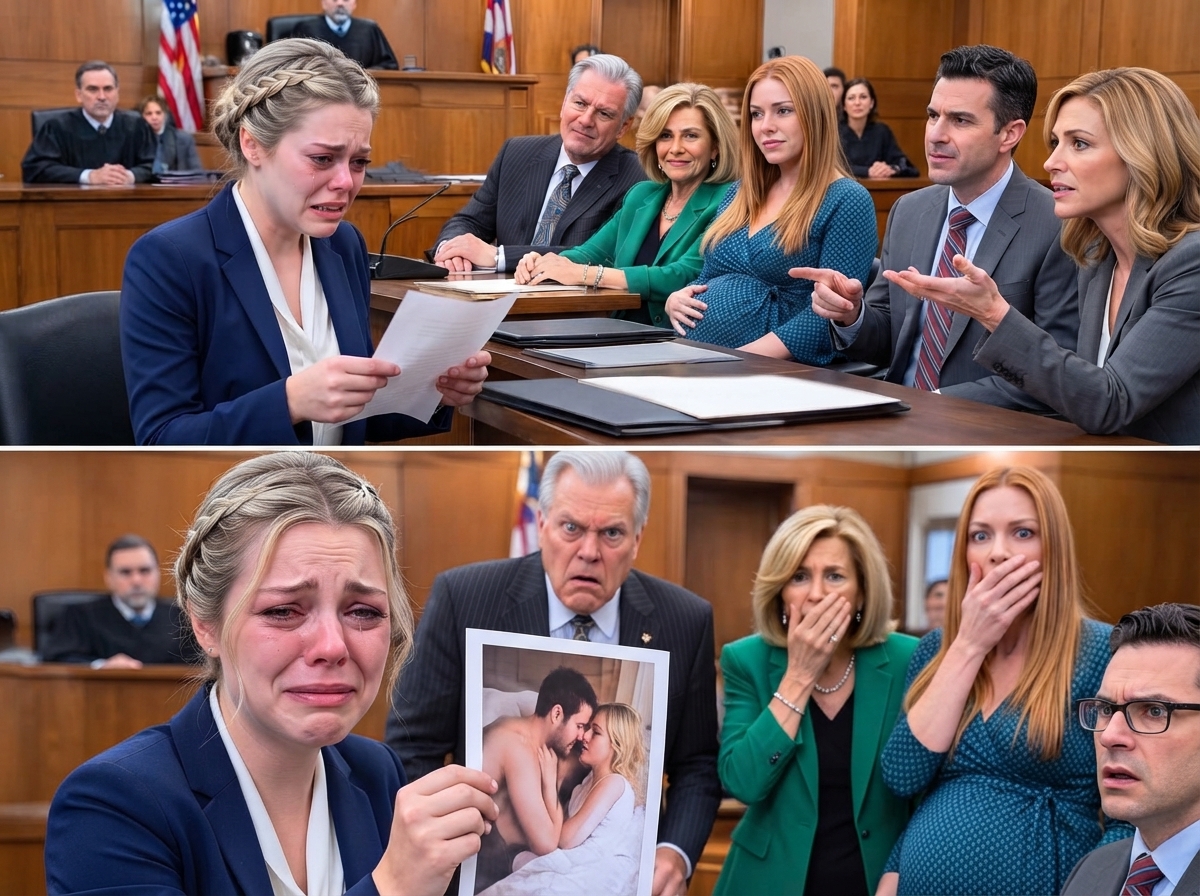
The first thing I noticed when I entered the federal courtroom was that my mother would not look at me. She sat beside my father in the second row, hands folded tightly over her purse, wearing the expression she usually reserved for funerals and family emergencies. Except this time, I was the emergency.
Across the aisle, my younger sister Brittany rested one palm over the curve of her pregnant stomach. Her husband, Jamal Price, sat beside her in an expensive charcoal suit, perfectly composed. He had the polished calm of a man who spent his career persuading strangers to trust numbers they could not independently verify.
They had brought me before a federal judge to argue that I was no longer capable of managing my own life.
Not because I was ill.
Not because I had asked them for help.
Because they wanted my home.
My condo stood on the Chicago riverfront, with wide windows, a private elevator, and enough space for a nursery, according to Brittany. Three years earlier, I had paid for it outright. No mortgage remained. No lien existed. No bank was waiting to seize it.
Yet my family's attorney, Mr. Caldwell, was preparing to tell Judge Harold Whitman that the property was supposedly one missed payment away from disappearing.
I sat at the defense table beside Evelyn Kensington, the attorney I had hired several weeks earlier after receiving the petition. She had spent most of the morning saying almost nothing. Her legal pad contained only a few handwritten notes, and she had not once looked nervous.
That steadied me.
“Cassidy Vale has become increasingly unstable,” Caldwell said, his voice soft enough to sound compassionate. “She has demonstrated paranoia, reckless financial behavior, and an inability to understand the consequences of her decisions.”
I watched Judge Whitman listen.
Caldwell continued, describing my alleged debts as though he had personally watched them accumulate. According to him, I had borrowed heavily against investments, abused credit facilities, and somehow maintained an extravagant lifestyle while earning what he called a modest salary in technical support.
Technical support.
That part almost made me smile.
For years, I had allowed my family to believe I worked an ordinary technology job. It was easier than explaining what I actually did, especially after I learned that every success I mentioned eventually became a comparison with Brittany.
If I bought something nice, I was showing off.
If I invested wisely, I was being secretive.
If I refused to lend money, I was selfish.
So I stopped explaining myself.
Now that silence had become part of their case against me.
Caldwell turned toward the judge. “Her parents are deeply concerned that she will lose everything.”
My father lowered his head at exactly the right moment.
My mother dabbed at the corner of one eye.
I knew those performances. I had seen them at family gatherings whenever they wanted relatives to believe I was the difficult daughter and Brittany was the fragile one who needed protecting.
Judge Whitman leaned forward.
“If you are asking this court to remove an adult's legal and financial autonomy,” he said, “I expect evidence substantially stronger than family concern.”
Caldwell smiled.
“We have evidence, Your Honor.”
Jamal was called first.
He walked to the witness stand with the confidence of someone who had spent years speaking in boardrooms. He was a senior investment broker at Northern Lake Capital, and he knew precisely how to make financial language sound frightening to people unfamiliar with it.
He testified that he had reviewed my accounts personally.
He described credit balances, investment loans, questionable purchases, and supposed margin obligations. According to him, my financial situation had become so unstable that I was incapable of protecting myself from further losses.
“If intervention does not happen quickly,” he said, “Ms. Vale could lose her property and place herself in even greater debt.”
I glanced at Evelyn.
She did not react.
Caldwell placed a stack of documents before the court.
My attorney finally leaned toward me.
“Look carefully.”
The first page was a bank statement bearing my name.
The address was mine.
The account number was mine.
The second document appeared to show a default notice. The third described a substantial investment loan. Several pages showed balances that, taken together, painted a picture of a woman sinking beneath obligations she could not possibly repay.
Except there was something wrong.
I recognized the account number on the first statement because I had stopped using that account more than a year earlier.
It was real.
The document was not.
Or at least, something about it was not.
I turned another page.
A memory surfaced.
Six months earlier, my family had gathered at my condo for dinner. Brittany had spent most of the evening talking about the baby's arrival. Jamal had disappeared for several minutes.
He told everyone he had gone to the bathroom.
I had later found him stepping out of my home office.
When I asked what he was doing, he laughed awkwardly and said he had been looking for a charger.
At the time, I had let it go.
Now I stared at the account statement again.
“He took something,” I whispered.
Evelyn looked at me.
“What?”
“Six months ago. Jamal was in my office. He shouldn't have been there.”
“Did anything disappear?”
“I didn't notice anything.”
She took the statement from my hand and studied it closely.
“Not necessarily something physical.”
Her eyes moved across the page.
“If he had access to legitimate financial information, he could have used real details to manufacture something false.”
I looked at Jamal.
He was sitting calmly at the witness table.
For the first time, I understood why the documents felt convincing.
They were built from pieces of my real life.
Evelyn found another inconsistency.
She tapped a classification code printed near the bottom of one statement.
“This is interesting.”
“What?”
“This isn't a normal personal account classification.”
She turned the page slightly toward me.
“It refers to a corporate entity.”
My stomach tightened.
Jamal had supposedly prepared these records to demonstrate that I, personally, had accumulated reckless investment debt.
Yet one of his supposedly personal statements carried a code associated with a business account.
Evelyn's expression changed.
Not dramatically.
Just enough.
She looked pleased.
That was when I realized something I had not expected to realize in court that morning.
My family had come here believing they had built a case against me.
But their attempt to make the lie look real had created a trail.
And someone on my side had already noticed it.
Click Here to continue read next: PART2: My Family Described a Perfect Plan for Saving Me, Until Their Own Words Revealed Who Was Supposed to Get My Home
They Came to Court for My Condo, but the First Lie They Told Was Already Beginning to Unravel
Part 1 of 8


One Comment on “PART 1 – They Came to Court for My Condo, but the First Lie They Told Was Already Beginning to Unravel”