
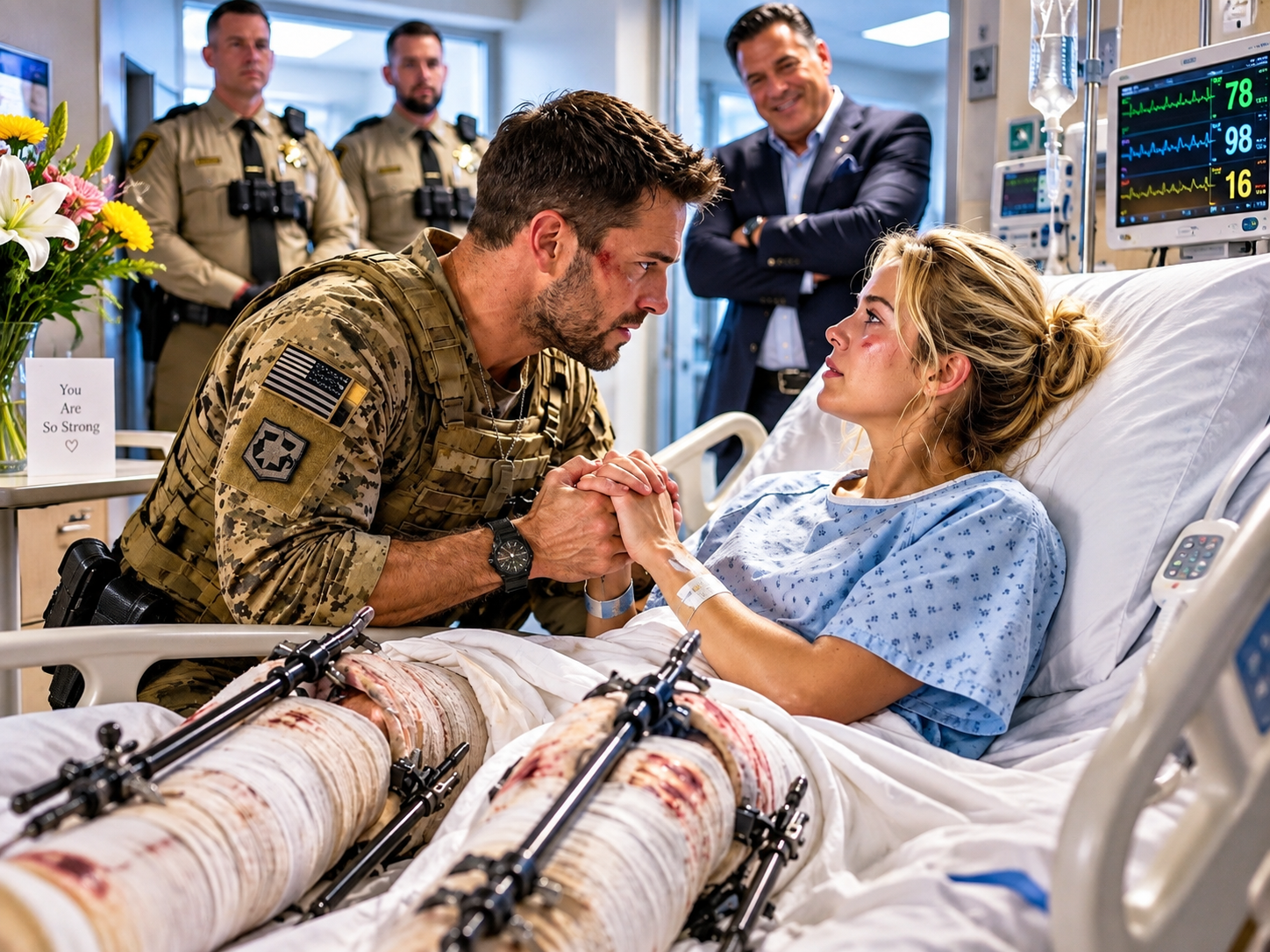
The first time Jessi stood without holding anything, I was not in the room.
She told me later that she had been furious about it.
Her therapist had asked her to rise from the chair.
She had tried.
Her knees shook.
Her palms were damp.
For several seconds, she managed to stay upright.
Then she sat down again.
“That's progress,” the therapist told her.
Jessi disagreed.
“I used to walk into courtrooms in heels.”
The therapist smiled.
“And now you stood.”
Jessi didn't answer.
She looked at her legs.
The injuries had changed everything about her daily life.
Stairs were difficult.
Long distances were worse.
Even showering required planning.
She hated needing help.
I learned to offer it without making her feel helpless.
There was a difference.
One afternoon, she caught me watching her struggle with a jar.
“You can help.”
I reached for it.
“I know.”
“No.”
I stopped.
She twisted the lid again.
“I mean you can help when I ask.”
I nodded.
That became our rule.
She would ask.
I would help.
Neither of us would pretend the injury hadn't changed her.
Neither of us would allow it to become the only thing that defined her.
Meanwhile, the investigation continued.
The six farms were reviewed.
Several property transfers were challenged.
Families who had believed they had lost everything were given legal assistance.
Jessi became deeply involved.
Her injuries kept her away from a courtroom for a while, but they did not keep her from reading documents.
She spent hours reviewing cases from her hospital bed.
Eventually, she began helping other property owners who had been pressured by developers.
Her experience had given her something she had never wanted.
A firsthand understanding of what it felt like to stand across from power with no reason to believe anyone would listen.
She became determined to make sure other people didn't have to wonder whether they would be believed.
I returned to my military duties.
But something had changed in me too.
Before the attack, distance had been normal.
Assignments overseas.
Long flights.
Bad connections.
Brief phone calls.
I had always believed that coming home eventually was enough.
It wasn't.
Five thousand miles had suddenly felt like an impossible distance.
I had been alive and working, while the person I loved was being carried into an emergency room.
That realization stayed with me.
The case was finally closed eighteen months after the night I received the call.
By then, Jessi could walk without crutches.
Slowly.
Carefully.
But independently.
We moved into a small craftsman house outside town.
There were trees behind it and a long gravel path leading toward the road.
Jessi liked the porch.
She said the house felt quiet without feeling isolated.
One autumn evening, we sat outside with coffee.
The mountains were turning orange beneath the setting sun.
Jessi rested both hands around her cup.
“Do you ever think about that morning?”
“Every day.”
“Me too.”
We were silent.
Then she asked, “Do you ever regret not hitting Flynn?”
I looked at her.
She smiled.
“I'm serious.”
“I know.”
“You had every reason.”
“I had reasons to be angry.”
“That's not what I asked.”
I leaned back.
“If I'd hit him, he might have gotten a bruise.”
She nodded.
“And then?”
“He would have hired a lawyer. He would have called me violent. The story would have changed.”
Jessi stared toward the valley.
“He wanted you to lose control.”
“Yes.”
“And you didn't.”
“No.”
She took a sip of coffee.
“I think that bothered him more than anything.”
“It probably did.”
She smiled.
The conversation could have ended there.
But neither of us was ready to pretend the story had ended simply because the courtroom doors had closed.
“What happened to Marcus?” she asked.
“He resigned.”
“Do you hate him?”
I thought about it.
“No.”
She looked surprised.
“He helped them.”
“He did.”
“Then why don't you hate him?”
“Because he eventually chose to tell the truth.”
Jessi nodded slowly.
“He was afraid.”
“Most people were.”
She looked at the courthouse lights far below.
“That's what I remember most.”
“What?”
“Everyone being afraid.”
I reached for her hand.
She let me take it.
“The sheriff had power because people believed resisting him would cost too much,” she said. “Flynn knew that. He counted on it.”
“And then?”
“Then someone finally stopped counting the cost.”
Her fingers tightened around mine.
“You.”
“No.”
She turned toward me.
“You were the one who came home.”
“I was the one who believed you.”
She shook her head.
“You did both.”
I smiled.
The wind moved through the trees.
For the first time since the attack, the silence between us felt peaceful instead of uncertain.
A week later, Jessi returned to legal work.
Not full time.
Not yet.
She started with one case involving a family who had been pressured to sell farmland below market value.
Then another.
Then another.
Eventually, she established an independent nonprofit practice focused on helping property owners facing predatory developers and corrupt officials.
She never called herself a hero.
If someone else did, she usually changed the subject.
She said she was simply doing the work she had already been doing before someone tried to stop her.
I transferred to a permanent shore-duty assignment closer to home.
The paperwork took months.
When the approval finally arrived, Jessi read the orders twice.
“You're really staying?”
“I'm staying.”
She looked at me for a long moment.
“Good.”
I knew what she meant.
She didn't want promises.
She wanted presence.
One evening, months later, we walked the gravel path behind the house.
She moved slowly.
I stayed beside her without reaching for her unless she asked.
Halfway down the path, she stopped.
“I can keep going.”
“I know.”
She smiled.
“You're learning.”
“I've had a good teacher.”
She laughed softly.
That laugh was different from the one I remembered before the attack.
Not louder.
Just freer.
We reached the porch as the last light faded.
Jessi looked toward the distant courthouse.
“They thought the badge would protect them.”
“It protected them for a while.”
“Not forever.”
“No.”
She leaned against my shoulder.
The world had not become fair because two men went to prison.
The scars did not disappear because a jury returned a verdict.
Some losses could not be restored.
But the families got their voices back.
Jessi got her work back.
We got each other back.
And the lesson I carried from those five thousand miles was not that distance could be conquered.
It was that distance could become dangerous when you believed being far away meant being powerless.
The next morning, Jessi stood at the kitchen counter making coffee.
She was wearing one of her old work shirts.
No brace.
No cane.
She looked over her shoulder.
“Luca?”
“Yeah?”
“Come here.”
I walked toward her.
She took my hand.
Nothing dramatic happened.
No announcement.
No victory speech.
Just her fingers closing around mine.
That was enough.
Because after everything that had happened, after the lies and the threats and the evidence and the courtroom, the most important thing was no longer proving that we had survived.
It was waking up beside each other and knowing we were finally home.
Click Here to continue read next: PART5: The Quiet Life We Built Began to Crack When an Old Property File Returned With One Name Neither of Us Had Expected to See Again
The Call Came Across Five Thousand Miles of Static, and Before My Plane Landed, Someone Had Already Decided What Story I Was Supposed to Believe
Part 4 of 8

