
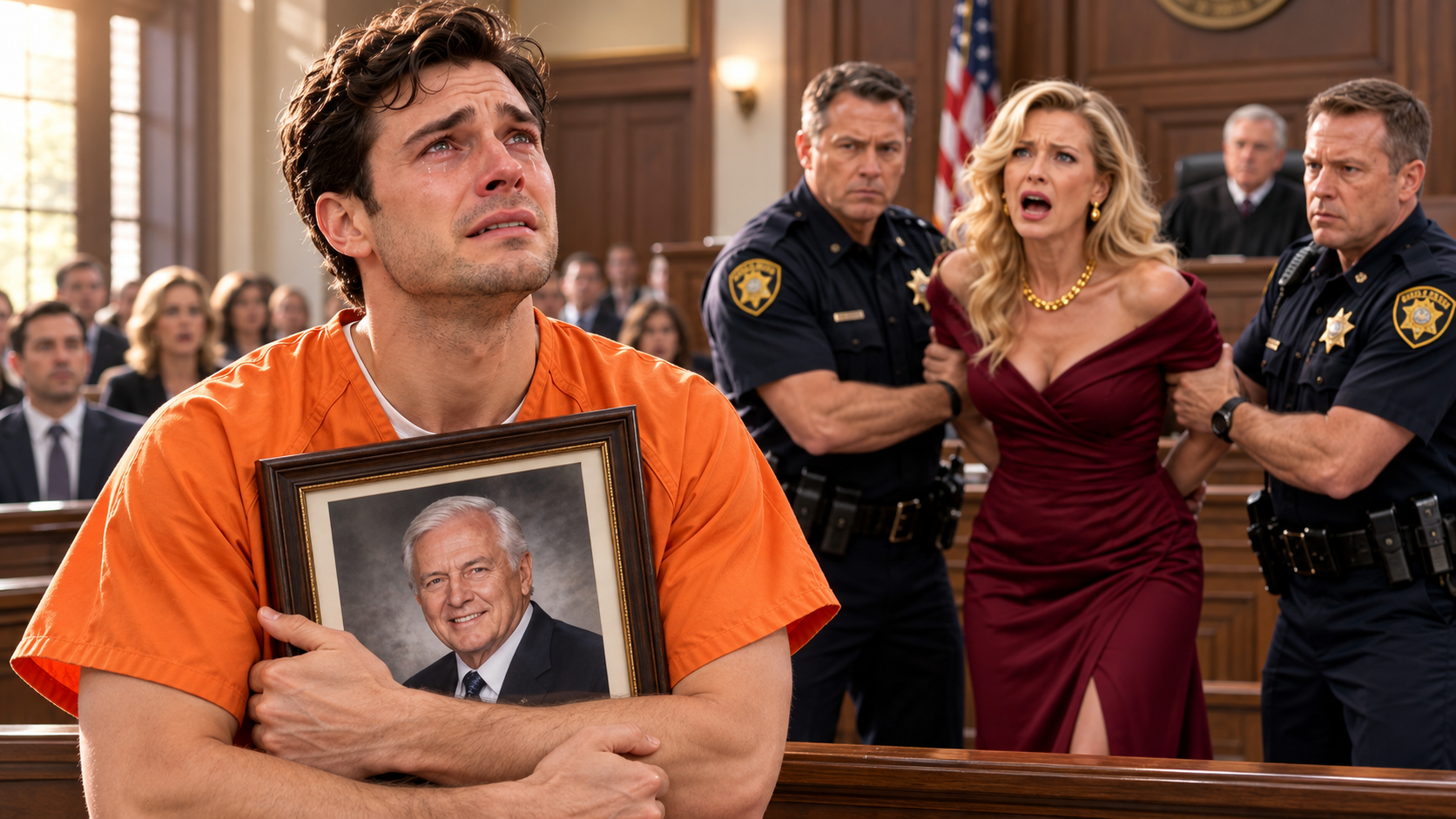
The federal hearing began on a gray Monday morning, three weeks after I left Silver Lake for the last time.
I sat behind the prosecution table with Miller and watched my father enter the courtroom.
He wore a dark suit.
His hair had been cut short.
The man who once seemed capable of controlling every room now moved carefully between two federal marshals.
He looked toward me.
I did not look away.
For once, neither of us had anything to hide behind.
The judge reviewed the charges first.
Financial crimes.
Conspiracy.
Obstruction.
Evidence tampering.
Fraud.
And charges connected to Claire's death, which prosecutors were still determining how to pursue based on the newly uncovered medical evidence.
My father's attorney argued that Camden had never intended to kill Claire.
The prosecutor did not dispute that point.
Instead, she described what happened afterward.
Camden had concealed the medication.
He had altered the explanation surrounding Claire's condition.
He had allowed the family to believe she had died naturally.
Then, years later, he had used the same culture of secrecy to manipulate my arrest.
The courtroom became very quiet.
When the prosecutor finished, the judge turned toward my father.
“Mr. Dennis, do you wish to make a statement?”
Dad stood.
His hands trembled.
“I spent most of my life believing that if I could control the damage, I could eventually repair it.”
He paused.
“I was wrong.”
Nobody moved.
“I built a business on money I should never have accepted. I continued practices I should have stopped. When I tried to leave, I was afraid of the people who knew what I had done.”
His eyes found mine.
“Then I became more afraid of losing my family than I was of telling them the truth.”
His voice weakened.
“That fear caused me to make decisions for people who had every right to make those decisions themselves.”
He swallowed.
“I sent my son to prison.”
A murmur passed through the courtroom.
“I allowed my wife to die without telling the truth about what happened.”
His face tightened.
“And I spent years calling those choices protection.”
He looked at the judge.
“They were not protection.”
I expected to feel something.
Anger.
Relief.
Maybe vindication.
Instead, I felt tired.
The confession did not return the years I had lost.
It did not return Claire.
It did not restore the childhood I had spent believing my family was ordinary.
It simply placed words beside wounds that already existed.
After the hearing, Miller found me in the corridor.
“There is one more thing.”
I turned.
“What now?”
“An old employee contacted the government.”
“Who?”
“His name is Samuel Rourke.”
I searched my memory.
Nothing.
“He worked for your father when the first companies were created.”
“Does he have records?”
“He says he has a recording.”
My stomach tightened.
“What kind?”
“He won't tell us.”
We met Rourke two days later.
He was in his seventies, thin, with hands that shook slightly whenever he lifted his coffee.
He had worked as an accountant for Dennis Industrial Systems more than twenty years earlier.
“I should have spoken sooner,” he said.
“Why didn't you?”
“Because Camden paid me to forget.”
I stared at him.
“How much?”
“Enough to disappear.”
“What changed?”
He looked toward the window.
“Claire.”
He placed a small cassette recorder on the table.
I recognized the model immediately.
It was the kind people used before digital recorders became common.
“Where did you get this?”
“Claire gave it to me.”
My heart stopped.
“When?”
“Three days before she died.”
He pressed play.
Static filled the room.
Then Claire's voice emerged.
Older.
Tired.
But unmistakably hers.
“I don't know how long I have.”
I closed my eyes.
Rourke watched me.
Claire continued.
“If this recording reaches Finnley, then Camden failed to keep everything buried.”
The tape clicked softly.
“I need him to understand one thing. His father is not the only person responsible for the lies around him.”
I opened my eyes.
The next words changed the room.
“Carter knows more than he admits.”
Miller leaned forward.
The recording continued.
“He discovered the old accounts years ago. He knows Camden's history. He knows about the money. But he also knows about the people who originally financed the company.”
Rourke stopped the tape.
“There is more.”
“Play it.”
He did.
Claire's voice returned.
“Camden believes the danger comes from Carter and Vale. I don't think that's true.”
I felt cold.
“Someone else has been protecting the old network.”
The tape crackled.
“I don't know who.”
Then another voice appeared.
Male.
Older.
Unfamiliar.
“You should stop looking.”
Claire answered.
“No.”
The man said something I could not hear.
Claire's voice sharpened.
“You don't get to decide what happens to my son.”
Then the recording ended.
Nobody spoke.
I looked at Rourke.
“Who was that man?”
“I don't know.”
“You kept this for years.”
“Yes.”
“Why?”
“Because I was afraid.”
I understood.
Fear had shaped every person around my family.
But Claire had resisted it.
That was why she had become dangerous.
Miller requested a forensic analysis of the recording.
While we waited, investigators searched old corporate records.
They found the name of the original financier.
Edgar Voss.
I had never heard it before.
But Rourke recognized it.
“Voss wasn't just an investor,” he said.
“What was he?”
“The person who made the first arrangements.”
“What arrangements?”
“The money.”
The original funding for Camden's factory had come from accounts linked to Voss.
Voss had relationships with organized financial criminals across several states.
Camden had accepted the money.
Then he built the company.
Years later, when he tried to leave, Voss threatened him.
That explained why my father had been afraid.
But it did not explain why Voss's influence had survived.
Miller found something else.
Voss had died twelve years earlier.
A natural death.
Or so the records said.
His estate, however, had been transferred into a private trust.
The trustee was a company that still existed.
Its director was Carter.
I stared at the document.
“Carter controlled Voss's trust?”
“Apparently.”
That changed everything.
Carter had not merely inherited my father's secrets.
He had inherited the network behind them.
But Claire's recording suggested something more.
She believed someone else was protecting that network.
Someone who had confronted her.
Someone who knew about me.
Someone who knew Camden's past.
The investigation turned toward the trust.
Bank records revealed payments to Carter.
Then payments to Vale.
Then payments to a company associated with Reagan.
But one account remained untouched.
It belonged to a person whose name I recognized.
Samuel Rourke.
I looked at him.
“You received money from the trust.”
His face drained of color.
“I told you Camden paid me.”
“You lied.”
Rourke's hands began shaking.
“I didn't know what it was.”
“You knew enough to take it.”
“I was afraid.”
“You keep saying that.”
He lowered his head.
“I took the money because they told me Claire had been killed for asking questions.”
“Who told you?”
He looked at Miller.
Then at me.
“Voss's attorney.”
“Voss was already dead.”
“The attorney was still alive.”
“Name.”
Rourke hesitated.
Then he whispered it.
“Jonathan Bell.”
The name meant nothing to me.
It meant everything to Miller.
He immediately reached for his phone.
“Where is Bell now?”
Rourke gave him an address.
Before the meeting ended, the federal team had already begun moving.
I remained behind.
The cassette recorder sat on the table.
Claire's voice had become a ghost inside that machine.
I listened to the final sentence again.
You don't get to decide what happens to my son.
I understood then why she had fought.
She had known that every person around me believed they had the right to choose my future.
My father chose prison.
Carter chose fear.
Reagan chose silence.
Vale chose corruption.
Claire had chosen something different.
She had chosen to leave me evidence.
Even if she never lived to explain it.
That evening, Miller called.
“We found Bell.”
“Where?”
“Gone.”
My stomach tightened.
“Gone?”
“His house was empty.”
“Did he leave anything?”
“Yes.”
“What?”
“A photograph.”
He sent it to my phone.
I opened it.
The photograph showed Edgar Voss standing beside a younger Camden.
Beside them stood a third man.
Jonathan Bell.
But there was another figure in the photograph.
A woman.
Claire.
I stared at her face.
She was smiling.
Not frightened.
Not trapped.
Almost confident.
On the back of the photograph, someone had written a date.
The same date as the first deposit into Camden's company.
Underneath it was a sentence.
They all believed Camden was the owner.
He was only the front man.
I read it again.
The man who had spent years believing he controlled the family had never controlled the whole system.
He had been part of something larger.
And Claire had discovered it.
The question was no longer whether my father had lied.
The question was how far the lie reached.
Click Here to continue read next: PART6: Jonathan Bell Disappeared Before Investigators Could Question Him, Leaving Behind One Document That Connected Claire’s Death to a Secret Agreement
The Man Beneath the Storage Door Knew My Name, and the Scar on His Face Turned Three Years of Grief Into Something Far More Dangerous
Part 5 of 8

