
The courtroom was smaller than I expected.
I had imagined something imposing.
Instead, it was a plain room with wooden benches and fluorescent lights.
Emily sat beside me.
My cane rested against my leg.
I kept my hands folded.
Daniel was several seats away.
I did not look at him for a long time.
Then I did.
He looked older.
Not transformed.
Not broken by regret.
Just older.
For months, I had wondered whether seeing him again would make me panic.
My heart beat faster.
My shoulders tightened.
But I remained seated.
I did not shrink.
I did not explain myself.
I did not apologize.
The proceedings began.
The medical evidence was summarized.
The hospital records were reviewed.
The injuries were described.
I had heard the words before.
Suspension.
Traction.
Spinal damage.
Abdominal trauma.
Pregnancy loss.
Hearing them in that room made them feel different.
They were no longer only things that had happened to me.
They were facts that existed independently of Daniel's version.
His attorney spoke about stress.
About emotional instability.
About the circumstances surrounding the assault.
I listened.
Then the prosecutor referred to Daniel's statement at the hospital.
He had insisted that a son was expected.
He had said I knew what was required.
The words sounded even uglier outside our house.
There was no refrigerator between us.
No kitchen counter.
No private argument where he could change the subject.
The sentence stood by itself.
A wife was expected to give him a son.
I looked down at my hands.
I remembered the two names on the paper.
The names he had torn apart.
I remembered the blue sleepers.
The diapers.
My wedding ring in plastic.
He had already prepared a world in which the baby was a boy and I was simply the person who had to deliver that world.
He had been wrong.
The judge asked whether Daniel understood the consequences of accepting responsibility.
Daniel answered yes.
His voice was quieter than I remembered.
I wondered whether I had once mistaken that quietness for kindness.
The hearing continued.
Eventually, the official language was read aloud.
The word came clearly.
Assault.
I closed my eyes.
That one word carried more weight than all of Daniel's explanations.
It was not misunderstanding.
It was not discipline.
It was not a husband trying to help.
It was assault.
I felt Emily's hand touch mine.
I squeezed it.
For years, Daniel had controlled the meaning of what happened inside our home.
If he apologized, it became an argument.
If he explained, it became a misunderstanding.
If he blamed me, I questioned myself.
Now the record had named it.
I did not have to defend the word.
It stood on its own.
No sentence could restore my pregnancy.
No court order could erase the pain in my back.
No punishment could give me back the nights I had lost to fear.
I knew that.
Still, hearing the official record mattered.
It meant I was no longer carrying the entire truth inside my own body.
The case ended without the kind of dramatic confrontation people might expect from a story like mine.
There was no final scream.
No desperate apology.
No moment when Daniel suddenly understood everything he had destroyed.
Real life was quieter.
He accepted responsibility.
The court recorded what he had done.
And I walked out with Emily.
Outside, the air felt cold.
I stood on the courthouse steps.
Emily waited.
“You okay?”
I looked at the street.
“I think so.”
“You want to go home?”
I smiled faintly.
“Yes.”
We returned to the apartment.
Life did not instantly become easy.
I still had medical appointments.
I still had pain.
Some nights I woke suddenly.
Sometimes a sound in the hallway made my body tense before my mind understood why.
A dangling cord could make me freeze.
An exposed beam could make my stomach turn.
The ceiling in Emily's apartment was plain.
She had chosen not to hang anything from it.
At first, I thought she had done it because of me.
Later, I realized she simply wanted the apartment to feel comfortable.
Either way, I was grateful.
Recovery continued in ordinary pieces.
I learned how to cook while standing for longer periods.
I learned how to carry small bags.
I learned when to rest before pain became severe.
I learned that asking for help did not mean surrendering control.
That lesson was harder than physical therapy.
Daniel had taught me that dependence meant weakness.
Emily showed me something different.
A person could help me without owning me.
A person could support me without deciding for me.
A year after the assault, I moved into a small apartment of my own.
The place was not large.
The kitchen was narrow.
The bedroom window looked toward another building.
The living room had enough space for a small table and two chairs.
But it was mine.
There was no history in the walls.
No utility room waiting at the back.
No kitchen where my phone had been taken.
No refrigerator where I had stood trying to reach my keys.
No door through which Daniel could call my name.
The first evening, Emily helped assemble a table.
The instructions were terrible.
She held one piece upside down.
I laughed.
“You're doing it wrong.”
“I know.”
“You said you could do it.”
“I said I could assemble it.”
“That's different.”
She looked at the instructions.
“Who writes these things?”
“Someone who hates furniture.”
She laughed.
I laughed too.
It felt strange.
The ordinary sound of it.
No fear followed.
No argument.
No accusation.
Just laughter.
Later, I stood in the kitchen making coffee.
My cane leaned against the counter.
Emily was struggling with a drawer in the bedroom.
I watched her for a moment.
Then I realized I had been waiting for something.
A noise.
A shadow.
A voice.
Anything that would remind me the peace was temporary.
Nothing happened.
The apartment stayed quiet.
Emily came into the kitchen carrying the drawer.
“I think this is broken.”
“It wasn't broken five minutes ago.”
“It is now.”
“You broke it.”
“I prefer the word redesigned.”
I smiled.
She put the drawer down.
Then she noticed the milk sitting on the counter.
“You should put that away.”
“I know.”
She reached for it.
I took it first.
“I have it.”
Emily stopped.
Her hand remained suspended for a second.
Then she let go.
I carried the milk to the refrigerator.
The movement was simple.
But I felt something inside me settle.
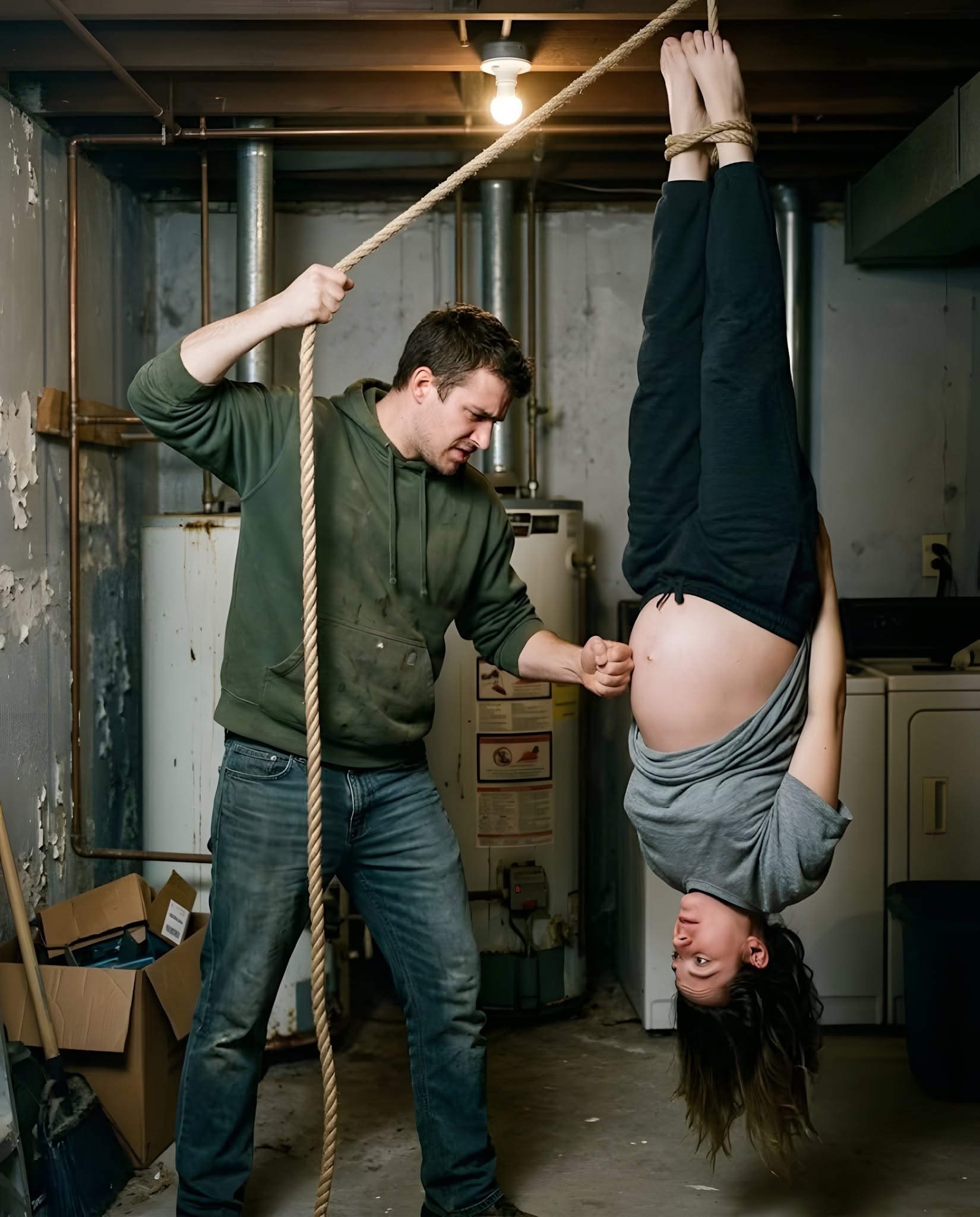
Daniel had once believed he could control my body by turning it upside down.
He had believed fear would make me obedient.
He had believed my role as his wife meant my choices belonged to him.
He had been wrong.
He was wrong about the baby.
He was wrong about my body.
He was wrong about how long fear could control me.
I still noticed ceiling beams.
Sometimes I still noticed cords.
Sometimes I still woke from dreams with my heart racing.
Healing had not erased memory.
It had changed my relationship with it.
The past remained part of me.
It simply no longer owned the room.
That night, I opened the wooden box.
The letter was still there.
So were the two torn pieces of paper.
I unfolded the letter.
I read the sentence again.
You were loved before anyone tried to turn you into a demand.
I touched the paper.
Then I placed it back in the box.
I did not need to pretend the loss had a purpose.
I did not need to tell myself that everything happened for a reason.
Some things were simply wrong.
Some losses could never be repaired.
But I could choose what happened next.
I could choose where I lived.
Who I trusted.
Who could reach me.
What I remembered.
What I refused to excuse.
I closed the box.
Then I put it in the drawer beside my bed.
Not hidden.
Not displayed.
Just somewhere safe.
The next morning, I woke before the alarm.
Sunlight came through the window.
For a moment, I lay still.
I listened.
Nothing.
No footsteps.
No shouting.
No angry hand striking a door.
I got up slowly.
My back hurt.
I reached for the cane.
Then I walked into the kitchen.
The apartment was quiet.
I made coffee.
I opened the window.
Cool air moved across my face.
I thought about the woman who had once stood in that unfinished utility room, terrified and unable to understand how the man she trusted had become capable of hurting her.
I wished I could go back and tell her something.
Not that everything would be easy.
Not that she would forget.
Not that the baby would somehow be returned.
Only this:
You are not what he says you are.
You are not responsible for what he chooses to do.
And one day, you will wake up in a home where nobody has to give you permission to breathe.
I stood at the window for a long time.
Then I turned away from it.
There was coffee waiting.
There was a quiet apartment.
There was work to do.
There were difficult memories.
There was grief.
There was also a life.
Mine.
Click Here to continue read next: PART5: Rachel Built a Quiet Life of Her Own, Until One Ordinary Afternoon Brought Back a Piece of the Past She Thought Was Finally Buried
The Hospital Door Stayed Locked While Daniel Demanded to See His Wife and the Truth About What Happened Behind It
Part 4 of 8

