
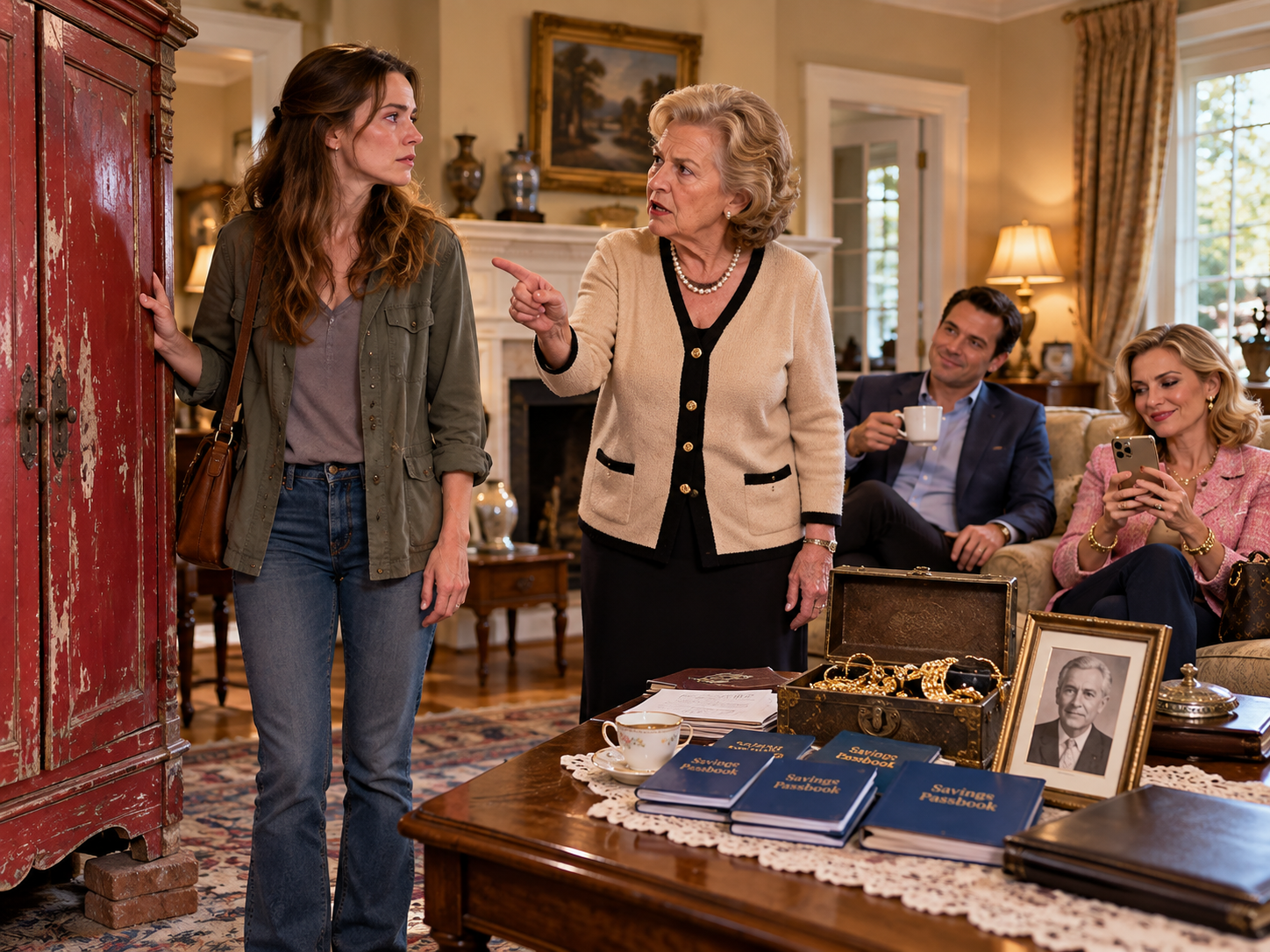
Tessa didn’t raise her voice when she told me who was in charge. She didn’t need to. She stood on the opposite side of the kitchen island, one hand resting beside her phone, while her mother sat at the breakfast table with a color-coded binder open in front of her. Three new assignments glowed on my tablet. I had not agreed to any of them.
“This is my home, my children, and my business, Lenora,” Tessa said. “I need you to understand that I’m the one responsible for decisions here.”
I looked at the calendar again. Friday afternoon: June and Micah. Saturday morning: bakery deliveries. Saturday afternoon: children again. All three blocks had been added under my name sometime after dinner.
I could have reminded her that I had already said I was unavailable on Saturday. I could have asked when helping her launch a bakery had turned into accepting a job with no hours, no days off, and no right to refuse an assignment. Instead, I set down my tablet and met her eyes.
“You’re right,” I said.
For a moment, she looked almost dissatisfied. Perhaps she had prepared herself for an argument and didn’t know what to do when I offered none.
I went upstairs, opened the closet, and dragged my suitcase from beneath the hanging clothes.
Six weeks earlier, I would never have imagined that a suitcase could become the clearest sentence I had left to say.
My name is Lenora Hayes. I was sixty-four, had been widowed for five years, and lived alone in a small brick ranch two hours from my son’s house. My husband, Ray, had been gone long enough that people no longer lowered their voices when they asked how I was doing. They assumed grief had become something I could fold away with the winter blankets.
Some days, I could almost believe them.
Other days, the quiet in my house seemed to spread through every room. The refrigerator hummed. The hallway clock clicked steadily toward an evening that would contain nothing but dinner for one. I sometimes left the television on while I washed dishes, not because I cared what was playing, but because another voice made the house feel less empty.
So when Callum called in early autumn and said he and Tessa were struggling to get everything ready for her bakery opening, I agreed to help before he had finished asking.
“Mom, I know it’s a lot,” he said. “But we really need you for a little while.”
I heard the words beneath the words. We need you.
After losing Ray, I had learned that being needed could resemble being loved closely enough to fool a lonely person. I wanted to be useful. I wanted to see my grandchildren without having to arrange a visit weeks in advance. I wanted to sit at a table where somebody might ask whether I wanted more potatoes before clearing the plates.
Callum’s children, June and Micah, were nine and six. June had a serious expression when she concentrated and a habit of tucking her hair behind both ears even when it was already out of her face. Micah could turn an ordinary cardboard box into a spaceship, a fort, or a submarine, depending on which adult was willing to provide the sound effects.
I adored them.
Tessa was preparing to open Juniper and Rye, a neighborhood bakery she had been talking about for years. She had spent months refining recipes, choosing display cases, negotiating with suppliers, and searching for a location that felt warm without being old-fashioned. Callum worked long hours in project management. Between his job, the children, and the bakery’s final preparations, the household had become a place where every conversation seemed to end with somebody needing to be somewhere else.
The plan sounded manageable when we discussed it at my kitchen table.
Six weeks, perhaps a little less. I would collect the children from school twice a week, make a few dinners, and watch Micah on one Saturday while Tessa dealt with inspections. I could stay in their guest room, and I would have my own car. They would cover groceries if I was cooking for everyone.
“Just until the opening is behind us,” Tessa said over the phone. “Then we’ll get back into a normal routine.”
I packed one medium suitcase. Four sweaters, two pairs of jeans, a pair of comfortable shoes, toiletries, and a paperback I was certain I would finally have time to read. I brought no furniture, no boxes of keepsakes, nothing that suggested I intended to stay permanently.
When I arrived, June wrapped both arms around my waist. Micah shouted that I had come just in time to inspect his cardboard rocket. Callum carried my suitcase upstairs, and Tessa hugged me with flour on her sleeve.
“You’re saving us,” she said.
I laughed and told her not to be dramatic.
At first, the requests were exactly what we had discussed. I picked June up after school on Tuesday and Thursday. I made spaghetti on Wednesday. I watched Micah while Tessa met a health inspector, then drove home with a list of supplies Callum had forgotten to order.
The first extra favor came so naturally I barely noticed it.
“Mom, could you grab June after choir?” Callum asked while searching for his keys.
“Of course.”
The next morning, a plumber was expected sometime between one and four, and someone needed to be there to let him in.
“Would you mind waiting?” Tessa asked. “I can’t leave the bakery.”
I said I didn’t mind.
Then a delivery company needed a signature for a new mixer. A package of bakery boxes arrived in the wrong size. Micah forgot his lunch. June needed a ride to soccer. Someone had to collect a prescription, and the dry cleaning had to be picked up before closing.
Each request was small enough to sound unreasonable to refuse. I was already in the car, already in the kitchen, already standing near the laundry room. If I could solve a problem in ten minutes, why make somebody else do it?
By the end of the first week, my paperback remained open on the guest-room nightstand at the same page where I had left it on the first evening.
The changes were quiet, almost polite. No one announced that my responsibilities were expanding. They simply began speaking as though those responsibilities had always existed.
“Could you take Micah to school tomorrow?” became, “Remember, Micah has to be at school by eight.”
“Would you be able to start dinner?” became, “We’ll be home around six, so dinner should be ready.”
I noticed the difference, but I told myself I was being sensitive. They were under pressure. The bakery was costing more than expected. Callum looked exhausted whenever he came through the door, and Tessa sometimes stood at the counter staring at her phone as if another unexpected problem might appear there.
I knew what it was to be overwhelmed. I had spent years helping Ray through the last difficult stretch of his life, and I remembered the strange arithmetic of exhaustion: how even a simple task could feel impossible when too many other things were waiting.
I wanted to make things easier for my son.
That was why, when I woke one morning with a headache that made the kitchen lights seem painfully bright, I tried to ask for a little help of my own.
Maris, Tessa’s mother, had arrived the previous evening. She was an elegant woman with silver-blonde hair, carefully shaped nails, and clothes in shades of cream and beige that never seemed to wrinkle. She had invested money in Juniper and Rye and had a paid consulting arrangement with Tessa, covering branding, packaging, press contacts, and social media.
I had no objection to any of that. Maris had contributed money and professional expertise. If Tessa paid her for her work, that was between them.
On that particular morning, Maris sat at the kitchen table with her laptop open and a headset resting beside her coffee.
“Could you stay with Micah for two hours?” I asked. “My head is bothering me, and I’d like to lie down.”
She glanced at the screen, not at me.
“I have a critical packaging call.”
“He can color in here. He’s very good at keeping himself occupied.”
“I really need to concentrate, Lenora.”
I waited, hoping she might suggest another time or ask whether I needed anything.
Instead, she gave me a bright, practiced smile.
“You’ll manage.”
I stood there for a second longer than necessary. Then I nodded and took Micah into the living room with his crayons.
Maris’s work required uninterrupted time. Mine, apparently, could be done with a headache and a six-year-old asking every three minutes whether blue was the right color for a spaceship.
That afternoon, I bought a small blue spiral notebook at the pharmacy. It cost three dollars, and I slipped it into my handbag without explaining why.
I wasn't planning to present anyone with a bill. I simply wanted to understand why I was tired enough to forget what I had gone upstairs to fetch.
On the first page, I wrote down everything I had done that day: school pickup, groceries, laundry, bakery return, dinner, kitchen cleanup. The next page filled even faster. Two school runs, a pharmacy stop, waiting for the plumber, signing permission forms, packing lunches, and delivering a box of supplies to the bakery.
By the end of the second week, both pages were crowded with my handwriting.
I stared at the list and felt something close to embarrassment. How could a person spend nearly every waking hour doing things and still feel as if she had done nothing worth mentioning?
Then I realized the list wasn't a record of everything I had failed to finish. It was evidence of how much I had already been carrying.
I closed the notebook and put it away.
The following Tuesday, I decided I would protect one small part of my week. Ruth, my old friend from book club, had called twice to ask when I might be free. We had known each other for decades, and before Ray died we used to meet for coffee every Thursday afternoon. Since moving into Callum’s house, I had canceled on her twice.
I found Tessa in the living room, reviewing photographs for the bakery’s promotional campaign.
“I won’t be available Thursday between two and five,” I told her. “I’m meeting Ruth.”
Tessa looked up. “Okay. That sounds nice.”
Her answer was so easy that I felt foolish for having rehearsed the conversation in my head.
The next morning, I checked the family calendar to see whether the children had any activities I needed to know about. A bright red block had appeared across the hours I had reserved for Ruth.
THURSDAY, 2–5 P.M. — LENORA: CHILDCARE.
I read it twice, then walked into the living room with my tablet in my hand.
“Tessa, I told you I couldn’t watch the children Thursday.”
She was scrolling through her phone. “The photographer changed the bakery shoot.”
“That’s unfortunate.”
“And Mom has a vendor meeting, so she can’t take them.”
“Then you and Callum need to arrange childcare.”
She finally looked up, her eyebrows drawing together as if I had introduced a complication she couldn't understand.
“Can’t you see Ruth another day?”
“I could.”
“Then what’s the issue?”
“The issue is that I already told you I wasn’t available.”
Maris lowered her eyes from the binder on her lap. She had been listening.
“Families have to pull together when one of them needs help,” she said.
“I agree,” I answered.
“Good.”
I took a breath. “But helping should still be a choice. It shouldn't mean one person loses the right to make plans.”
Maris's pleasant expression tightened. Tessa pressed her fingertips to her forehead.
“Can we not make this into a whole situation?” she asked.
I looked at the red block on my screen. Three hours that had belonged to me had been taken over without a question, and somehow I was the one making a situation out of it.
I canceled coffee with Ruth.
No one forced me to do it. No one threatened me or took my phone. I simply couldn't bear the thought of disappointing my son and his wife when they were already stressed.
I sent Ruth a message, put the tablet down, and told myself I would make it up to her next week.
I didn't yet understand how many next weeks I was about to surrender.
Click here to continue reading: PART 2: The Night They Celebrated the Bakery, I Discovered Which Kind of Work Deserved Applause
My Name Was Already Written Into Their Future, Though Nobody Had Ever Asked Me to Stay
Part 1 of 20

