
There is a final distance in every artist's biography.
During life, the artist stands between the work and the audience.
After death, that distance disappears.
Peter Max spent decades standing beside his paintings, explaining them, demonstrating them, selling them, defending them, and creating new ones.
After September 14, 2026, none of that could continue.
The work had to exist without its maker.
For Max, that transition was especially striking because his career had depended so heavily on visibility.
He was a recognizable face.
He had appeared on television.
He had been photographed in studios.
He had participated in public events.
He had become associated with a distinctive signature.
People knew what Peter Max looked like.
They knew what Peter Max art looked like.
The two identities had reinforced each other for decades.
Now only one could continue.
The paintings remained.
That fact is deceptively simple.
A painting can survive the person who made it.
A museum can preserve a canvas.
A collector can preserve it privately.
A photograph can preserve an image of it.
A reproduction can carry the design into another generation.
A public commission can remain physically present in the environment.
The work can therefore continue functioning long after the artist's voice has disappeared.
Max's career was especially suited to that kind of survival.
His imagery depended on recognizable forms.
Those forms could travel.
A sun could be reproduced.
A face could be reproduced.
Liberty could be reproduced.
Stars could be reproduced.
The visual vocabulary could be transferred to different surfaces and still remain identifiable.
That was one reason his work had reached such an enormous audience.
It was also one reason the distinction between original and reproduction became so important.
An original canvas contains physical evidence of the artist's hand.
A reproduction contains evidence of the artist's design.
Both can be culturally significant, but they are not the same object.
Max's career repeatedly moved between those two worlds.
He painted originals.
He created designs intended for reproduction.
He licensed imagery.
He worked on public commissions.
He created images for large events.
The same visual identity could exist in different forms.
That multiplicity was central to his success.
It was also one reason his name became so familiar.
People encountered the style repeatedly.
The recognition accumulated.
Eventually, the style itself could function almost like a signature.
Even without seeing the name Peter Max, viewers could often associate the colors and forms with him.
That is a rare achievement.
It means the artist's identity became embedded in the visual memory of a culture.
But cultural memory is selective.
It tends to remember the simplest version of a complicated life.
For Max, that simplified version might be the psychedelic artist of the 1960s.
That description is not false.
It is simply incomplete.
The full biography begins earlier.
It begins with a child born in Berlin.
It continues with a family leaving Germany.
It passes through Shanghai.
It continues through Israel.
It reaches New York.
The young Max studies art.
He learns anatomy.
He works in graphic design.
He develops his own visual language.
Then the public notices.
The 1960s bring enormous attention.
His work appears on posters and products.
Television makes him recognizable.
Life magazine puts him on its cover.
The visual language spreads.
Then Max steps back.
He wants to paint.
The commercial machine has become too dominant.
He returns to the studio.
A different kind of painting develops.
The colors remain.
The brushwork becomes more physical.
The work expands.
The public commissions continue.
Liberty becomes central.
The environmental message appears.
The Berlin Wall becomes a peace dove.
The international events arrive.
The career continues.
The legal problems become part of the record.
The family disputes become public.
The years pass.
The artist becomes elderly.
Dementia enters the final chapter.
Then the career stops.
That sequence is more informative than any single label.
It shows a person moving through history rather than occupying one frozen decade.
It also shows why Max's biography cannot be reduced to his best-known visual style.
The style was one achievement.
The life was larger.
The contradictions were larger.
The geographic journey was larger.
The period of commercial success was larger.
The decision to withdraw from that success was significant.
The public commissions were significant.
The later decline was significant.
Together they form the record.
There is also a larger historical question.
Why did Max's work remain recognizable for so long?
Part of the answer lies in repetition.
He returned to familiar symbols.
But repetition alone cannot create lasting recognition.
The symbols were also simple.
A viewer could understand them immediately.
The colors were distinctive.
The compositions were accessible.
The images could function in different sizes.
And the work appeared in enough places to become part of collective visual memory.
That combination made the style durable.
It also meant that Max could reach people who did not normally follow contemporary art.
His audience was not confined to museums.
The audience included ordinary consumers, television viewers, sports fans, travelers, collectors, readers, and people encountering his images in public spaces.
That breadth may ultimately be one of the most important facts about his career.
Max demonstrated that an artist could become part of everyday visual life without disappearing entirely into anonymity.
His name remained attached.
That attachment matters because commercial culture can often remove the creator from the creation.
Max's work resisted that process.
People knew the name.
They knew the style.
They knew the artist.
Now the name has become historical.
Future generations will encounter “Peter Max” as a figure from the twentieth and early twenty-first centuries.
They may not experience his television appearances.
They may not remember the cultural environment in which his psychedelic images first became famous.
They may know the works through museums, books, digital archives, reproductions, or private collections.
Their relationship to the work will therefore be different from that of the people who saw it when it was new.
That does not make the later relationship less real.
It simply makes it historical.
A museum visitor decades from now may stand before a Max painting without knowing that the artist spent his early childhood in Shanghai.
A student may study his psychedelic imagery without knowing that he had formal training in anatomy.
A designer may recognize his influence without remembering the 1960s.
A viewer may see Liberty without knowing that Max had arrived in New York as an immigrant teenager.
That is why biography remains useful.
It restores context.
It does not tell the viewer what to feel.
It tells the viewer what happened.
And what happened to Peter Max was extraordinary in its range.
He survived the upheavals of twentieth-century Europe as a child.
He became part of the American cultural landscape.
He helped shape the visual language of an era.
He became a successful commercial artist.
He stepped away from commercial production.
He created public art.
He became closely connected with national symbols.
He worked on international events.
He faced legal and family difficulties.
He lived into his late eighties.
He experienced advanced dementia.
He died in Manhattan.
His exact medical cause of death was not publicly established in the reliable reporting available immediately after his death.
Those facts form the boundary around the story.
Everything else must remain interpretation.
Perhaps that is fitting.
Max spent his career creating images that invited viewers to complete the experience themselves.
He gave them colors.
He gave them forms.
He gave them symbols.
He left space for the viewer to see connections.
The same can be said of his legacy.
One person will see the immigrant story.
Another will see the commercial artist.
Another will see the psychedelic designer.
Another will see the painter of Liberty.
Another will see the cosmic artist.
Another will see a complicated public figure whose life included legal and family difficulties alongside enormous professional accomplishments.
None of those perspectives needs to erase the others.
The complete record is larger than any one description.
That is the most honest way to close the biography.
Peter Max was born in Berlin on October 19, 1937.
He died in Manhattan on September 14, 2026.
He was eighty-eight.
His final years were affected by advanced dementia, according to reporting, while a specific cause of death was not publicly disclosed in the reliable reports available at the time.
He left behind children, an enormous body of artwork, and a visual language recognized by generations of viewers.
The man who created those images could no longer add anything to them.
But the images had already acquired lives of their own.
A painting can remain bright after the painter is gone.
A signature can remain visible after the hand has stopped moving.
A symbol can remain recognizable after the person who gave it new color has disappeared.
That is what remains of Peter Max.
Not a single final message.
Not a perfect life.
Not an uncomplicated legend.
A record.
A body of work.
A sequence of choices.
A history that began with a child leaving Berlin and continued through Shanghai, Israel, New York, the psychedelic era, commercial success, artistic withdrawal, public commissions, family difficulties, illness, and finally death.
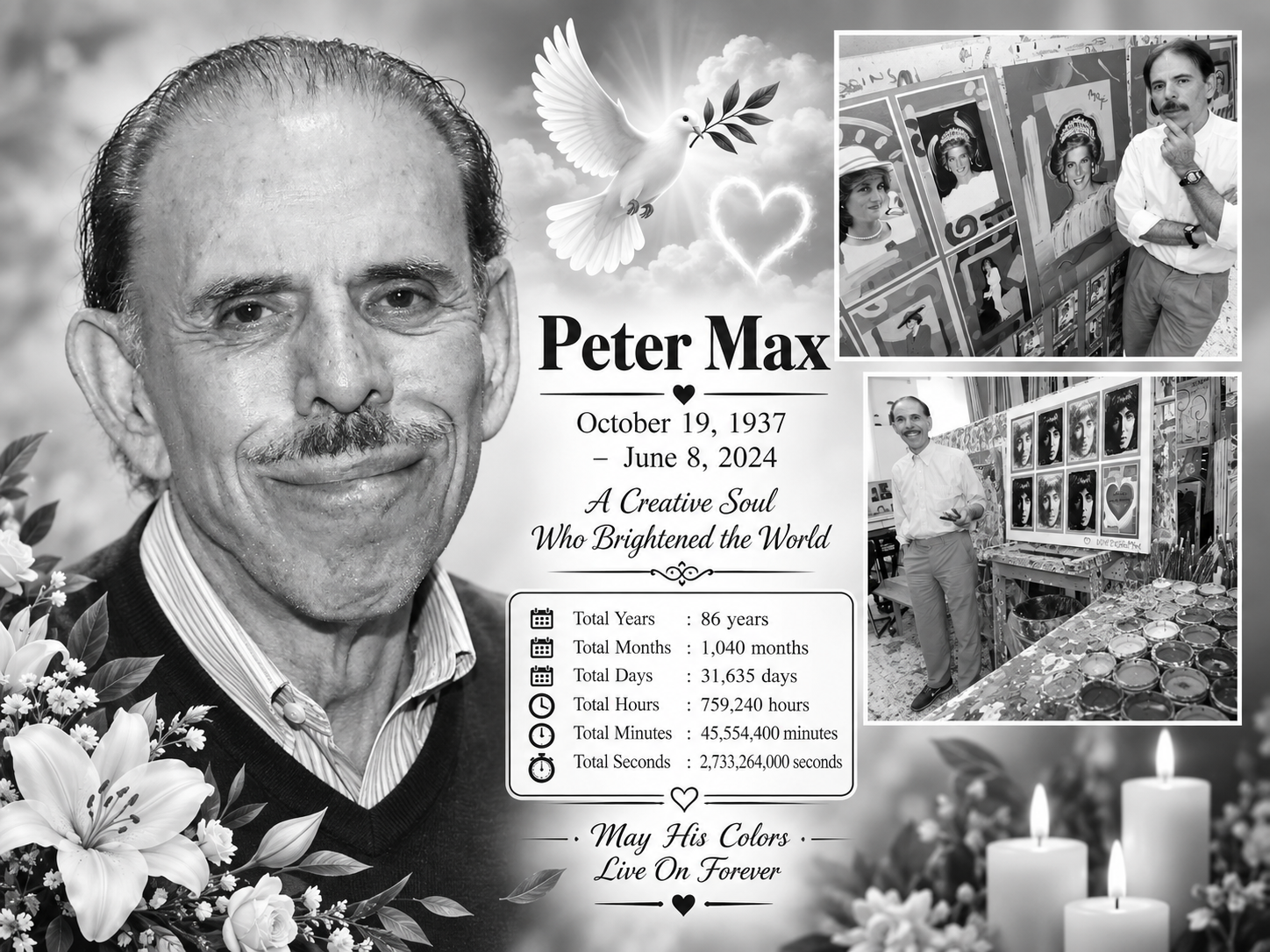
The final photograph shows the older artist surrounded by his colors.
It is tempting to let the colors become the entire story.
They should not.
They are the visible surface of a much longer life.
Behind them was migration.
Behind them was training.
Behind them was ambition.
Behind them was commercial pressure.
Behind them was a desire to keep painting.
Behind them were public successes and private troubles.
Behind them was a long life that changed as the world changed.
And beneath all of it was a person who could not have known where the images would eventually travel.
The child in Berlin could not see the Manhattan studio.
The teenager entering New York could not see the future fame.
The young designer could not see the museum collections.
The famous artist could not see the final years.
And the elderly man could not know how future generations would remember him.
That uncertainty is part of being human.
The paintings remain certain.
They can be dated.
Studied.
Preserved.
Exhibited.
Discussed.
They can be seen.
The life behind them can be reconstructed only through evidence.
That evidence now forms the lasting record of Peter Max.
The career is finished.
The archive is not.
The man is gone.
The images remain.
And somewhere in the continuing life of those images, the journey from Berlin to New York, from a refugee childhood to American cultural fame, from commercial design to painting, from public celebration to private decline, remains visible in the colors he left behind.
The End
Read more original stories on Feel Every Story.
Before the Colors Became Famous, a Child Escaped a Dangerous Europe and Carried a Memory of the World Into His Art
Part 16 of 16

