
Peter Max had spent much of his career resisting easy categories, even when the public repeatedly placed him inside them.
He was called a psychedelic artist.
He was associated with Pop Art.
He was described as a graphic designer.
He became known as a painter.
He was a commercial phenomenon.
He was also represented in museums and institutional collections.
Each description contained part of the truth.
None contained the whole career.
The difficulty became more obvious after his death because there was no longer an active artist producing new work that could change the balance.
During his lifetime, Max could move from one kind of project to another.
He could paint Liberty after working on a commercial assignment.
He could create a public commission after making a private painting.
He could return to cosmic imagery after working on portraits.
His career remained open.
Death closed that possibility.
The historical record now has a boundary.
Everything after September 14, 2026 belongs to the interpretation and preservation of his existing work rather than to a continuing artistic career.
That makes the final years important in another way.
Max's later dementia meant that the public image of the energetic artist remained visible even as the person himself became increasingly vulnerable.
For decades, viewers had watched him draw.
They had seen photographs of him surrounded by paintings.
They had associated him with constant visual activity.
The illness created the opposite condition.
Memory weakened.
The ability to participate in the artistic life that had defined him declined.
And yet the paintings around him remained vivid.
There was something almost painfully literal about that contrast.
His art was built around images that were difficult to ignore.
His final years involved a condition that affected memory and recognition.
The public could still recognize Peter Max's work even when the artist himself was no longer able to participate in the public identity that had grown around it.
That is not a contradiction in the work.
It is a reminder that a person's biography and artistic legacy eventually separate.
Max's legacy had already been larger than his daily life.
It included works made decades before his illness.
It included projects created when he was young.
It included paintings made during periods when he was experimenting with different techniques.
It included public projects whose physical locations continued to exist independently of him.
The Statue of Liberty offered one example.
The monument itself remained.
The paintings remained.
The history of Max's relationship with it remained.
His involvement with the Berlin Wall offered another.
The piece he transformed remained an object with historical significance beyond the artist's own lifetime.
The same was true of his environmental work.
A postage stamp created in the 1970s could survive as an artifact of both American postal history and changing environmental awareness.
His World Cup artwork belonged to another kind of history.
It demonstrated how a painter could become involved with global sporting culture.
The scale was different from a gallery.
The audience was different.
But the recognizable Max vocabulary could function in both places.
That adaptability was central to his success.
He understood that images did not have to remain inside one context.
A painting could become a poster.
A poster could become a cultural memory.
A symbol could become merchandise.
A commission could become part of a national celebration.
The same image could move from one audience to another.
That movement was one of the defining features of twentieth-century mass culture.
Max participated in it fully.
He did not stand outside popular culture and observe it.
He entered it.
He helped shape its visual language.
That is why his career is often discussed alongside the history of the 1960s.
But the 1960s were only the beginning.
He lived through the 1970s, 1980s, 1990s, 2000s, 2010s, and 2020s.
Each decade changed the cultural environment around him.
The counterculture became nostalgia.
Print culture increasingly shared space with digital media.
Television became one part of a much larger media environment.
The meaning of celebrity changed.
The way people encountered art changed.
Max's imagery survived those changes because its essential components were not tied to one technology.
Color could move from paper to canvas.
A face could move from a poster to a screen.
A Liberty image could appear in different formats.
A cosmic composition could be reproduced in different media.
The visual language was flexible.
That flexibility helped protect the work from becoming trapped in one historical format.
It also created a challenge for historians.
When an artist's work becomes widely commercialized, it can be difficult to determine which objects best represent the artist's original intentions.
A museum painting is not identical to a mass-produced product.
A licensed reproduction is not identical to an original canvas.
A public commission is not identical to a private studio work.
Yet all may carry the same recognizable style.
Max's career forces viewers to consider those distinctions.
The question is not whether one category is legitimate and another illegitimate.
The question is what each object tells us.
A commercial product can tell us about the cultural reach of the artist.
An original painting can reveal the physical qualities of his technique.
A public commission can show how his imagery functioned in civic life.
A museum exhibition can show how institutions interpreted his work.
A photograph can show how he presented himself to the public.
Together, these sources create a fuller picture.
No single object can carry the entire biography.
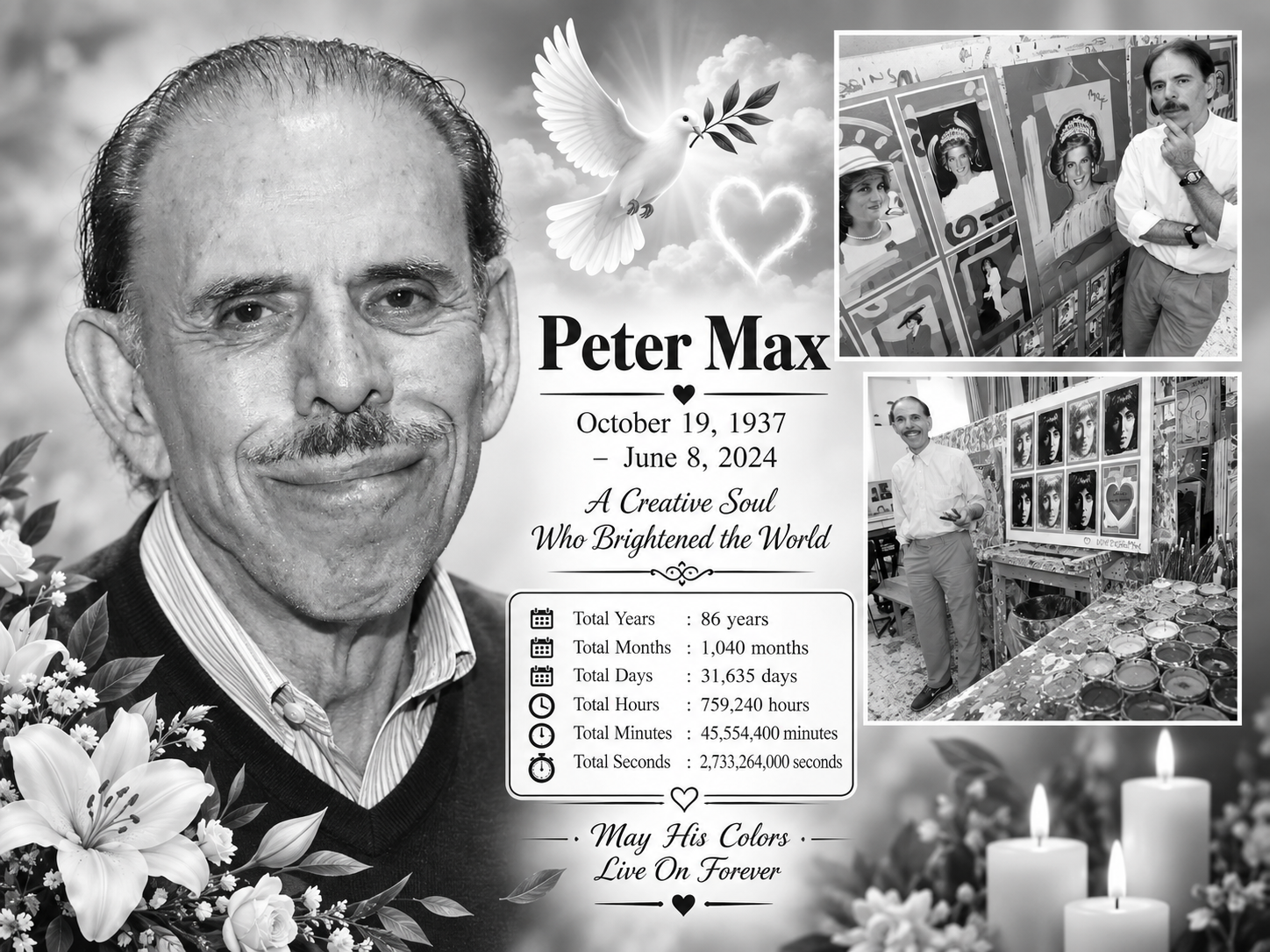
That is particularly true of the image accompanying this story.
It shows an older Peter Max in front of a backdrop, with photographs of him working in a colorful studio placed beside the portrait.
The photographs provide context.
They show Max surrounded by paintings.
But they still capture only one moment.
They cannot reveal the entire life.
They cannot show the Berlin of 1937.
They cannot show the family's departure.
They cannot show Shanghai.
They cannot show the teenager arriving in New York.
They cannot show his art training.
They cannot show the moment when his graphic language began attracting attention.
They cannot show the commercial explosion.
They cannot show the retreat.
They cannot show the legal troubles.
They cannot show the family disputes.
They cannot show dementia.
A photograph is evidence, but it is not a biography.
The biography comes from the accumulation of evidence.
That accumulation also helps correct an easy misunderstanding about Max's personality.
Because his art was often cheerful, viewers sometimes assume the person behind it must have lived inside the same emotional atmosphere.
There is no reason to make that assumption.
Artists do not paint autobiography in a simple one-to-one manner.
A painter can create peaceful images during a difficult period.
A person can experience private conflict while producing joyful public art.
Max's colors tell us about his artistic choices.
They do not provide a medical record of his emotional life.
That distinction becomes especially important when discussing his final years.
His dementia should not be turned into a metaphor for his art.
It was a medical condition affecting an elderly man.
His work remained what it was.
The paintings did not become tragic because the artist became ill.
Nor did the illness somehow make the paintings more meaningful.
The two facts simply existed in the same late chapter of his life.
That restraint matters because Max's career was already dramatic enough without adding invented symbolism.
His actual history contained extraordinary turns.
A child refugee became a famous American artist.
A trained illustrator became a defining figure in psychedelic design.
A commercial success withdrew from his own commercial machine.
A painter became closely associated with the Statue of Liberty.
A Berlin-born artist transformed a piece of the Berlin Wall.
A creator whose work had appeared on everyday products became represented in museums and public institutions.
Those facts do not require exaggeration.
They are enough.
And they leave one important question for the future.
When people encounter Peter Max's work decades from now, will they still know the story behind the colors?
Perhaps not.
But that is not necessarily a failure.
Art can survive even when biography fades.
Someone may see a bright sun without knowing the artist's childhood.
Someone may see Liberty without knowing his family's journey.
Someone may see a cosmic portrait without knowing about his early fascination with astronomy.
The image can still work.
But the biography adds another layer.
It reminds viewers that the colors came from a particular person at a particular time, shaped by migration, training, popular culture, spirituality, commercial success, and the changing America he spent most of his adult life observing.
That is the history now left behind.
The painter is gone.
The categories remain unsettled.
The images remain recognizable.
And the future will decide which parts of the enormous record receive the most attention.
Click Here to continue read next: PART15: The Brightest Images Could Not Tell the Whole Story, and the Final Record Required Looking Beyond the Posters to the Man Who Lived Behind Them
Before the Colors Became Famous, a Child Escaped a Dangerous Europe and Carried a Memory of the World Into His Art
Part 14 of 16

