
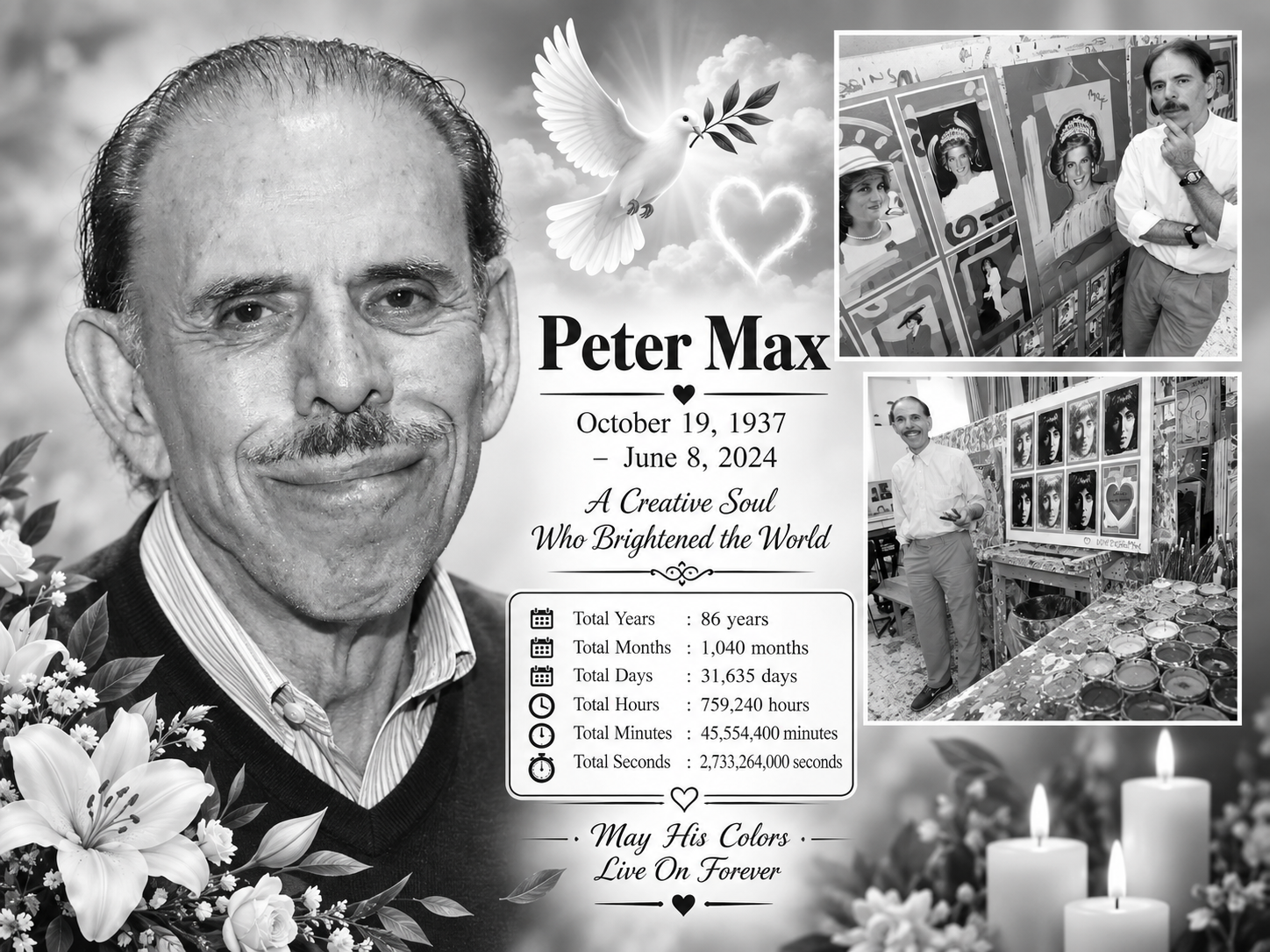
When Peter Max died, there was no single object that could contain his career.
The obvious candidates were everywhere: a Statue of Liberty painting, a cosmic composition, a portrait, a psychedelic poster, a public commission.
But none could explain the full arc.
His achievement was cumulative.
It existed in the repeated encounters people had with his imagery over several generations.
One person might have known him through a poster.
Another through a postage stamp.
Another through a museum exhibition.
Another through a painting of Liberty.
Another through a product carrying his unmistakable colors.
Another through a television appearance decades earlier.
The individual encounters differed, but they pointed toward the same visual vocabulary.
That vocabulary was immediately recognizable.
Max could take a familiar object and make it his through color, repetition, outline, scale, and arrangement.
The process was deceptively simple.
A face could be divided into blocks of color.
A sun could become a circular field radiating outward.
A flower could be enlarged until it became the center of an entire composition.
Stars could fill a background.
A familiar monument could be transformed without losing its identity.
The viewer often understood the subject before understanding the technique.
That immediacy was one of the reasons Max's work traveled so successfully.
It also meant that his art could be reproduced without losing all of its communicative power.
A large original painting and a small printed image were not identical, but the essential visual language remained.
That was particularly useful in the commercial world.
It was also part of the reason Max's imagery became so deeply embedded in popular culture.
The same visual principles could operate at different scales.
A poster could be seen from across a room.
A postage stamp could be held between fingers.
A mural could cover a wall.
A ship could carry the imagery across the ocean.
An aircraft could turn into a moving canvas.
The artist's ability to scale his imagery was not incidental.
It was built into the graphic character of the work.
But Max's career also showed the limits of scale.
The more his work became reproducible, the more difficult it became to maintain a clear distinction between original art and commercial merchandise.
That tension had already led him to step away from the commercial operation.
The decision revealed something important about his priorities.
He did not reject popularity.
He rejected the idea that popularity should completely determine what he made.
The return to painting gave him a different relationship with his own imagery.
The large brushes and acrylics allowed him to work physically, rather than thinking primarily about how a design would reproduce.
A brushstroke could remain visible.
A color could be layered over another color.
A figure could become less precise.
The canvas could record the movement of the artist rather than simply the final graphic image.
That approach brought Max back toward the traditional idea of the painter in a studio.
But he never abandoned the visual language that had made him famous.
Instead, he brought the language into a more physical medium.
The result was a career in which commercial and fine art remained permanently connected.
This is one reason Max's position in American art history remains difficult to reduce.
He was not an isolated studio painter.
He was not solely a commercial illustrator.
He was not simply a Pop artist.
He was not only a psychedelic designer.
He occupied the spaces between those categories.
The categories themselves changed during his lifetime.
American art became increasingly comfortable with images from advertising, music, celebrity culture, comics, and mass media.
Max's career developed alongside that transformation.
His work showed how an image could move from a gallery to a magazine and from a magazine to a consumer object without losing its cultural identity.
That movement helped define the visual environment in which later generations of designers and artists worked.
His influence was therefore partly structural.
He demonstrated that an artist could reach huge audiences without abandoning a distinctive personal vocabulary.
Whether viewers considered the result fine art, commercial art, or popular design depended partly on where the work appeared and how it was being used.
But the recognizable hand remained.
That recognizability became perhaps his most durable achievement.
A person could see a particular combination of bright colors and immediately think of Peter Max.
That kind of recognition is difficult to manufacture deliberately.
It develops through repetition over time.
Max had it because his images appeared in so many places for so many years.
His association with the 1960s gave the style its historical origin, but later decades kept reinforcing the connection.
He continued receiving commissions.
He continued producing public imagery.
He continued exhibiting work.
He continued painting Liberty.
He continued working with cosmic subjects.
The style survived because the artist continued to inhabit it.
After his death, the situation changed.
The imagery can continue to be reproduced, but the living artist is no longer there to make decisions about new work.
That creates a boundary between legacy and career.
A career is active.
A legacy is interpreted.
During a career, an artist can respond to criticism.
He can change direction.
He can reject an attribution.
He can explain an old painting.
He can create a new series that alters how earlier work is understood.
After death, those possibilities disappear.
The existing record becomes the foundation.
For Max, that record is unusually large.
It includes thousands of works and decades of commissions.
It includes photographs, interviews, exhibitions, commercial reproductions, public projects, and institutional records.
It also includes controversies.
A complete legacy cannot simply remove the uncomfortable chapters.
The tax-fraud conviction is part of the record.
The family disputes are part of the record.
The commercial criticism is part of the record.
The later dementia is part of the record.
The absence of a publicly established specific cause of death is part of the record.
None of these facts needs to dominate the story.
But none should disappear merely because the paintings are beautiful.
A biography becomes more useful when it allows the evidence to remain complicated.
That is particularly important for someone as famous as Max.
The public image was unusually polished.
Bright colors.
Smiling faces.
Cosmic skies.
Liberty.
Peace.
Flowers.
Those symbols can create the impression of a life without darkness.
But Max's life was not a painting.
It contained displacement, professional conflict, legal trouble, family disputes, illness, and loss.
The art and the biography should be held beside each other.
One does not cancel the other.
The bright images can remain bright.
The difficult events can remain difficult.
The artist can be recognized for his accomplishments without turning every part of his life into celebration.
That balance becomes especially important when considering his final years.
Advanced dementia affected the person behind the famous signature.
The condition did not alter the paintings already made.
But it altered the circumstances in which new work could be created.
Eventually there was no new work.
The production stopped because the artist's life stopped.
Yet the archive remained.
The paintings continued to exist.
The posters continued to circulate.
The museum pieces remained on walls.
The public symbols remained recognizable.
And people who had never met Max could continue encountering his visual language.
That is the strange endurance of an artist.
The body is temporary.
The image can be extraordinarily durable.
Max had spent his career making images that traveled farther than he could.
The child born in Berlin could never have predicted that a style developed decades later in New York would become recognizable across the world.
The teenager arriving in America could not have known that his paintings would eventually be used to represent an entire cultural period.
The older man living with dementia could not control what future viewers would think when they encountered those works.
But the work had already escaped the boundaries of one lifetime.
That does not mean every future viewer will interpret it the same way.
Some will see nostalgia.
Some will see Pop Art.
Some will see commercial design.
Some will see American optimism.
Some will see an immigrant's complicated relationship with his adopted country.
Some will simply see color.
The important fact is that the work leaves room for those encounters.
Max's legacy therefore does not need a single final interpretation.
It can remain open.
That openness is fitting for an artist whose career crossed so many boundaries.
Berlin and New York.
Fine art and commerce.
Astronomy and spirituality.
Painting and design.
Private studio and mass culture.
Personal memory and public symbolism.
The final task is not to force those opposites into one answer.
It is to recognize that they were all present.
Click Here to continue read next: PART12: The Last Chapter Was Not About Another Painting but About What Remains When an Artist’s Voice Falls Silent and the Work Must Carry the Story Alone
Before the Colors Became Famous, a Child Escaped a Dangerous Europe and Carried a Memory of the World Into His Art
Part 11 of 16

