
The first difficult case arrived six months later.
A young veteran named Marcus came to Sarah's foundation carrying a plastic folder.
His discharge papers did not match his medical records.
His name had been misspelled on one document.
His unit number was wrong on another.
A third page appeared to have been replaced.
Sarah recognized the pattern immediately.
“Where did you get these?”
“The records office.”
“When did you request them?”
“Three months ago.”
Sarah opened the folder.
“This isn't enough to establish what happened.”
Marcus looked disappointed.
“I thought you could fix it.”
“We can help you investigate.”
“Isn't that the same thing?”
“No.”
She smiled gently.
“We don't change records. We find the records that should have been there.”
Marcus nodded.
That distinction had become the foundation's rule.
Sarah requested the original files.
The response came two weeks later.
Several documents were missing.
Marcus became angry.
“They're hiding something.”
“Maybe.”
“Then what?”
“Then we verify.”
Sarah contacted Claire.
Claire helped compare the records.
The missing pages concerned a training exercise.
Claire's stomach tightened when she saw the description.
Live-fire component.
Medical evacuation.
Altered schedule.
For a moment, the old past seemed to return.
Sarah noticed.
“You okay?”
“Yes.”
“You're lying.”
Claire smiled.
“Occupational hazard.”
They continued.
The case eventually revealed a clerical error, not a conspiracy.
The live-fire exercise had been properly authorized.
The missing pages had been misplaced during a records transfer.
Marcus received corrected documentation.
He thanked Sarah.
Then he asked why she had been so careful.
“Because records can hurt people when we assume too much.”
He nodded.
“That sounds personal.”
“It is.”
She did not explain everything.
She didn't need to.
The foundation grew.
More people came.
Some had genuine grievances.
Some simply misunderstood old documents.
Sarah treated both seriously.
She learned that helping people did not always mean confirming what they believed.
Sometimes it meant showing them where the evidence disagreed.
Claire admired that.
One afternoon, Sarah asked Claire to speak at the foundation.
Claire agreed.
The room was full.
Veterans.
Families.
Students.
Archivists.
Lawyers.
Claire stood at the front.
“I used to think records were neutral.”
She paused.
“They aren't.”
A few people leaned forward.
“Records are created by people. They can be incomplete. They can be wrong. They can be manipulated. They can also preserve truth when memories fail.”
She looked toward Sarah.
“The answer is not to distrust every document.”
“It is to understand what each document can actually prove.”
The audience remained quiet.
Then someone asked about her own case.
“Do you believe Richard's death will ever be solved?”
Claire thought.
“I don't know.”
The woman looked surprised.
Claire continued.
“And I have learned that saying ‘I don't know’ is sometimes more honest than giving someone the answer they want.”
After the event, Sarah found her outside.
“You didn't mention Thomas.”
“I didn't need to.”
“You didn't mention Michael either.”
“No.”
“Why?”
“Because this foundation isn't about us.”
Sarah smiled.
“That may be the best thing you've ever said.”
They walked together toward the parking lot.
A familiar older man stood beside a car.
Michael.
Sarah stopped.
Claire looked at him.
He had aged considerably since the investigation.
He no longer wore a military uniform.
He looked smaller without it.
“I wanted to apologize,” he said.
Sarah crossed her arms.
“For what?”
“For knowing about you and saying nothing.”
Sarah stared.
“You weren't the only one.”
“No.”
“But you knew.”
“Yes.”
“Why didn't you tell me?”
Michael looked at the pavement.
“Because I believed secrecy would keep you safe.”
Sarah shook her head.
“That excuse has hurt more people than almost anything else.”
Michael nodded.
“I know.”
She studied him.
“I don't forgive you.”
“I understand.”
“But I don't hate you.”
Michael looked up.
Sarah continued.
“You can live with that.”
He nodded.
Then he left.
Claire watched the car disappear.
“You handled that well.”
Sarah smiled.
“I didn't forgive him.”
“I noticed.”
“I don't think forgiveness is required for closure.”
Claire nodded.
“That took me years to learn.”
The foundation's work continued.
Sarah eventually hired two archivists.
She created procedures for sensitive family records.
She required consent before contacting relatives.
She refused to publish private documents simply because they were interesting.
Those rules came directly from her own history.
One day, a donor asked her why she cared so much about privacy.
Sarah answered honestly.
“Because I know what it feels like to have your entire life discussed by people who never asked you.”
The donor nodded.
The policy remained.
Meanwhile, Claire's archive received more Mercer materials.
Each new document added context.
None changed the central facts.
That pleased her.
History did not need constant twists.
Sometimes the most valuable discovery was confirmation.
Daniel visited the archive regularly.
He had become a volunteer.
He helped families organize old military records.
He was careful around anyone who reminded him of his own mistakes.
Claire noticed.
“You don't have to punish yourself forever.”
Daniel looked at her.
“I know.”
“Do you?”
He smiled.
“I'm practicing.”
Margaret joined him.
Together, they helped sort donated photographs.
Their marriage had changed.
Not dramatically.
Quietly.
They spoke more.
They argued openly.
They stopped using silence as a substitute for agreement.
One evening, Claire visited them.
Margaret was labeling photographs.
Daniel was making tea.
Sarah called.
She had received an old letter.
It was from Elena.
Claire listened.
“What does it say?”
Sarah laughed.
“Nothing mysterious.”
“Good.”
“It says she wanted to plant roses.”
Claire smiled.
“That sounds right.”
Sarah read the rest.
Elena had written about ordinary things.
A difficult winter.
Sarah's first tooth.
A neighbor's noisy dog.
Richard bringing groceries.
Thomas missing another birthday.
No conspiracy.
No warning.
Just a woman living inside a complicated life.
Sarah began crying.
Claire understood.
Sometimes ordinary details were more precious than revelations.
They preserved the person rather than the mystery.
Sarah decided to donate the letter.
Not the original.
A copy.
The original stayed with her.
Claire approved.
Some things belonged in archives.
Some belonged in families.
Knowing the difference was part of the work.
That night, Sarah placed Elena's letter beside her bed.
She read it once more.
Then she turned off the light.
Her mother's voice had survived.
Not because it had been hidden.
Because someone had finally chosen to preserve it.
Click Here to continue read next: PART15: Claire Opened the Archive’s Final Restricted Folder and Found No New Scandal, Only a Letter That Changed What She Believed About Her Father
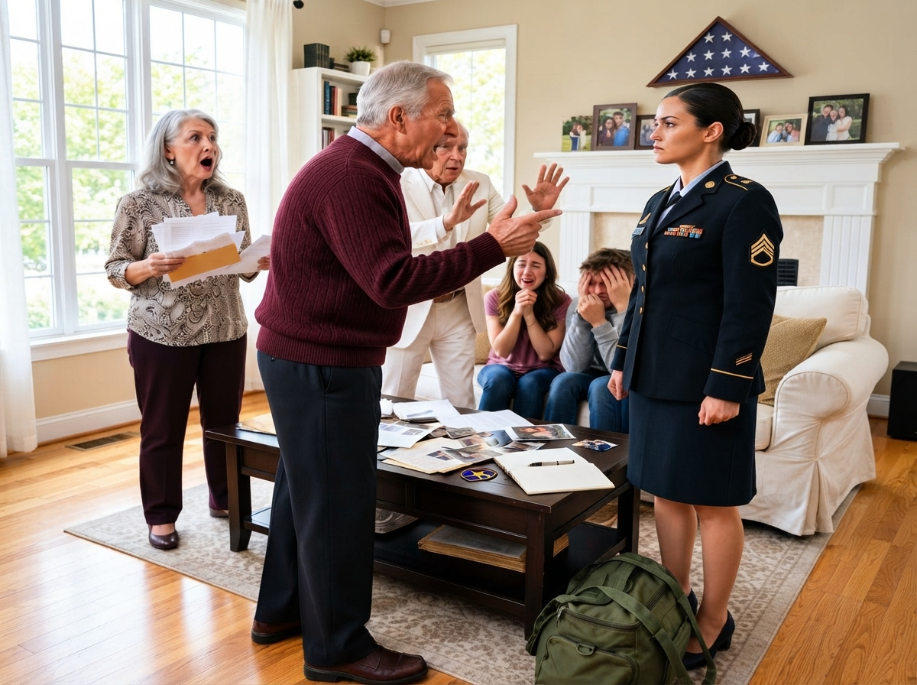
She Returned Home in Uniform Without Warning, Placed a Sealed Military Envelope on the Table, and Asked Her Father Why He Had Kept Her Discharge Secret
Part 14 of 16

