
The restricted folder had been untouched for nearly three years.
Claire opened it because the archive was conducting a routine review.
Nothing more.
She expected administrative documents.
Instead, she found a letter addressed to Daniel.
The handwriting belonged to Thomas.
Claire almost closed it.
Then she read the first line.
You will probably hate me for writing this.
She continued.
Thomas admitted that he had manipulated Daniel's reputation.
He had used Daniel's office access.
He had forged signatures.
He had created financial records designed to implicate him.
But then came something Claire had never seen.
Thomas admitted that Daniel had once discovered the scheme.
Daniel had confronted him.
He had threatened to report it.
Thomas had responded by warning him that Claire's career would be destroyed.
Claire stopped reading.
She understood why Daniel had always carried so much shame.
He had not simply failed to act.
He had been threatened.
But the letter did not excuse him.
Thomas wrote that Daniel chose silence afterward.
He knew enough to suspect.
He did not know everything.
He had been afraid.
Claire closed her eyes.
The old anger returned briefly.
Then faded.
The letter ended with an apology that was never sent.
Thomas had written it before his death.
Claire sat alone.
She could have hidden the letter.
Instead, she called Daniel.
He arrived within an hour.
She placed it in front of him.
He recognized the handwriting.
“I thought everything was gone.”
“So did I.”
Daniel read.
His hands shook.
“I never knew he wrote this.”
“Did you know he threatened you?”
“Yes.”
“Did you tell anyone?”
“No.”
Claire waited.
“Why?”
“I thought I could handle it.”
She shook her head.
“That sounds familiar.”
Daniel smiled sadly.
“You're right.”
He read the final paragraph.
Then he folded the letter.
“Do you want it?”
Claire looked at him.
“No.”
“Why not?”
“Because it belongs to the record.”
Daniel nodded.
The letter was scanned.
A copy was placed in the family collection.
The original remained restricted according to the archive agreement.
Claire asked Daniel whether he wanted the document public.
“No.”
She respected that.
The truth did not require exposure.
That distinction had become second nature.
Later that afternoon, Claire visited Sarah.
She told her about the letter.
Sarah listened.
“Does it change how you see your father?”
“Yes.”
“How?”
“I understand him more.”
“Do you forgive him?”
Claire thought.
“I don't know.”
Sarah smiled.
“You're allowed to say that.”
“I know.”
They sat in silence.
Then Sarah said, “Maybe forgiveness isn't the point.”
“What is?”
“Understanding what happened without letting it decide who you become.”
Claire smiled.
“That sounds like something I'd say.”
“You taught me.”
The foundation continued expanding.
Sarah received a grant to digitize family records.
Claire helped design the archival standards.
They built a secure system.
Families could upload documents.
They could decide which parts were public.
Researchers could request access.
No one could simply take a family story and turn it into entertainment.
That mattered deeply to both women.
One evening, Claire and Sarah reviewed the first completed collection.
It belonged to a family that had migrated across three countries.
The documents were beautiful.
Letters.
Recipes.
School records.
Photographs.
Sarah looked at the collection.
“This is what we should have had.”
Claire nodded.
“Maybe.”
“But we do now.”
“Yes.”
The work became their shared answer to the past.
Not revenge.
Not denial.
Preservation.
They helped people keep their histories without being trapped by them.
Daniel eventually retired from volunteering.
His knees bothered him.
He complained about it constantly.
Claire teased him.
“You've become officially old.”
“Watch yourself.”
Margaret laughed.
“You've been old since fifty.”
Daniel looked offended.
The family still gathered regularly.
Sarah joined them when she wanted.
She was not expected to play a role.
That mattered.
Sometimes she came to dinner.
Sometimes she didn't.
Nobody asked for explanations.
She was family without being absorbed into the family.
That balance suited everyone.
One summer afternoon, Claire found Sarah sitting beneath the old maple tree.
Sarah was holding Elena's photograph.
“What's wrong?”
“Nothing.”
Claire sat beside her.
Sarah looked at the photograph.
“I used to think my mother abandoned me.”
Claire waited.
“She didn't.”
“No.”
“She was afraid.”
“Yes.”
Sarah sighed.
“I wish I had known.”
“I do too.”
“But knowing now doesn't erase the childhood I had.”
“No.”
Sarah folded the photograph carefully.
“I used to think that if I found the truth, I'd feel whole.”
“Did you?”
“No.”
Claire smiled.
“Neither did I.”
“What did you find?”
“A way to live with the pieces.”
Sarah nodded.
“That might be better.”
They sat quietly.
Leaves moved above them.
A child shouted somewhere across the park.
The world continued.
No secret waited behind every sound.
No document needed to be opened.
For once, silence was simply silence.
That evening, Claire returned home.
Daniel was reading in the living room.
He looked up.
“How was your day?”
“Good.”
“Anything happen?”
“A lot.”
He smiled.
“Good things?”
“Mostly.”
She sat beside him.
They watched the sunset through the window.
Claire thought about the first envelope.
How much fear it had carried.
How much had changed since then.
She had once believed the past was a locked room.
Now she understood it differently.
The past was a house with many rooms.
Some could be entered.
Some needed permission.
Some should remain closed.
And none needed to become a prison.
Daniel reached for her hand.
“You seem peaceful.”
Claire smiled.
“I think I am.”
He squeezed her fingers.
“I like that.”
“So do I.”
That night, she placed the new letter into its archival folder.
She added a final note.
Context matters. The document provides evidence of coercion but does not remove individual responsibility for later choices.
She signed her name.
Then she closed the folder.
The record was honest.
The family was still imperfect.
That was enough.
Click Here to continue read next: PART16: Years Later, Claire Returned to the House With Sarah and Found the Old Envelope Waiting in the Same Drawer, but This Time Neither Woman Was Afraid
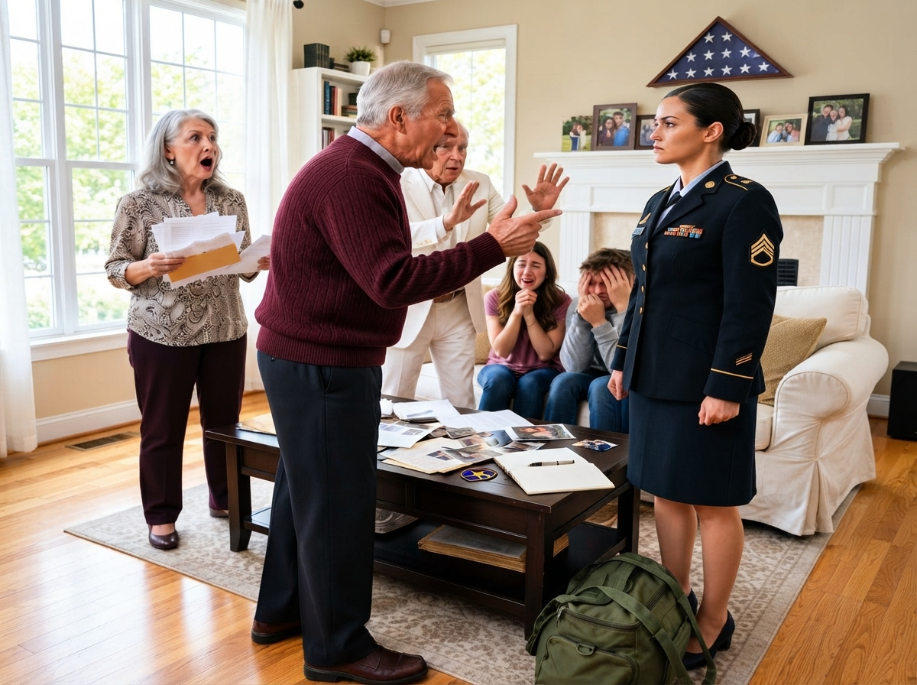
She Returned Home in Uniform Without Warning, Placed a Sealed Military Envelope on the Table, and Asked Her Father Why He Had Kept Her Discharge Secret
Part 15 of 16

