
The question came during dinner.
Elise had been unusually quiet.
She pushed food around her plate before finally looking at Nora.
“Do you remember the first photograph?”
Nora smiled.
“Of course.”
“The woman behind you.”
“Yes.”
“Did you ever wonder why she was there?”
Nora frowned.
“I thought she was watching us.”
“She was.”
Julian looked up.
“Why?”
Elise hesitated.
“Because I asked her to.”
The room went silent.
Nora stared.
“What?”
Elise leaned back.
“I didn't know you would take the photograph.”
“Then why were you there?”
“I wanted to see whether Julian had told you.”
“Told me what?”
“That I was alive.”
Julian looked at her.
“I didn't know you were going to be there.”
“I know.”
Nora remembered the day.
Julian had reacted immediately.
He had recognized Elise.
But he had not known she was watching.
Elise explained.
She had been trying to decide whether to approach them.
She had seen Nora.
She had seen how Julian looked at her.
And she had hesitated.
“I thought you might be safer without me.”
Nora shook her head.
“You could have come forward.”
“I was afraid.”
“Of Marcus?”
“Yes.”
“And of me?”
“No.”
Elise smiled.
“I was afraid of what my return would do to Julian.”
Julian looked at her.
“It nearly destroyed me.”
“I know.”
“But it also saved me.”
Elise nodded.
That conversation led them back to Mercer Street.
Not because there was another secret.
Because they wanted to stand where everything had begun.
The trees had grown.
The building had been renovated.
The café had changed owners.
The sidewalk looked almost identical.
Nora stood beneath the branches.
“It's strange.”
“What?”
“How normal it looks.”
Julian smiled.
“Most important places do.”
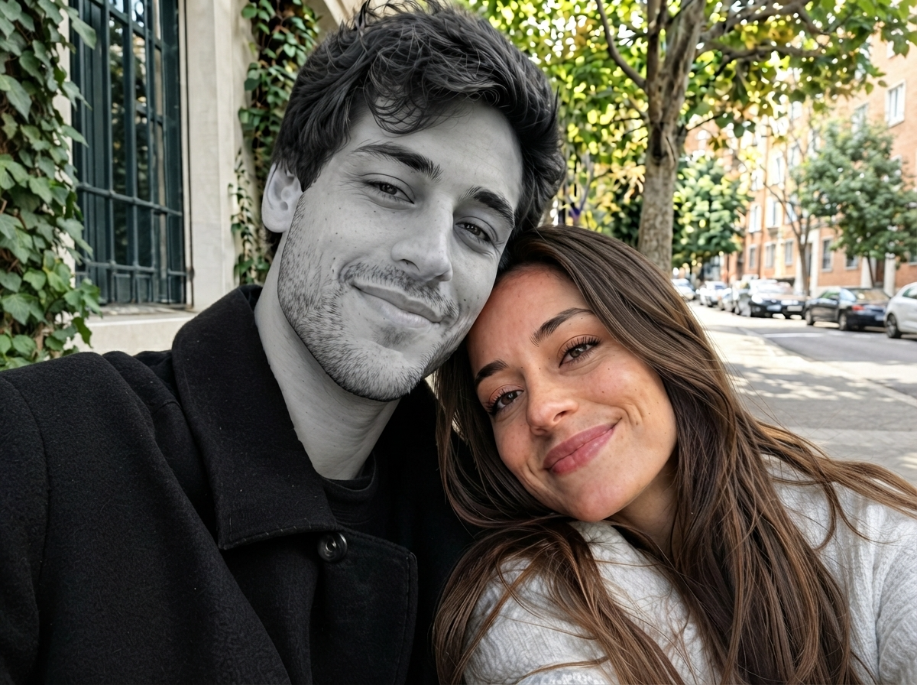
They took a photograph.
This time, all four stood together.
Nora.
Julian.
Elise.
Nora's mother.
Nobody hid.
Nobody stood in the background.
They laughed afterward.
The picture became one of Nora's favorites.
Not because it was perfect.
Because everyone was looking at the camera.
That night, Elise asked Nora something else.
“Do you ever regret knowing everything?”
Nora thought.
“No.”
“Not even once?”
“Sometimes I miss ignorance.”
Elise nodded.
“But?”
“But ignorance wasn't peace.”
Elise smiled.
That sentence stayed with her.
The family continued gathering.
Birthdays.
Holidays.
Ordinary Sundays.
Robert's chair remained empty after his death, but nobody treated it as sacred.
They moved it into the living room.
Then one day, they gave it away.
Robert would have approved.
His life had never belonged to one chair.
His life belonged to the people he had helped.
Years after the case ended, Julian found a box in the attic.
Inside was a stack of letters.
Most were old.
One was addressed to him.
It had been written by Robert.
Julian opened it.
Robert wrote that he had spent too much of his life believing that protecting people meant controlling what they knew.
He admitted that he had been wrong.
The final paragraph said:
If you love someone, give them the truth when they are strong enough to carry it. Do not confuse silence with kindness.
Julian showed Nora.
She read it.
Then she folded it carefully.
“That's probably the best thing he ever wrote.”
Julian nodded.
The letter became part of the archive.
The family retained a copy.
Nothing else happened.
That was important.
No secret villain returned.
No hidden organization appeared.
No second conspiracy emerged.
The story ended because sometimes stories end when people stop feeding them.
Nora eventually wrote a book.
She did not write it as a thriller.
She wrote it as a family history.
The book opened with the photograph.
The first chapter described an ordinary afternoon.
Two people taking a picture.
A woman in the background.
A secret.
Then it followed the evidence.
She wrote about her mother's fear.
Elise's disappearance.
Julian's childhood.
Robert's choices.
Adrian's failures.
The ledger.
The investigation.
The aftermath.
She wrote carefully.
She did not turn pain into entertainment.
She did not make heroes where there were none.
She did not erase wrongdoing because someone had later tried to repair it.
The book became successful.
People asked whether she planned a sequel.
She always smiled.
“No.”
“Why?”
“Because I don't want another mystery.”
That answer became part of the book's final interview.
Elise teased her about it.
“You sound boring.”
“I am boring.”
“You're not.”
“After everything we've been through, I deserve boring.”
Julian laughed.
“You definitely do.”
Their life became exactly that.
Boring.
Beautifully boring.
There were broken appliances.
Missed trains.
Burnt dinners.
Cold coffee.
Arguments about whose turn it was to walk the dog.
Nora loved every part of it.
Because ordinary life had once seemed impossible.
One winter evening, snow covered Mercer Street.
Nora and Julian walked beneath the trees.
The branches were bare.
The city was quiet.
Julian reached for her hand.
“You cold?”
“A little.”
“Want to go home?”
“Yes.”
They turned.
Halfway down the block, Nora looked back.
The place where they had taken the photograph was empty.
No stranger.
No watcher.
No mystery.
She smiled.
Then she walked on.
Click Here to continue read next: PART12: Years Later, Nora Returned to Mercer Street With a Camera in Her Hand and Realized the Story Had Never Really Been About the Photograph
The Photograph Was Supposed to Be a Simple Memory, Until Nora Noticed the Stranger Behind Them and Realized Julian Had Been Hiding Something
Part 11 of 16

