
The black dog did not appear in any of the public records.
Mara searched the archive.
Nothing.
She searched the original trial documents.
Nothing.
She searched the transport manifests.
Still nothing.
The dog existed only in the photograph.
Daniel studied it for nearly an hour.
“I've never seen him.”
“Are you sure?”
“Yes.”
“What about Helen?”
“I'll ask her.”
Helen arrived the next morning.
The photograph was placed on the table.
She stared at it.
Then sat down.
“I remember him.”
Mara felt her pulse quicken.
“Who?”
“His name was Bear.”
“Research code?”
Helen closed her eyes.
“B-06.”
Mara searched the old database.
The code existed.
But the record was almost empty.
B-06.
Male.
Large mixed breed.
Transferred.
No owner listed.
No destination.
No final status.
Mara looked at Helen.
“Why was he excluded from the trial records?”
“He wasn't.”
“Then why isn't he there?”
“Because Bear wasn't part of the original five.”
“What was he?”
Helen hesitated.
“He was the control.”
Mara frowned.
The study had required control animals.
Animals that received no experimental treatment.
Bear had been one of them.
That made the photograph more important.
If Bear had survived without receiving the treatment, his records could show whether the neurological changes were actually caused by the drug.
The company had a reason to hide him.
He was evidence they could not manipulate through treatment results.
Daniel looked at the photograph.
“Where was he sent?”
Helen shook her head.
“I don't know.”
Mara found the first transfer form.
The signature belonged to a researcher who had never been questioned.
Dr. Samuel Price.
He had left East Ridge before the facility closed.
Public records showed that he had moved overseas.
But a recent corporate filing listed him as a consultant for Northstar.
Mara looked at Daniel.
“Another connection.”
The investigators contacted Price.
He refused an interview.
His attorney claimed he had no knowledge of the animals.
That response was enough to raise further questions.
Mara searched old financial records.
Price had received payments from a private foundation.
The foundation had funded animal rehabilitation programs.
One of those programs operated a sanctuary in the northern mountains.
The same sanctuary mentioned in the old records.
Mara and the investigators traveled there.
The sanctuary was surrounded by pine trees.
It was quiet.
Dogs barked from distant runs.
Cats watched from enclosed gardens.
A woman named Rebecca met them at the gate.
When Mara showed her the photograph, Rebecca's face changed.
“Where did you get this?”
“An old file.”
Rebecca looked at the black dog.
“That was Bear.”
“Was?”
“He died three years ago.”
Mara felt disappointment.
But Rebecca continued.
“He lived here for almost seven years.”
Daniel closed his eyes.
“He was alive.”
“Yes.”
“Why wasn't he in the records?”
Rebecca looked confused.
“What records?”
Mara explained.
Rebecca shook her head.
“He arrived with papers under a different name.”
“Which name?”
“Bruno.”
Mara froze.
“Bruno?”
The dog they had found months earlier?
Rebecca shook her head.
“No. Another Bruno.”
The confusion illustrated exactly how the system had worked.
Animals could disappear simply by changing names.
Mara asked for the intake files.
Rebecca brought them.
Bear had arrived under a fabricated identity.
The transfer had been authorized by Thomas Reed.
But the paperwork listed him as a rescue dog.
The date matched the old research timeline.
The sanctuary had unknowingly protected him.
Mara read the medical notes.
Bear had shown none of the neurological effects associated with the treatment.
He had remained healthy.
His behavior had been normal.
His memory tests were ordinary.
That was exactly why his existence mattered.
He was the comparison the company did not want.
The investigators photographed the records.
Rebecca gave permission for copies.
Then she showed them Bear's grave.
It was beneath a pine tree.
A simple wooden marker carried his real name.
Bear.
Daniel stood there quietly.
“He made it.”
Mara nodded.
“He did.”
The discovery did not bring Bear back.
But it restored his history.
That mattered.
The investigation expanded to other control animals.
Several had been misidentified.
Some were still alive.
Others had died years earlier.
Their records were recovered.
The scientific conclusions changed.
Independent experts reviewed the original data.
The treatment had produced real neurological effects in some animals.
But the company had overstated the safety.
The control animals demonstrated that some of the reported improvements had been misinterpreted.
The research had been compromised.
The evidence was becoming more complicated.
Not every finding was false.
Not every finding was true.
The problem was that the company had hidden the information necessary to distinguish the two.
Mara testified again.
She emphasized the importance of preserving complete records.
The court ordered the recovered data released to independent researchers.
Northstar was required to disclose additional historical records.
That process uncovered another surprise.
The company had maintained a private database of former research animals.
The database contained hundreds of entries.
Many had been assigned new names.
Some were marked “civilian placement.”
Others were marked “monitor.”
Mara asked what monitor meant.
The investigators discovered that some animals had been followed after adoption.
Their owners had not been informed.
The monitoring had included veterinary visits.
Behavioral observations.
Location data.
Mara felt anger rise again.
“People thought they had adopted pets.”
“They had.”
“But someone was still tracking them.”
“Yes.”
That practice was investigated separately.
Some owners chose to participate in future monitoring voluntarily.
Others demanded that all tracking stop.
The court protected those choices.
Mara appreciated the distinction.
The animals deserved a future free from involuntary surveillance.
Then the investigators found A-107.
The collar number from the photograph.
It belonged to a black dog.
His civilian name was Rex.
He had been adopted from a shelter eighteen months earlier.
The shelter had no unusual records.
The family loved him.
But a microchip database showed a prior registration.
Northstar.
Mara's heart sank.
Rex was alive.
And someone had been trying to recover him.
The family agreed to meet investigators.
Rex approached Mara cautiously.
He sniffed her hand.
Then stepped behind his owner.
Mara did not reach for him.
She waited.
The owner whispered, “He's always been nervous around strangers.”
Mara nodded.
“Let him choose.”
After several minutes, Rex approached.
His nose touched Mara's hand.
Then he looked toward Daniel.
Daniel had seen the photograph.
His face changed.
“I know that dog.”
Mara looked at him.
“Bear?”
“No.”
He pointed toward Rex.
“B-07.”
The investigator checked the records.
B-07.
Another control animal.
Alive.
The sixth survivor was not the end.
There were at least seven.
Mara looked at the dog.
He stood beside the family who had adopted him.
He was safe.
But the people who had once tracked him still knew where he lived.
The investigators recommended protective measures.
The family agreed.
Rex would remain with them.
No one would remove him.
No company would claim him.
His records would be corrected.
The old code would remain only as historical information.
His name was Rex.
That was the name his family had given him.
The investigation had begun with Tiger.
It had uncovered dozens of animals.
Now it was revealing an entire generation of lives that had been renamed, transferred, and forgotten.
Mara returned to the clinic that evening.
Tiger was waiting at the door.
She crouched.
“You started all this.”
He blinked.
Then rubbed his cheek against her hand.
Mara smiled.
Behind him, Nori appeared.
Lena followed.
Jasper came slowly from the garden.
The others gathered.
For a moment, Mara thought about the photograph.
Six survivors.
Then she remembered Rex.
Seven.
And perhaps more.
The number no longer mattered as much as it once had.
But someone had left the photograph because they wanted Mara to keep looking.
She wondered who.
Then her phone rang.
The investigator spoke only one sentence.
“We found the person who took the photograph.”
Mara's expression changed.
“Who?”
The answer was a name she had never expected.
Click Here to continue read next: PART15: The Photographer Had Worked Beside Daniel for Years, and His Confession Explained Why the Survivors Kept Appearing Where Mara Least Expected
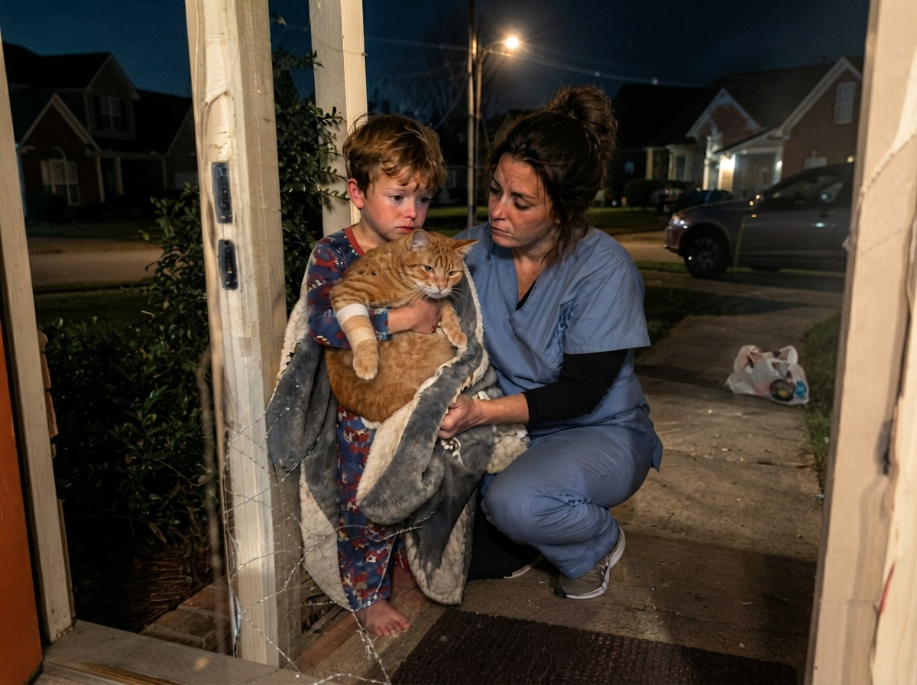
At Nearly Midnight, the Boy Arrived Barefoot With a Trembling Cat in His Arms, and One Detail Made Dr. Mara Question Everything
Part 14 of 16

