
The name belonged to Grace Porter.
Mara remembered her immediately.
Grace had been the financial employee who gave them the payment records.
She had testified against Northstar.
She had helped expose Thomas.
Mara could not understand why investigators believed she had taken the photograph.
“She says she didn't.”
The investigator replied, “She admits the camera was hers.”
Mara stared at the phone.
“Then what does she say?”
“She says someone borrowed it.”
“Who?”
“She won't tell us.”
Mara met Grace the following morning.
Grace looked exhausted.
“I didn't photograph Tiger.”
“But the camera was yours.”
“Yes.”
“Who borrowed it?”
Grace remained silent.
Mara waited.
Eventually Grace said, “Daniel.”
Mara looked toward him.
Daniel was standing across the room.
His face had gone still.
“I didn't.”
Grace nodded.
“Not recently.”
She explained that years earlier, before Daniel disappeared, he had borrowed the camera.
He had photographed the five animals.
He had also photographed several employees.
The camera had later been returned.
The photograph of Tiger had remained stored on it.
Someone had copied the image recently.
Mara frowned.
“So the photograph was old?”
“The animals were.”
“But the photograph appeared new.”
Grace nodded.
“That was intentional.”
Someone had printed an old photograph and left it at the clinic.
The purpose was psychological.
They wanted Mara to believe the animals were being watched again.
But there was more.
Grace admitted that she had once kept a private copy of Daniel's records.
She had used them to help investigators.
One file contained a list of animals that had never been found.
The list included B-06 and B-07.
Bear.
Rex.
But there were twelve others.
Mara looked at the page.
“Where are they?”
Grace shook her head.
“I don't know.”
The investigators searched the old database.
Some had been adopted.
Some had died.
Three remained unaccounted for.
Mara felt the familiar tension return.
The case had begun with one missing cat.
Now three animals might still be somewhere without anyone knowing their history.
The investigators followed the records.
The first was a dog named Molly.
She had been registered under a different name and adopted by a family in another state.
The second was a cat named Pearl.
Her last record was from a rural veterinary clinic.
The third had no name.
Only a code.
B-12.
Mara asked whether they should search for all three.
Daniel answered before anyone else.
“Yes.”
The investigation did not become a dramatic hunt.
There were no raids.
No breaking into homes.
They used records.
Shelter databases.
Veterinary histories.
Microchip registries.
Public adoption records.
The first confirmed animal was Molly.
She lived with a retired teacher.
She had arthritis and slept beside a fireplace.
Her owner agreed to genetic testing.
The results confirmed that she had been part of the control group.
The owner was stunned.
“I never knew.”
Mara explained that nothing about Molly's present life needed to change.
The family could keep her.
The record simply needed correction.
Molly remained where she belonged.
The second animal, Pearl, was harder.
Her microchip had been removed.
But her old clinic records contained a distinctive scar pattern.
Investigators traced the veterinarian.
He remembered the cat.
“She was called Poppy.”
Poppy had been adopted from a shelter.
The shelter had closed.
Its records had been moved.
Mara searched the archived database.
The name Poppy appeared.
So did a transport company.
Thomas Reed's company.
The trail eventually led to a family living near the coast.
They had adopted Pearl eight years earlier.
Pearl was alive.
Her owner agreed to testing.
The result confirmed her connection.
Another history restored.
Only B-12 remained.
Its records were nearly empty.
No name.
No owner.
No destination.
Only one note:
“Do not place near T-14.”
Tiger.
Mara stared at the sentence.
Why had the researchers separated B-12 from Tiger?
Daniel studied the record.
“Maybe because they reacted to each other.”
“Like Nori and Lena?”
“Possibly.”
Mara searched behavioral notes.
B-12 had demonstrated unusually strong recognition of other animals.
The animal seemed to remember individuals from the trial.
The researchers had worried that group contact would reveal the animals' shared history.
That meant B-12 might have been deliberately isolated.
The investigation traced one final address.
An old boarding kennel.
The kennel had closed eight years earlier.
The owner was still alive.
She remembered B-12.
“He was a black-and-white dog.”
“Where did he go?”
“A man picked him up.”
“Who?”
“I don't know.”
“Did he show identification?”
“Yes.”
“What name?”
The woman hesitated.
“Samuel Price.”
Mara's heart tightened.
Dr. Samuel Price.
The same researcher who had disappeared from the old records.
Investigators located Price.
He was living quietly under his own name.
He agreed to speak.
Price admitted that he had taken B-12.
He claimed he had intended to protect the animal.
“Why didn't you report him?”
“Because I knew the company would recover him.”
“So you kept him hidden.”
“Yes.”
“Where?”
Price looked down.
“He died.”
Mara felt disappointment.
“When?”
“Five years ago.”
“Why didn't you tell anyone?”
Price looked at Daniel.
“Because I was ashamed.”
He described B-12 as a gentle dog who remembered people.
The dog had spent his final years on Price's property.
He had never been used in further research.
Price kept him hidden because he feared Northstar would discover him.
It did not erase the secrecy.
But it explained it.
The investigators documented the testimony.
B-12 was dead.
His life had not been recorded properly.
But now it would be.
Mara realized that the investigation had reached its natural limit.
They could not restore every lost life.
They could restore the truth.
That became the focus.
A national archive was established for the animals connected to the research program.
Owners could voluntarily submit records.
Veterinary clinics could correct historical files.
The identification codes were preserved only as research history.
No code could establish ownership.
The system was designed to prevent another company from repeating the same pattern.
Mara helped write the veterinary guidelines.
Every transfer needed documentation.
Every research animal needed traceable records.
Owners had to know when an animal had been enrolled in research.
Animals could not be transferred through shell companies without disclosure.
Tracking devices required clear authorization.
The rules were ordinary.
That was the point.
Good systems did not need to be dramatic.
They needed to work when nobody was watching.
The legal proceedings eventually ended.
Northstar accepted penalties and agreed to release historical records.
Several former executives faced separate consequences.
Others were cleared.
The final report carefully distinguished proven violations from allegations that could not be established.
Mara read the report twice.
It was not satisfying in the way stories often promised.
Some people had been punished.
Some had not.
Some animals had been found.
Others had died before anyone knew their real history.
But the truth was no longer hidden.
That was something.
Daniel visited the clinic after the final hearing.
He stood beneath the old tree.
Mara joined him.
“It's really over.”
“For the case.”
“Yes.”
Daniel looked toward Tiger.
“And him?”
“He still thinks the clinic belongs to him.”
Daniel smiled.
“That sounds right.”
Tiger walked toward them.
His gait was slower now.
He stopped between them.
Daniel crouched.
Tiger rested his head against his knee.
Daniel closed his eyes.
“You remembered.”
Tiger blinked.
Mara watched.
She had once thought the most important thing was discovering what had happened.
Now she understood something else.
The animals did not need the world to remember every detail.
They needed people to stop taking away their choices.
That was the real ending.
Not a courtroom.
Not a punishment.
Choice.
Tiger could choose where to sleep.
Nori could choose who touched her.
Lena could choose whether to stay near another cat.
Jasper could choose the garden.
Rex could stay with his family.
Molly could remain beside the fireplace.
Pearl could keep her home.
Their histories were restored.
But their futures were theirs.
That evening, Eli arrived with a drawing.
He placed it on Mara's desk.
It showed the clinic beneath a large tree.
There were animals everywhere.
Some had names.
Others had question marks.
Mara smiled.
“You're still drawing them.”
Eli nodded.
“Dad says there are more.”
“There might be.”
“Will we find them?”
Mara considered the question.
“I hope so.”
Eli looked at her.
“But?”
“But we can't promise.”
He nodded.
That answer did not frighten him anymore.
He had learned that uncertainty was different from abandonment.
Mara pinned the drawing to the wall.
Tiger watched.
Then he walked toward the garden.
Eli followed.
The evening light fell across the grass.
Mara stood in the doorway.
For the first time, she did not feel the need to search beyond the fence.
Not tonight.
Tonight, the animals were safe.
The records were secure.
The families knew the truth.
And the people responsible had been forced to answer for what could be proven.
Mara closed the archive room.
She locked it.
Then she returned to the garden.
Tiger was lying beneath the tree.
Nori was beside him.
Lena had curled against Nori.
Jasper rested near the steps.
Clover was exploring the grass.
Sam was trying to climb the fence.
Mara laughed.
“Sam.”
The monkey looked at her.
He stopped.
Then continued climbing.
Daniel laughed from behind her.
“He listens about as well as Eli did at that age.”
Eli protested.
“I did listen.”
Mara smiled.
The sound of their laughter carried through the yard.
The past had not disappeared.
But it had finally stopped demanding every moment.
Click Here to continue read next: PART16: Years After the Last Hearing, Mara Returned to the Tree With the Old Photograph and Realized the Survivors Had Already Written the Ending Themselves
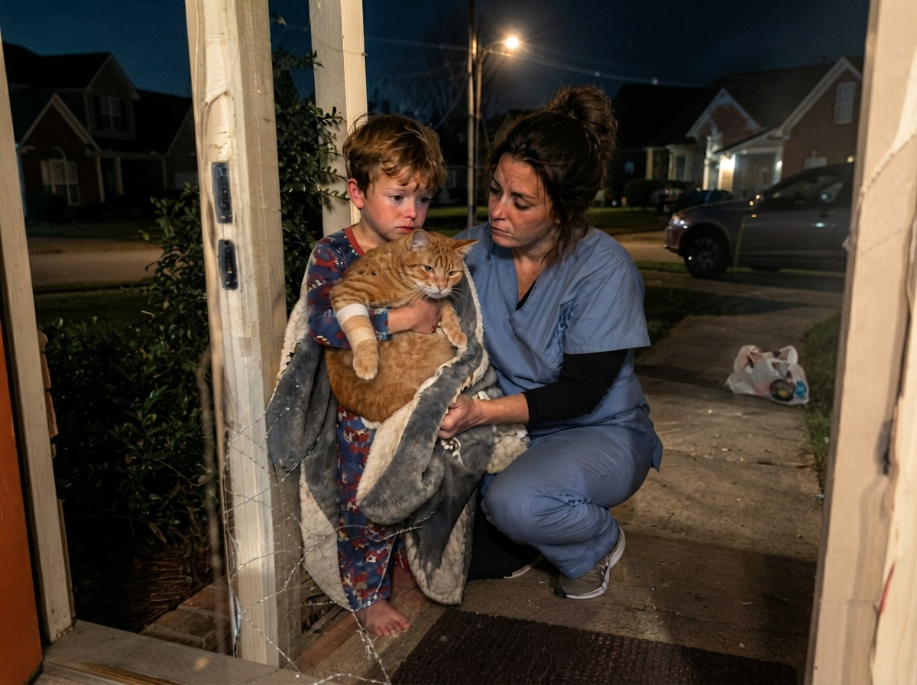
At Nearly Midnight, the Boy Arrived Barefoot With a Trembling Cat in His Arms, and One Detail Made Dr. Mara Question Everything
Part 15 of 16

