
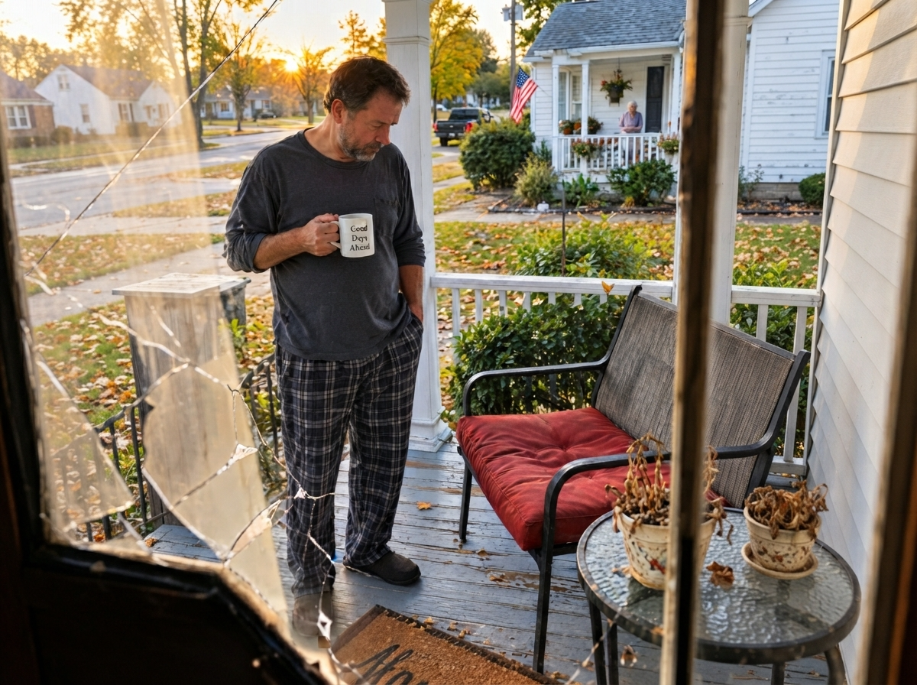
Harold Mercer was holding a chipped white mug when he noticed the window was broken. He had been standing on the porch for less than a minute, enjoying the weak gold of early morning, when a jagged line in the glass caught the sunlight. He lowered the mug and stared. The window beside the front door had been shattered from the outside, its lower pane fractured into a web of sharp pieces. For several seconds he could hear nothing except the distant hum of a garbage truck and the ticking of the cooling kettle inside his kitchen.
The mug trembled slightly in his hand. Someone had printed the words GOOD DAYS AHEAD across its side in crooked blue letters. His daughter had bought it for him years earlier, after his wife died, insisting that he needed something cheerful to look at each morning. Harold had always found the slogan irritating. That morning, however, he looked down at it and felt an unexpected sadness. The phrase seemed almost cruel against the broken glass.
He stepped closer to the window without touching it. A few fragments had fallen onto the porch floor. Others remained hanging in the wooden frame. The curtains behind the pane were still closed, and the room beyond them was dark. Harold examined the porch boards. There were tiny shards near his slippers, but no large stone or object that could have caused the damage. That bothered him. If someone had thrown something through the window, where was it?
"Harold?"
He looked across the yard.
Mrs. Bennett stood on her porch in a pale cardigan, one hand gripping the railing. She lived directly opposite him and had a habit of appearing whenever anything unusual happened on the street. Her gray hair was pinned loosely behind her head, and she wore the concerned expression she usually reserved for neighborhood emergencies.
"Your window," she called.
"I noticed."
"Was it like that when you woke up?"
Harold glanced toward his front door.
"I don't know. I didn't come outside before now."
Mrs. Bennett crossed the street before he could stop her. She moved slowly but with determination, stepping around the fallen leaves and damp patches left by overnight rain. When she reached the porch, she looked through the broken pane and then at Harold.
"Did you hear anything?"
"No."
"Nothing?"
"Nothing."
She studied him.
"Are you sure?"
Harold almost smiled. "Margaret, if I heard a window breaking, I'd remember."
She ignored the mild joke. "Then someone was very careful."
Harold looked at the glass again.
"Or very quiet."
Mrs. Bennett leaned closer. "Don't touch anything."
"I wasn't planning to."
"Good."
She pointed toward the porch floor.
"Look there."
Harold followed her finger.
A small dark mark was visible beneath the broken window, partly hidden by the leg of his porch chair. He bent down carefully.
It was a footprint.
Not a full one, just the front half of a shoe pressed into the thin layer of dust that had collected on the boards. The sole pattern was distinctive: a narrow heel followed by three diagonal ridges.
Harold straightened.
Mrs. Bennett's voice dropped.
"That wasn't there yesterday."
"You were watching my porch yesterday?"
"I watch my own porch."
"Which happens to face mine."
"Exactly."
Harold looked toward the street.
No one was outside now.
A car moved slowly past the intersection and disappeared.
Mrs. Bennett folded her arms.
"Call the police."
Harold reached into his pocket for his phone.
Then he stopped.
Something about the footprint bothered him.
Not the size.
The direction.
The shoe had been facing toward his house.
But the heel was closer to the broken glass.
Someone had stood there facing the window.
And then walked backward.
Harold crouched again.
He studied the mark until his knees hurt.
"What's wrong?" Mrs. Bennett asked.
"I've seen that tread before."
"Where?"
Harold looked up.
"At the cemetery."
Her expression changed.
Neither of them spoke for a moment.
Harold's wife, June, had been buried there six years earlier. Since then, he had visited her grave every Sunday morning, regardless of weather. The cemetery was quiet, familiar, almost comforting.
But three weeks ago, Harold had noticed the same strange shoe print near June's headstone.
He had assumed it belonged to a groundskeeper.
Now he wasn't sure.
"Why didn't you tell me?" Margaret asked.
"I didn't think it mattered."
"It matters now."
Harold finally took out his phone.
He dialed the police.
While waiting, he walked to the edge of the porch and looked toward the sidewalk.
A folded piece of paper lay beneath the hedge.
He had not seen it before.
He stepped down.
Margaret grabbed his sleeve.
"Don't."
"It's just paper."
"Then let the police pick it up."
Harold hesitated.
She was right.
He returned to the porch.
They waited.
The police arrived twenty minutes later.
Officer Daniel Ruiz was younger than Harold expected, perhaps in his thirties, with a calm manner that made him seem older. He photographed the broken pane, the footprint, and the paper beneath the hedge before putting on gloves.
"Did you move anything?" he asked.
"No."
"Anyone else?"
"Mrs. Bennett was here."
Daniel nodded.
"Did you see anyone?"
Margaret shook her head.
"Not this morning."
Daniel looked at Harold.
"What about overnight?"
"I slept."
"Deep sleeper?"
"Usually."
Daniel glanced toward the house.
"Any alarm?"
"No."
"Security cameras?"
Harold pointed toward the roof.
"I've got one above the garage."
Daniel's eyebrows lifted.
"That's useful."
He checked the camera.
The small indicator light was off.
"Was this working yesterday?"
"Yes."
Daniel looked at Harold.
"When did you last check it?"
"Last night."
The officer examined the cable.
"It was cut."
Harold felt a heaviness settle in his chest.
"Cut?"
"Cleanly."
Daniel photographed it.
Then he picked up the folded paper.
He opened it.
His expression changed.
"What?"
Daniel looked at Harold.
"Do you recognize this handwriting?"
Harold read the message.
Three words.
ASK MARGARET FIRST.
He looked across the porch.
Margaret had gone pale.
"Margaret?"
She stared at the paper.
"I don't know that handwriting."
Daniel watched her.
Harold knew that look.
Margaret was lying.
Not convincingly.
Not well.
But deliberately.
"Margaret," Harold said quietly.
She looked at him.
"I've seen that note before."
The officer stepped closer.
"Where?"
Margaret swallowed.
"On June's grave."
Harold's hand tightened around the mug.
"What?"
"Two weeks ago."
"You said you never saw anything unusual."
"I was trying to protect you."
"From what?"
She looked through the broken window.
Then she whispered something Harold had not expected.
"From the person who has been watching your house."
Daniel's expression sharpened.
"Who?"
Margaret shook her head.
"I don't know."
Harold stared at her.
"You knew someone was watching me?"
"I suspected."
"Why didn't you tell me?"
"Because the last time I did, someone broke my kitchen window."
Silence fell over the porch.
Daniel slowly turned toward her.
"When?"
"Eight years ago."
"Did you report it?"
"No."
"Why?"
Margaret looked at Harold.
"Because I thought it was a warning."
Harold felt his mouth go dry.
"A warning about what?"
Margaret reached into the pocket of her cardigan.
She pulled out a small photograph.
It was old and faded.
She handed it to Harold.
He looked down.
The photograph showed the street forty years earlier.
His house was visible in the background.
So was Margaret's.
And standing between them were two younger people.
Harold recognized one immediately.
June.
The other person was a man he had never seen before.
But on the back of the photograph, someone had written a date.
October 17.
And beneath it, a sentence.
THEY NEVER TOLD HAROLD WHAT HAPPENED THAT NIGHT.
Harold looked at Margaret.
"What night?"
She said nothing.
Daniel took the photograph.
"Mrs. Bennett, I think you should come with us."
Margaret shook her head.
"No."
"Why not?"
"Because if the person who left that message knows I gave you this, he'll know I finally told you."
Harold stared at the broken window.
Then at the photograph.
Then at the words on his mug.
GOOD DAYS AHEAD.
For the first time in six years, Harold wondered whether June's death had really been the simple tragedy everyone had described.
And suddenly, the broken window no longer looked like an attack.
It looked like an invitation.
Click Here to continue read next: PART2: Margaret Finally Admitted Why She Had Kept June’s Photograph Hidden, and Harold Discovered His Wife Had Left Him One Last Unanswered Question
At Seven in the Morning, Harold Found His Porch Window Shattered, Yet the Broken Glass Held a Clue That Made Him Afraid to Call the Police
Part 1 of 8

