
NOTE: This part focuses on the family confronting the full history together, the emotional consequences of Rachel’s story, and the difficult distinction between forgiveness, accountability, and forgetting.
The family meeting happened on a rainy Sunday.
There were no police officers.
No lawyers.
No evidence bags.
Just us.
David.
Eleanor.
Daniel, my brother-in-law.
And me.
Mia was upstairs with a babysitter.
We needed to talk without pretending she couldn't hear the tension in our voices.
Eleanor brought the final box of documents.
She placed it on the table.
“This is everything.”
I looked at the box.
“Everything?”
“Everything I have.”
Daniel leaned back.
“Then let's open it.”
Nobody moved.
Finally, David lifted the lid.
Inside were letters.
Photographs.
Receipts.
Old newspaper clippings.
And one small envelope.
Eleanor reached for it.
“This belongs to you.”
She handed it to me.
The handwriting was unfamiliar.
“Who wrote this?”
“Rachel.”
I opened it carefully.
The letter had been written shortly before her disappearance.
Rachel described her fear.
She believed David's father intended to separate her from the children.
She believed Marcus was waiting for an opportunity.
But she also wrote that she trusted one person.
Eleanor.
I looked up.
“She trusted you.”
Eleanor began crying.
“Yes.”
“Then why did you betray her?”
Eleanor wiped her eyes.
“I thought I was helping.”
There it was again.
The same sentence that had haunted our family for years.
But this time I understood its deeper meaning.
People often did terrible things while believing they were preventing something worse.
That did not make the actions harmless.
Rachel had trusted Eleanor.
Eleanor had helped separate the children.
Even if she believed she was preventing Marcus from finding them, Rachel had lost her daughters.
That mattered.
David read the letter.
His expression hardened.
“My father knew she was afraid.”
“Yes.”
“And he still took the baby.”
“Yes.”
Daniel looked at him.
“Do you hate him?”
David stared at the table.
“I don't know.”
I understood.
Hatred would have been easier.
Love was harder.
The people who hurt us are often people whose good memories remain attached to them.
David remembered his father teaching him to ride a bicycle.
Helping with homework.
Taking him fishing.
Standing beside him at graduation.
Those memories were real.
So were the lies.
Both had to exist.
The family could not choose only the version that felt comfortable.
Daniel eventually spoke.
“My father always said Grandpa was complicated.”
Eleanor gave a sad smile.
“He was.”
“Everyone keeps saying that.”
“Because he was.”
Daniel looked at me.
“Does that excuse him?”
“No.”
I answered before anyone else.
“Understanding why someone did something isn't the same as saying it was right.”
Everyone became quiet.
That sentence became the center of the meeting.
We needed it.
Without it, we would either turn the past into a fairy tale or a nightmare.
Neither was accurate.
Detective Harris later confirmed that the court had accepted the newly discovered documents as evidence.
Marcus's defense tried to challenge the older material.
But the documents had been preserved.
Their dates were verified.
Several signatures matched.
The photographs could be authenticated.
The historical record was becoming harder to dispute.
Then came the most unexpected development.
A woman contacted the police.
She said she believed she was related to Rachel.
Her name was Clara.
She had spent years researching her mother's family.
When she heard about the investigation, she recognized a name.
Rachel.
She sent DNA information to the investigators.
The results confirmed a distant family connection.
Clara was Anna's granddaughter.
David met her first.
He called me afterward.
“She exists.”
I knew what he meant.
“Rachel's family.”
“Yes.”
“How does she feel?”
“Confused.”
“That makes two of us.”
He laughed quietly.
Clara eventually agreed to meet all of us.
She arrived carrying an old photograph.
“This was my grandmother.”
She placed it on the table.
Anna.
The missing baby.
Now an elderly woman in the photograph.
Alive for decades after everyone had stopped searching.
I stared at her face.
She had lived.
She had grown up.
She had married.
She had children.
She had died without ever knowing the entire truth about her mother.
Clara told us that Anna had always believed her early childhood was unusual.
“She knew she had been adopted.”
“But did she know about Rachel?”
“No.”
“Did she ever ask?”
“All her life.”
I felt tears fill my eyes.
The secret had not protected Anna.
It had only delayed the questions.
Clara had inherited those questions.
Then I had inherited them.
Now Mia would inherit the family history.
The difference was that she would not inherit the silence.
Clara asked about me.
“When did you learn?”
“Recently.”
“And your daughter?”
“She was the reason everything came out.”
Clara smiled sadly.
“Maybe she was supposed to.”
I didn't know whether I believed in things being supposed to happen.
But I understood what she meant.
Mia's existence had exposed a secret that might otherwise have remained buried.
Clara gave me a photograph.
Rachel holding both babies.
It was the first photograph we had ever seen showing the twins together.
They were tiny.
Wrapped in identical blankets.
Rachel was smiling.
I stared at it for a long time.
Two babies.
One mother.
One moment before everything changed.
David stood behind me.
“I wish Dad had let her keep them.”
“So do I.”
“But if he hadn't hidden you—”
“I might never have existed the way I do now.”
He stopped.
That was the terrible paradox.
My life existed because of choices that had also caused enormous suffering.
I did not have to be grateful for the suffering.
But I could be grateful for the life that came afterward.
That distinction became important to me.
I could love my life without approving of the circumstances that shaped it.
The legal case against Marcus moved forward.
He admitted to threatening Eleanor.
He admitted to tracking the family.
He denied involvement in Rachel's death.
The evidence suggested otherwise, but some parts of the historical case remained difficult to prove beyond reasonable doubt.
We learned to accept that not every question would receive a courtroom answer.
Some answers existed only in documents.
Some in memories.
Some in probabilities.
And some would remain unknown forever.
That was difficult.
But uncertainty was better than another lie.
Eleanor changed too.
She began attending counseling.
She stopped making excuses.
She visited Rachel's memorial.
She wrote letters she never sent.
One day she showed me one.
“What does it say?”
“I told her I'm sorry.”
“Do you think she can hear you?”
“No.”
“Then why write it?”
“Because I needed to say it.”
I understood.
Apologies were sometimes less about receiving forgiveness and more about finally accepting responsibility.
I didn't tell her I forgave her.
Not yet.
I didn't know if I could.
But I stopped thinking of her only as the woman who had betrayed Rachel.
She was also an aging woman who had spent decades living with fear and guilt.
Both were true.
Mia continued growing.
She began laughing whenever David made funny faces.
She loved the sound of the fireplace.
Every evening, she would crawl toward the warmth.
I watched her carefully.
The first time she reached for the flames, I gently pulled her back.
“No.”
She looked at me with complete confusion.
I laughed.
“Not everything beautiful is safe to touch.”
David heard me.
“That's a lesson for the whole family.”
We both smiled.
One evening, Clara asked me whether I intended to tell Mia about her ancestry.
“Yes.”
“When?”
“When she's ready.”
Clara nodded.
“Good.”
She looked at the photograph of Rachel.
“Anna deserved to know.”
“She did.”
“So do you.”
I looked at Mia.
“So does she.”
Clara touched my arm.
“Then the secret ends with you.”
I shook my head.
“No.”
She looked surprised.
“It ends with all of us.”
We placed Rachel's photograph into the family archive.
Not hidden.
Not locked behind the fireplace.
It became part of the history we kept openly.
The next morning, I framed it.
I placed it beside a photograph of Mia.
Two generations apart.
Two children connected by blood.
One surrounded by secrecy.
One surrounded by people determined not to repeat it.
David stood beside me.
“I think Dad would have been proud of her.”
I looked at him.
“Maybe.”
He nodded.
“And maybe he would have understood what he did wrong.”
“Maybe.”
We didn't need certainty.
For once, maybe was enough.
Click Here to continue read next: PART7: We Had Spent Years Chasing the Missing Pieces of a Family History, Until Mia’s First Questions Forced Us to Decide What Truth Really Meant
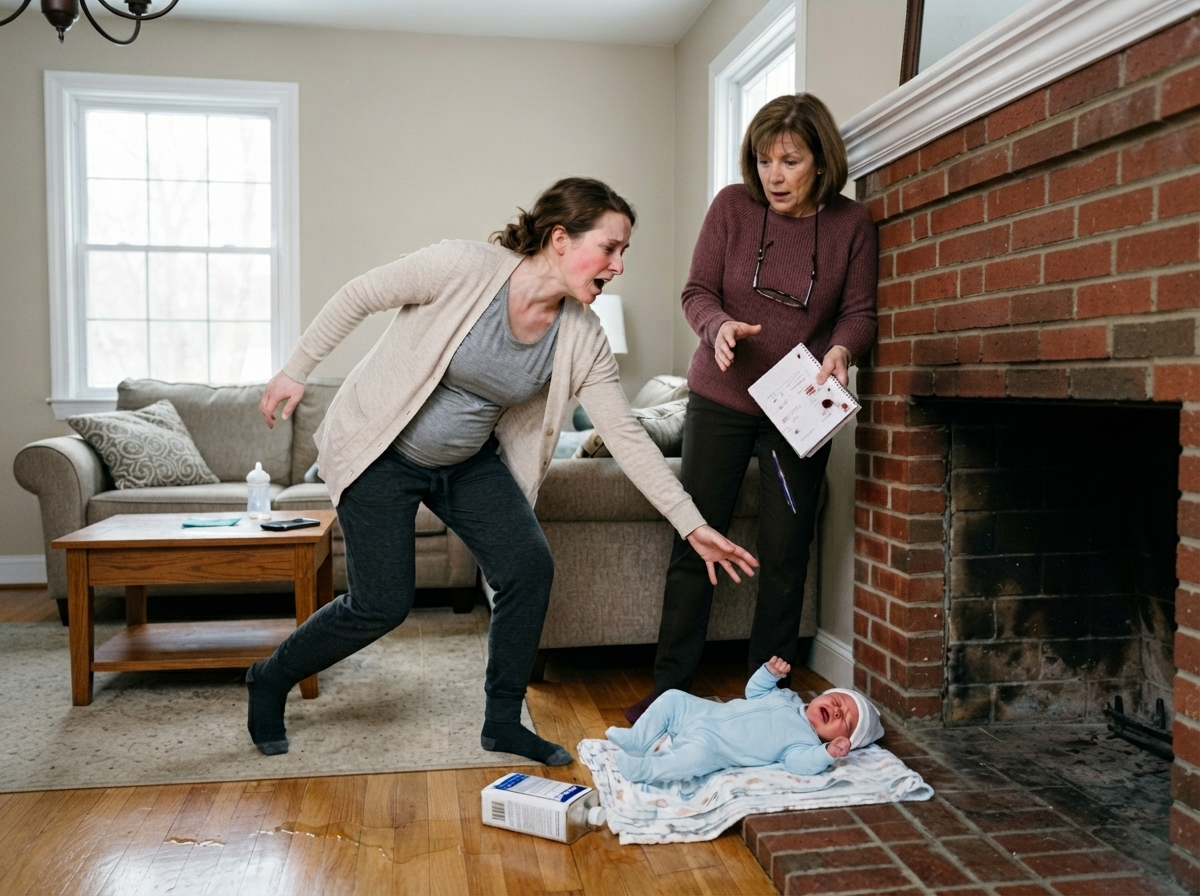
My Baby Began Crying Beside the Fireplace, but the Blood on the Letter in My Mother-In-Law’s Hand Made Me Forget Everything Else
Part 6 of 8

