
Jessi opened the envelope alone.
I waited outside the room.
She had asked for ten minutes.
It became twenty.
Then thirty.
When she finally emerged, she was holding several pages of handwritten notes.
Her eyes were red.
“What did he say?”
She sat down.
“He knew.”
I waited.
“He knew Hale would eventually come after him. He knew Arthur was involved. He knew the corridor would be worth millions.”
She unfolded the first page.
“But he didn't know whether they would come after me.”
“What else?”
“He wanted me to stay away from it.”
She gave a small, broken laugh.
“I obviously didn't listen.”
I sat beside her.
She handed me the letter.
Her father's handwriting filled several pages.
He explained that he had discovered the manipulated surveys while working on a county planning project. At first, he believed it was ordinary corruption.
Then he realized the land acquisitions were connected.
Hale had approached him with an offer.
Money.
A consulting position.
A promise that his family would be protected.
He refused.
After that, pressure began.
His work was questioned.
His reputation was attacked.
He was accused of mistakes he hadn't made.
Then came the night he realized someone had entered his office.
He understood that keeping evidence at home would put Jessi at risk.
So he divided it.
Some went to the retired surveyor.
Some went into the courthouse vault.
And some disappeared entirely.
The final pages explained the map.
The red line was not simply a transportation route.
It marked the original corridor.
The public route had been altered to conceal the acquisition plan.
The final circle marked the location of the proposed logistics facility.
The facility had eventually been moved.
That meant the land scheme should have become worthless.
But Hale had continued buying property.
Why?
Because he knew something the public didn't.
The facility was being reconsidered.
If he controlled the corridor, he could profit when the project was announced.
Jessi looked at me.
“He wasn't trying to make money from the land alone.”
“What was he doing?”
“He was controlling the negotiation.”
If the government needed the corridor, Hale could demand enormous prices.
The families had been pressured into selling cheaply.
The final owners would then face the opposite pressure.
They would be told they had no choice but to sell.
The entire scheme depended on secrecy.
Jessi's father had threatened that secrecy.
So had Jessi.
The attack against her was not random.
It was an attempt to end the investigation before she discovered the larger network.
By the time Hale went to trial, the evidence was overwhelming.
He was convicted on multiple federal charges.
The property scheme was dismantled.
The affected families received compensation.
Several properties were returned.
Others were sold under independent supervision.
The transportation project was redesigned without Hale's involvement.
The county established an independent land-records oversight office.
Arthur remained in prison.
Flynn remained in prison.
Marcus testified publicly about his role and accepted responsibility for the years he had spent obeying orders he knew were wrong.
He never asked Jessi to forgive him.
She never promised that she would.
But she did tell him one thing.
“Tell the truth for the rest of your life.”
He nodded.
And he did.
Months later, Jessi returned to her father's old survey office.
The building had been renovated.
She stood in the doorway for several minutes.
“Do you want me to come in?”
She shook her head.
“I need a minute.”
I waited outside.
When she emerged, she carried a small wooden box.
Inside were the final documents from her father's investigation.
She placed them in the trunk of our car.
Then she looked back at the building.
“I used to think the truth was something people either had or didn't have.”
She closed the trunk.
“What do you think now?”
“I think people can know the truth and still be afraid of it.”
She nodded.
“And I think silence can protect you for a while.”
She looked at the building again.
“But it can also leave the wrong people in control.”
That evening, we returned home.
The porch light was on.
The same porch where we had sat after the trials.
The same gravel path where she had first walked without a cane.
Nothing about the house had changed.
Yet everything felt different.
Jessi took off her shoes and stepped onto the porch.
She looked at me.
“You remember when I said I just wanted you to stay?”
“I remember.”
“You did.”
“I did.”
She smiled.
“I think that was the bravest thing either of us did.”
I sat beside her.
The sun was going down behind the trees.
For years, she had believed her father's death was an isolated tragedy.
Now she understood that he had spent his final years trying to keep a larger truth alive.
He had failed to protect himself.
But he had succeeded in protecting the evidence.
And eventually, that evidence had reached the person he had been trying hardest to protect.
Her.
She rested her head against my shoulder.
“Do you think he would have been proud?”
I looked at the road.
“Yes.”
“How do you know?”
“Because you didn't become him.”
She lifted her head.
“What does that mean?”
“Your father fought them by himself. You built a life where other people could fight together.”
She thought about that.
Then she smiled.
“I like that answer.”
The years that followed were quieter.
Not perfect.
Quiet.
Jessi continued helping families with property disputes.
I remained close to home.
We traveled when we could.
We argued about ordinary things.
We laughed about stupid things.
Sometimes she still woke from nightmares.
Sometimes I still checked the locks twice before going to bed.
Healing did not erase what happened.
It simply stopped the past from controlling every room we entered.
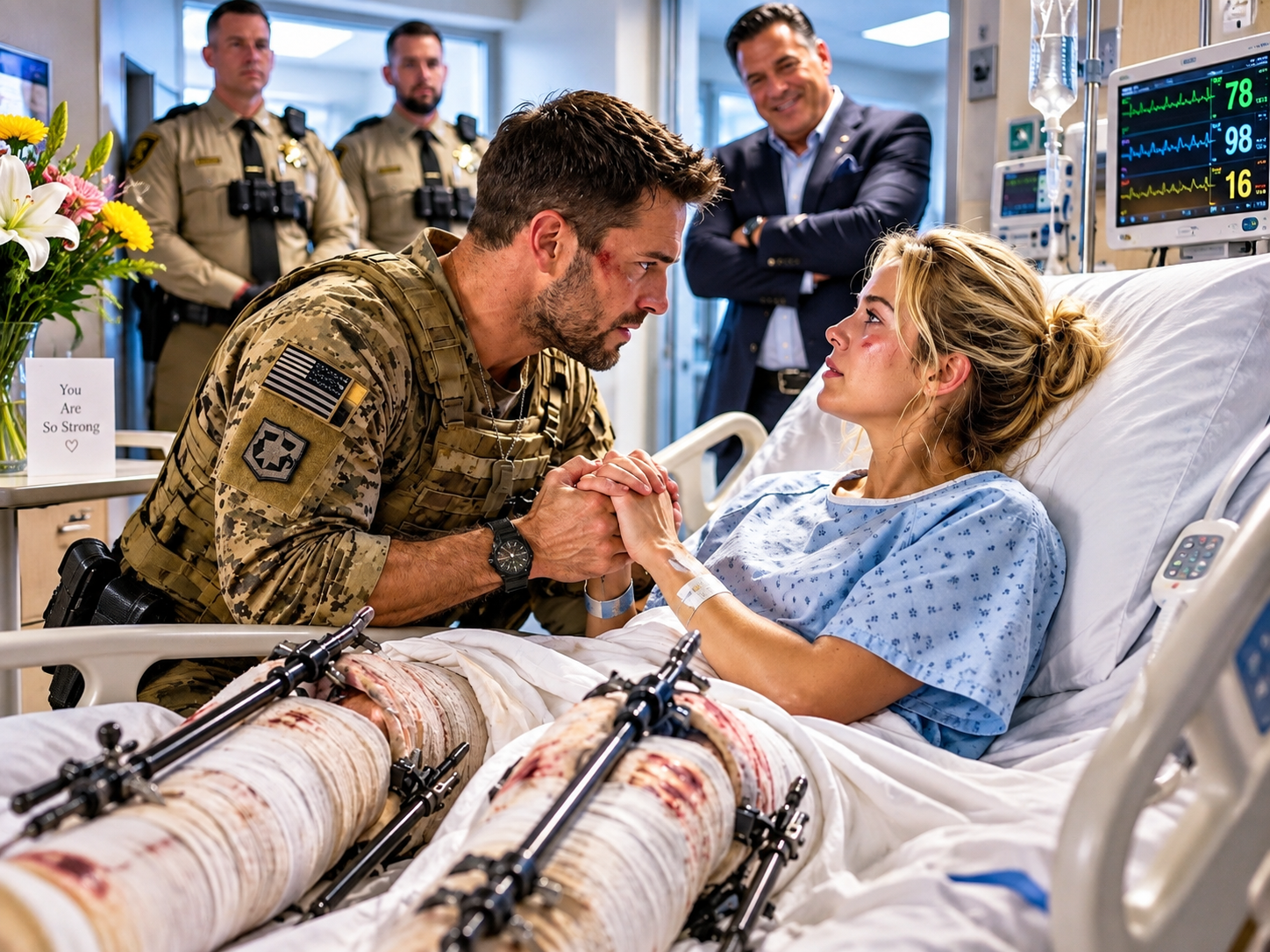
On the anniversary of the night she was attacked, we went back to the hospital.
The emergency entrance looked smaller than I remembered.
Jessi stood beside me.
“You know what I remember?”
“What?”
“The nurse telling me you were coming.”
I looked at her.
“You remembered that?”
“She said, ‘Your husband is on his way.’”
She smiled.
“I didn't believe her.”
“Why?”
“Because you were five thousand miles away.”
I laughed quietly.
“And yet?”
“And yet you came.”
We stood there for a while.
No cameras.
No reporters.
No courtroom.
No deputies.
No lawyers.
Just two people standing outside a hospital that had once represented the worst night of their lives.
Then Jessi took my hand.
We walked back toward the car.
The road ahead was ordinary.
That was what made it beautiful.
There was no dramatic ending waiting for us.
No final enemy.
No hidden threat.
Just the life we had fought to keep.
And for the first time, I understood what home really meant.
It wasn't the distance between one country and another.
It wasn't a house.
It wasn't a place where nothing bad could happen.
Home was the person who still reached for your hand after everything had happened.
The person who told the truth even when the truth hurt.
The person who stood beside you when the distance seemed impossible.
Five thousand miles had once separated us.
Fear had tried to make that distance permanent.
It hadn't succeeded.
Neither had the lies.
Neither had the men who believed money, badges, and influence could decide whose truth mattered.
In the end, the evidence survived.
The families survived.
Jessi survived.
And so did the life we had nearly lost.
When we reached the car, she squeezed my hand once.
“Ready?”
I looked at her.
“Always.”
She smiled.
We drove home together.
The End
Read more original stories on Feel Every Story.
The Call Came Across Five Thousand Miles of Static, and Before My Plane Landed, Someone Had Already Decided What Story I Was Supposed to Believe
Part 8 of 8

