
Maya came home eight months later.
She arrived with two suitcases, three boxes of books, and a serious expression that made me suspicious before she had even taken off her coat.
Sophie met her at the door.
“You look different.”
“So do you.”
“I got taller.”
“You got louder.”
“That isn't possible.”
Maya laughed.
Then she looked at me.
“You're going to hate this.”
“Excellent opening.”
She handed me a folder.
Inside were research notes from her fellowship.
Her work had examined what happened to students whose housing became unstable during secondary school.
The numbers were worse than either of us expected.
Students didn't simply lose homes.
They lost transportation.
Records.
Meals.
Sleep.
Access to technology.
School continuity.
And, most damaging of all, adults who remembered what they were capable of.
Maya had found a pattern.
Students were frequently removed from programs because institutions interpreted instability as lack of commitment.
“They're punished for consequences they didn't create,” she said.
I read the pages.
“What's the solution?”
“Not one solution.”
She sat down.
“That's the problem.”
The Claire Project had been working around the edges.
Maya wanted to change the system itself.
She had been invited to testify before a state education committee.
The invitation came with a warning.
Several institutions were unhappy with her findings.
“Are you worried?”
“Yes.”
“About what?”
“Being turned into the angry former scholarship kid.”
I frowned.
“You're not.”
“I know.”
“But people may want that story.”
She nodded.
“It's easier to dismiss someone if you turn their argument into a personal grudge.”
That was precisely what happened.
Within days, an editorial appeared accusing the Claire Project of undermining private schools.
Another suggested that scholarship students should simply meet higher standards.
Maya read both.
Then closed her laptop.
“I'm not responding.”
“Good.”
“Why?”
“Because they're trying to make you defend yourself instead of your evidence.”
She smiled.
“You really have learned something.”
“Don't sound so surprised.”
At the hearing, Maya spoke for eighteen minutes.
She didn't raise her voice.
She didn't mention Whitmore until someone asked directly.
Then she told the truth.
“My experience influenced my research.”
She paused.
“But the data doesn't depend on my experience.”
That sentence was quoted everywhere.
The hearing led to a proposal requiring schools receiving certain public funds to maintain scholarship continuity when students experienced documented housing disruption.
It wasn't revolutionary.
But it was practical.
And practical changes sometimes survive longer than dramatic ones.
Then something unexpected happened.
A former Whitmore administrator contacted Maya.
Her name was Elaine Mercer.
She had worked in the scholarship office during the years Maya attended.
She wanted to meet.
Maya asked me to come.
Elaine brought a file.
I recognized the format immediately.
“What's this?”
“An internal scholarship review.”
She looked frightened.
“I should have given it to you years ago.”
Maya opened the file.
Inside were notes about her scholarship.
One page stopped us.
The scholarship office had recommended continuing Maya's enrollment.
Another administrator had written that Maya's family circumstances created “reputational concerns.”
Maya's hand tightened around the paper.
“Who wrote this?”
Elaine hesitated.
“Dr. Whitmore approved it.”
“But why?”
“Because a donor family had complained.”
I looked at Maya.
“What donor family?”
Elaine gave us a name.
It was a prominent family.
Their daughter had been competing for the same academic scholarship.
They didn't want someone from an unstable home receiving recognition ahead of her.
Maya stared at the page.
“So it wasn't because I failed.”
“No.”
“They pushed me out because somebody didn't like where I came from.”
Elaine nodded.
“I was afraid to say it.”
Maya closed the folder.
For a long moment, she said nothing.
Then she asked the question I had been dreading.
“Why did Claire trust this school?”
I didn't have a satisfying answer.
Because Claire had believed people could make mistakes.
Because she believed institutions could change.
Because she hadn't imagined the extent of what was happening.
Or perhaps because she had seen something worth saving in the school despite its flaws.
Maya looked at me.
“Does that make her wrong?”
“No.”
“Does it make me wrong for building the project?”
“No.”
She looked toward the window.
“Then I think I know what to do.”
She didn't sue.
She didn't make the administrator's name public.
Instead, she asked Elaine to testify anonymously to the committee.
Then Maya requested that the new scholarship standards include independent oversight.
No single administrator should be able to end a child's scholarship without review.
The proposal passed.
Months later, Whitmore invited Maya back.
The school had changed leadership.
The new headmaster asked her to speak to the students.
She almost refused.
Then she accepted.
The auditorium was full.
Maya stood at the same podium where she had once been introduced as a scholarship success story.
She looked out at the students.
“I used to think this building was the place that rejected me.”
The room was silent.
“Then I thought it was the place Claire brought me.”
She paused.
“Now I think it was simply a place.”
Several students looked confused.
Maya smiled.
“Buildings don't decide who you become.”
She glanced toward the faculty.
“People do.”
Then she looked back at the students.
“And sometimes people make the wrong decision.”
The new headmaster stood at the side of the stage.
He did not interrupt.
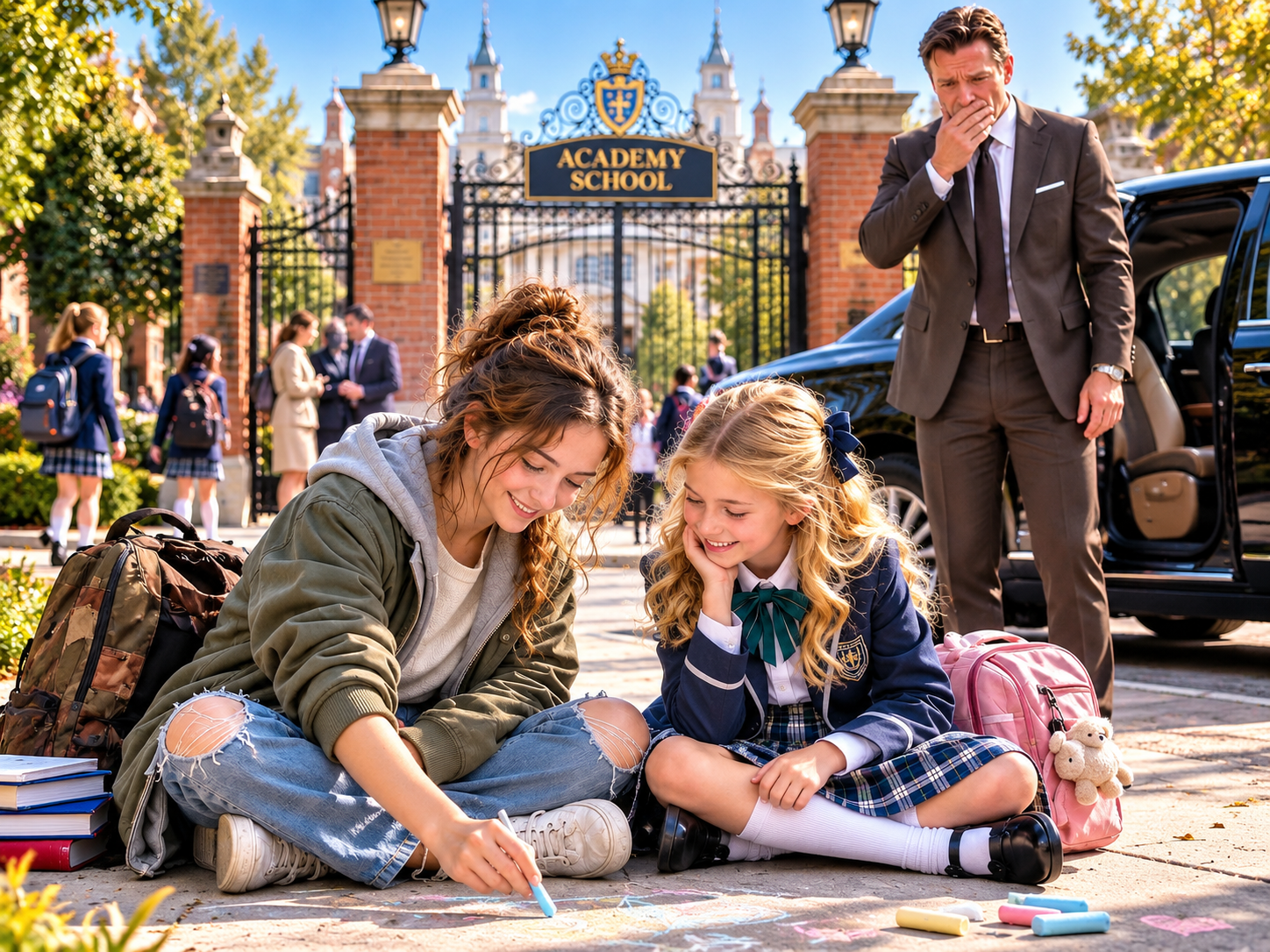
Maya finished by telling them about the sidewalk.
Not the version people had heard in newspapers.
The real version.
A girl sitting outside a gate.
Another child choosing to sit beside her.
An adult arriving early enough to notice.
“I used to think that was the important part,” Maya said.
“It isn't.”
“The important part is what happens after someone notices.”
The students listened.
“Does anyone open a door?”
“Does someone keep it open?”
“Does the person walking through that door eventually open another one?”
Maya looked toward the back row.
I was sitting there with Sophie.
She smiled at us.
Afterward, the headmaster asked whether the school could establish a permanent student support center in Claire's name.
Maya considered it.
“Only if students help design it.”
He agreed.
She shook his hand.
That evening, we walked through the old courtyard.
Maya stopped near the gate.
“This is where Sophie found me.”
“No.”
She looked at me.
“This is where you found me.”
I smiled.
“Sophie found you first.”
“That counts.”
We stood there.
The school looked smaller than I remembered.
Perhaps because Maya was no longer looking up at it.
“Do you ever wonder what would have happened if you hadn't arrived early?”
“All the time.”
“What do you think?”
“I think someone else would eventually have noticed.”
Maya shook her head.
“Maybe.”
Then she smiled.
“But I'm glad it was you.”
I wanted to say something profound.
Instead I said, “I'm glad too.”
She laughed.
“You've become sentimental.”
“Don't tell anyone.”
We walked toward the car.
At the curb, Maya stopped again.
“Daniel.”
“Yes?”
“I found something else.”
She reached into her bag.
A small envelope.
My name was written on it.
The handwriting was Claire's.
I stared at it.
Maya's voice became quiet.
“Elaine found it in the old scholarship records.”
I couldn't move.
“Why didn't she give it to me before?”
“She didn't know it existed.”
I took the envelope.
The paper was yellowed.
The seal had never been opened.
Claire had written:
For Daniel, if I don't get the chance.
I held it without opening it.
Maya touched my arm.
“You don't have to read it tonight.”
I looked at the envelope.
For two years, I had searched for Claire's words.
Now another message had found me.
I wasn't sure I was ready.
But I knew one thing.
I would open it.
Click Here to continue read next: PART7: Claire’s Unopened Letter Finally Revealed the Fear Behind Her Scholarship, and It Changed What Maya and I Believed About Her Last Years
I Came for My Daughter Twenty Minutes Early, Then Saw a Stranger Beside Her—and the Name Inside That Girl’s Backpack Stopped Me Cold
Part 6 of 8

