
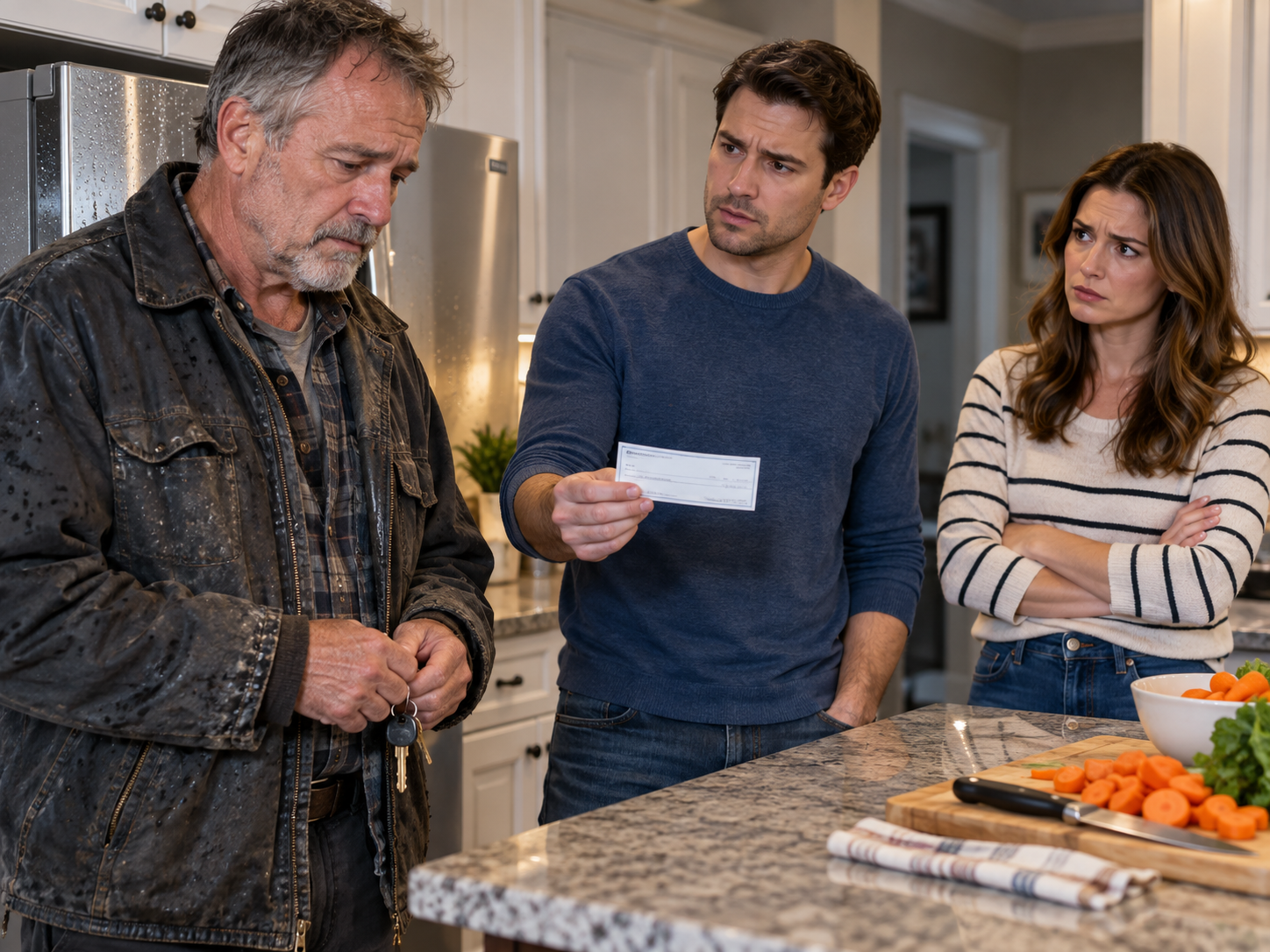
My father stood in our kitchen with rain darkening the shoulders of his work jacket, asking me for a thousand dollars. Arthur Hayes had spent his entire life doing the opposite of asking for help, which was why the request immediately felt wrong.
Dad could repair almost anything with a socket wrench, electrical tape, and enough stubbornness to outlast the problem. He had once driven home with a damaged radiator because, as he later explained, calling a tow truck would have been “an unnecessary conversation.” He had never been embarrassed by hard work, but he had always been embarrassed by needing anything from anyone.
So when he said, “Ethan, I need to borrow a thousand,” I stood with the refrigerator door half open and forgot why I had opened it.
“A thousand dollars?”
He nodded.
Across the island, my wife, Jessica, stopped cutting carrots. The knife remained suspended above the cutting board.
Dad looked tired. Not merely tired from work, either. His face had the drawn appearance of someone who had spent several nights sleeping badly and pretending otherwise.
Jessica set down the knife.
“What do you need it for?”
Dad rubbed the metal ring holding his truck keys. It was an old habit I had seen since childhood, something he did whenever he was choosing his words.
“Some records,” he said. “I need to speak with a lawyer. There’s also a test.”
“A test for what?”
His gaze shifted toward Jessica.
Only briefly.
But I saw it.
“So?” she asked.
Dad looked back at me. “Something personal.”
Jessica gave a short, humorless breath. “That explains almost nothing.”
“Jess,” I said quietly.
She turned toward me. “What? He’s asking us for a thousand dollars. We have bills too.”
Dad lowered his eyes.
That bothered me more than her tone.
My father had paid my first apartment deposit without being asked. When I was twenty-two and too proud to admit I was behind on the electric bill, he had somehow noticed and settled it before the power company sent a final notice. When Jessica and I bought our house, Dad had arrived with an envelope and refused to take it back.
He had never once asked me for repayment.
Now he was standing in my kitchen asking for money, and my wife was treating him like a stranger.
“I’ll give it to him,” I said.
Jessica looked at me.
“You don't even know what it’s for.”
“He needs it.”
“That’s not an answer.”
“It’s enough of one for me.”
Dad immediately shook his head. “Forget it.”
He reached for the chair where he had left his jacket.
“Dad.”
“I shouldn’t have asked.”
“You came here for a reason.”
Jessica folded her arms. “Arthur, nobody is saying you can’t ask. We’re saying we need to understand what we’re paying for.”
Dad looked at her.
Something passed across his face.
Not anger.
Something colder.
Suspicion.
Then it disappeared.
“I’ll find another way,” he said.
I followed him toward the door.
“Wait.”
He stopped.
I could see how thin his forearm had become beneath the work jacket. I hadn't noticed it before. Suddenly I noticed everything—the gray around his temples, the looseness of his collar, the slight hesitation before he bent to put on his boots.
“Come upstairs with me.”
Jessica followed before I could close the office door.
“Ethan, don't.”
I opened the drawer containing our checkbook.
“You're making this bigger than it is.”
“No. Your father is refusing to tell us why he needs the money.”
“He said records, legal advice, and a test.”
“That sounds suspicious.”
I pulled out a check.
Jessica stared at me.
“What if someone is taking advantage of him?”
“I've considered that.”
“What if he's gambling?”
I looked up sharply.
She knew how ridiculous the accusation sounded.
“My father doesn't gamble.”
“You don't know everything about him.”
The words stayed between us.
I wrote the amount.
Jessica watched the pen move.
“You always do this.”
“Do what?”
“You act like because he raised you, you owe him forever.”
I stopped writing.
Dad had raised me alone after my mother supposedly died when I was four.
That was the story I had grown up with.
My mother had died in a house fire.
Dad had never discussed it much. There were few photographs. Fewer memories. Whenever I asked questions, he would answer briefly and redirect the conversation.
I had learned not to press.
“He raised me,” I said.
“I know.”
“He gave up everything for me.”
“I know that too.”
“Then this isn't about debt.”
“What is it about?”
I looked at her.
“It's about being his son.”
Her expression softened for half a second, but she didn't move.
I finished the check.
When we returned downstairs, Dad was waiting near the door.
I handed it to him.
He looked at the amount, then at me.
“I'll pay this back.”
“No.”
“Ethan—”
“Keep it.”
His mouth tightened.
“I said borrow.”
“And I said you don't have to.”
For a moment he looked like the father I remembered from childhood, the man who could argue with a contractor for twenty minutes over three dollars.
Then the fight left him.
“Thank you.”
I stepped closer.
“What are you really doing?”
His eyes went to Jessica.
“Not here.”
“Then where?”
“When I know I'm right.”
“Right about what?”
His lips parted.
Jessica appeared behind me.
Dad changed direction immediately.
“Old adoption records,” he said.
I frowned.
We had never discussed adoption.
Not once.
Jessica noticed my expression.
“Adoption?”
Dad nodded.
“Some old family paperwork.”
I understood what he was doing.
He was giving us an answer that sounded harmless enough to end the conversation.
I played along.
“Okay.”
Dad put a hand on my shoulder.
“Give me three days.”
“For what?”
“I should know something by then.”
“What something?”
His fingers tightened.
He glanced toward Jessica again.
Then he left.
I followed him onto the porch.
Rain tapped against the railing. His truck sat at the curb with water shining across the hood.
“Dad.”
He turned.
“If you're in trouble, tell me.”
For several seconds he simply looked at me.
Then he said, “I'm trying to make sure you're not.”
He got into his truck.
The engine coughed before catching.
I stood under the porch roof and watched him disappear.
When I went back inside, Jessica was at the counter.
“Adoption records?”
“That’s what he said.”
“You believe him?”
“I don't know.”
She pushed the carrots into a bowl.
“Arthur has always been secretive.”
“He's private.”
“There's a difference.”
I leaned against the counter.
“Why were you so hard on him?”
She looked at me.
“I wasn't trying to be.”
“You embarrassed him.”
“He walked into our house asking for a thousand dollars without explaining anything.”
“He's my father.”
“And I'm your wife.”
“I know.”
“Do you?”
The knife came down against the cutting board.
I watched her carefully.
Eight years of marriage had taught me to recognize the small changes in her face. The crease between her eyebrows meant she was thinking. The way she pressed her tongue against her cheek meant she was holding something back.
She was doing that now.
“What?”
“Nothing.”
“Ask me.”
She hesitated.
“What kind of test?”
“I don't know.”
“Medical?”
“He said not exactly.”
She looked down.
“DNA?”
The word landed strangely.
“Why would you say DNA?”
“You mentioned adoption.”
“But Dad didn't mention DNA.”
She shrugged.
“Maybe I guessed.”
I couldn't explain why that bothered me.
Maybe it was because the word had arrived too quickly.
Maybe it was because Dad had looked at her before answering me.
Maybe it was because, for the first time in my life, I had the uncomfortable feeling that two people knew something about my past that I didn't.
That night I called Dad.
He didn't answer.
I called again the next morning.
Nothing.
Around lunchtime he sent a brief message.
Busy. Everything okay. Talk soon.
That was it.
Wednesday passed.
Then Thursday.
By Friday, I had nearly convinced myself I was imagining things. Dad was secretive. He always had been. Maybe he had found some old family documents and decided to chase a mystery that mattered only to him.
At 2:14 that afternoon, my phone rang.
The number was unfamiliar.
I nearly ignored it.
Instead, I answered.
“Ethan Hayes?”
“Yes.”
“My name is Linda Carver. I'm calling from St. Vincent Medical Center.”
I stood.
“Why?”
“Your father has been brought into the emergency department.”
The room seemed to change around me.
“What happened?”
“He collapsed earlier this afternoon.”
“Is he conscious?”
“He was when he arrived.”
Was.
That single word made my stomach drop.
“What happened to him?”
“He has an aortic aneurysm. The surgical team is preparing him now.”
I grabbed my keys.
“How serious is it?”
“I think you should come immediately.”
I was already moving.
Then Linda said, “There is something else.”
I stopped.
“What?”
“Your father gave us specific instructions.”
“What instructions?”
“He asked that we contact you directly.”
“Okay.”
“He also left an envelope.”
I tightened my grip on the phone.
“For me?”
“Yes.”
“What's in it?”
“He didn't tell us.”
“Then why are you calling me about it?”
“Because he was very specific about who could receive it.”
I pushed through the office doors.
“Me?”
“Yes.”
“Can my wife pick it up?”
There was a pause.
“No.”
“Why?”
“Your father specifically said that it was not to be released to Jessica.”
I stopped walking.
The sounds of the office continued around me. A printer hummed. Someone laughed near the reception desk. A car horn sounded outside.
None of it seemed connected to my life anymore.
“Did he say why?”
“No.”
“Who else knows about it?”
“There is an attorney here. Your father asked that you speak with her before opening the envelope.”
“An attorney?”
“Yes.”
I looked down at my phone.
Three days earlier, Dad had asked me for money to see a lawyer and obtain records.
Now he was in surgery.
An attorney was waiting for me.
And my wife had been specifically excluded.
Before I could say anything else, Linda added, “Mr. Hayes?”
“Yes?”
“Your father also told us something else.”
“What?”
“He said he was trying to protect you.”
The same sentence returned from the porch.
I'm trying to make sure you're not.
I drove to the hospital with both hands locked around the steering wheel.
Halfway there, Jessica sent me a message.
Call me when you can. I need to know whether your dad got what he was looking for.
I read it twice.
Then again.
She didn't know Dad was in the hospital.
I hadn't told her.
So why was she asking about what he had been looking for?
Click Here to continue read next: PART2: At the Hospital, My Father’s Lawyer Opened a Door Into the Childhood I Thought I Understood, and Nothing Beyond It Looked Familiar
The Thousand-Dollar Request That Should Have Been Ordinary Became the First Sign That Someone Was Hiding the Truth From Me
Part 1 of 8

