
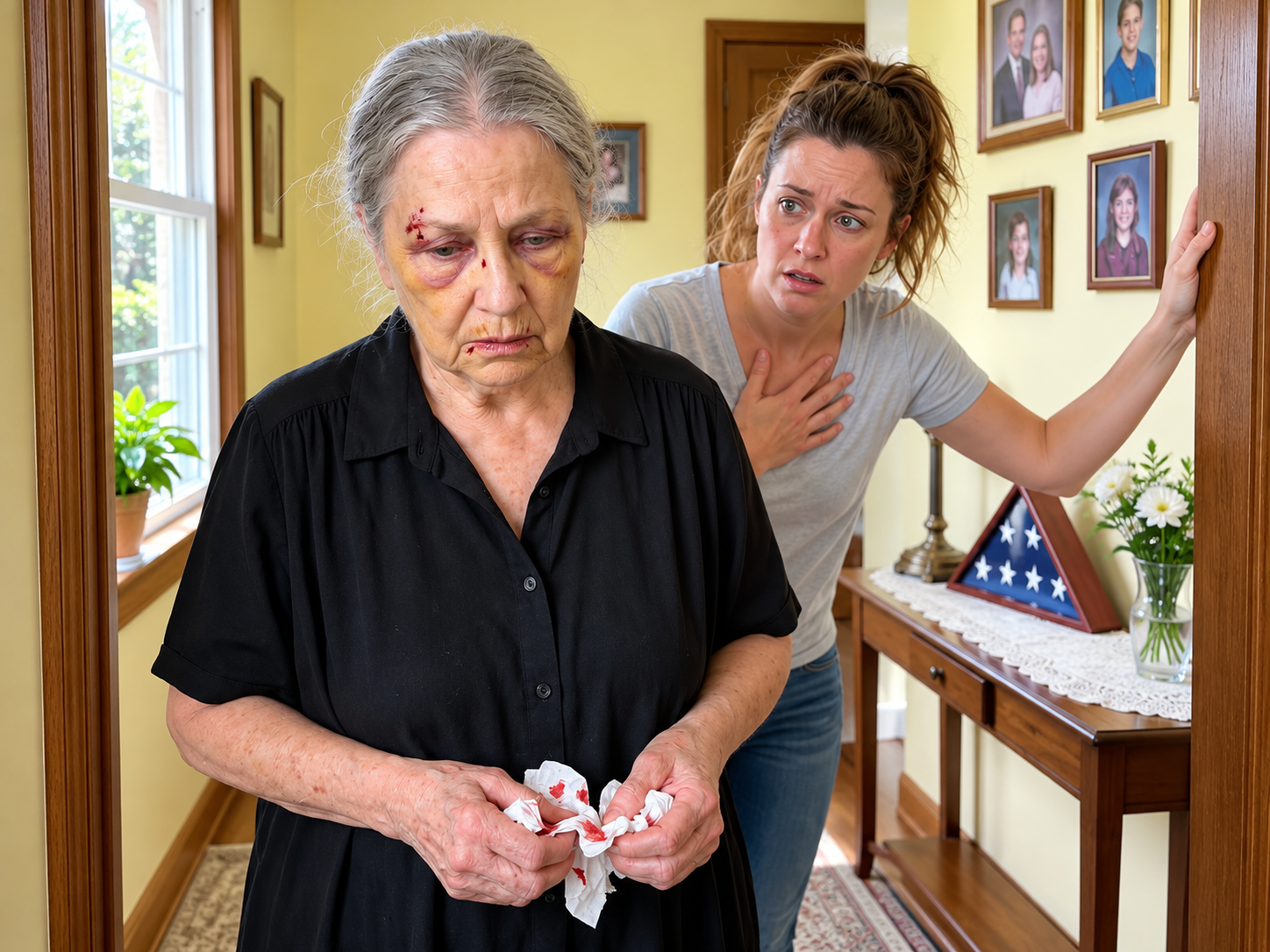
Melissa reached for the phone.
I stopped her.
“Wait.”
She looked at me.
“Why?”
“Because if he knows about the box, we need to know how.”
The man outside knocked again.
“Mrs. Eulalia, I am not here to hurt you.”
I almost laughed.
People who say that rarely make a person feel safer.
“Who are you?” I called.
“My name is Daniel Voss.”
Melissa's face went white.
I motioned for her to step away from the door.
Daniel spoke through the wood.
“I know Neftalí left you documents.”
“How?”
“He told me.”
That answer made no sense.
I looked at Melissa.
She whispered, “Don't open it.”
“I wasn't planning to.”
Daniel continued.
“You have been given only half the story.”
I said nothing.
“Your son believed I was stealing from him.”
“Were you?”
“No.”
“You were dismissed.”
“Yes.”
“Then why did he think you were moving money?”
“Because I was.”
My stomach tightened.
“Why?”
“To protect it.”
I glanced at Melissa.
Daniel continued.
“Someone else was taking money. I moved it before they could.”
“Why didn't you tell him?”
“I tried.”
“Then why did he accuse you?”
“Because the transfers appeared under my authority.”
“Did they?”
“No.”
“Then who made them?”
He didn't answer.
I asked again.
“Who?”
A long pause.
Then he said, “Someone close to him.”
Melissa stared at the door.
Her face was expressionless.
Daniel added, “Not your daughter-in-law.”
I looked at Melissa.
She exhaled.
I had suspected that possibility.
Now it was gone.
“Then who?”
“I need to speak to you inside.”
“No.”
“I can prove what I am saying.”
“How?”
“I have the original transaction records.”
I thought of the documents in the box.
Copies.
Not originals.
Daniel had said he knew about the box.
Perhaps he knew what was inside because Neftalí had told him.
I asked, “Why did you follow us?”
“I didn't.”
“You were at the cabin.”
“I came because someone else did.”
“What do you mean?”
Daniel lowered his voice.
“Two men came here yesterday.”
I remembered the vehicle.
“They watched the cabin.”
“Yes.”
“Who were they?”
“I don't know.”
“Then how do you know they were here?”
“Because I was watching them.”
I looked at Melissa.
The story was becoming too complicated to trust.
Then Daniel said, “Neftalí called me the night before he died.”
I froze.
“What did he say?”
“He said he was afraid.”
My hand went cold.
“What happened?”
“He told me someone had discovered the protected accounts.”
“And?”
“He said if anything happened to him, I was to make sure you received the documents.”
I looked at the metal box.
Daniel continued.
“I arrived too late.”
“Too late for what?”
“To stop the accident.”
The room seemed to tilt.
“You were there?”
“No.”
“Then how do you know?”
“Because I found his car.”
I stared at the door.
“Why didn't you tell the police?”
“Because when I arrived, someone else was already there.”
“Who?”
“I don't know.”
“Then how can you be sure?”
“Because that person took something from the car.”
My heart pounded.
“What?”
“A phone.”
Melissa whispered, “His phone.”
Daniel said, “Yes.”
I looked at her.
She nodded slowly.
“The police told me his phone was destroyed in the crash.”
Daniel answered.
“That was not true.”
The silence that followed was unbearable.
I unlocked the door.
Melissa grabbed my arm.
“Are you sure?”
“No.”
I opened it anyway.
Daniel stood beneath the porch light.
He was older than I expected.
Gray at the temples.
Dark coat.
A thin scar ran beside his left eyebrow.
He looked exhausted.
He raised both hands.
“I don't want trouble.”
“Come inside.”
He entered.
He placed a small envelope on the table.
“This belonged to Neftalí.”
I opened it.
Inside was a memory card.
My hands shook.
“What is this?”
“Copies of files from his phone.”
“Where did you get it?”
“From him.”
“Before he died?”
“Yes.”
I looked at Melissa.
Daniel said, “He gave it to me two days before the accident.”
“Why?”
“Because he knew someone was watching him.”
I placed the card on the table.
“What is on it?”
“Messages.”
“From whom?”
“Several people.”
“Daniel,” I said, “stop making me ask one question at a time.”
He nodded.
“You deserve the whole truth.”
He explained that Neftalí had discovered a scheme involving the development company trying to acquire the surrounding properties.
Someone inside Neftalí's business network had been secretly selling information about his holdings.
The unauthorized transfers were part of the scheme.
Daniel had tried to stop the losses by moving money into temporary accounts.
Neftalí initially thought Daniel was responsible.
Then he discovered the truth.
By then, the people behind the scheme knew about the house.
And they knew about me.
“Why me?” I asked.
“Because your right to remain in the house made the property harder to control.”
Melissa closed her eyes.
The pieces fit.
The pressure on her.
The papers she had been told to make me sign.
The urgency.
The insistence that the house belonged to her.
Someone had wanted me removed.
But Daniel had said the scheme went deeper.
“Who was behind it?”
He placed another photograph on the table.
It showed a man I recognized.
Not from the cabin.
Not from the attorney's office.
From the funeral.
I had seen him standing near the back of the cemetery.
A family friend of Neftalí's business partner.
I remembered him offering condolences.
My stomach turned.
“What did he do?”
“He had access to the property records.”
“Did he kill my son?”
Daniel looked at me.
“I don't know.”
“Don't lie to me.”
“I am not.”
He explained that the accident had never been conclusively linked to anyone.
There was evidence of tampering with the vehicle.
But not enough to identify who did it.
The police investigation had stalled.
The missing phone was the largest unanswered question.
The memory card might change that.
I looked at Melissa.
“What do we do?”
She answered before Daniel could.
“We go to the police.”
Daniel nodded.
“That is what I wanted.”
The next morning, we went together.
The detectives listened.
They examined the memory card.
They reviewed the documents.
They reopened the case.
The process was slow.
Painfully slow.
But this time there was evidence.
Phone records.
Financial transfers.
Messages.
Photographs.
And Neftalí's recorded statement.
Over the following weeks, investigators traced the financial activity.
The money had not gone to Melissa.
It had gone through a chain of shell companies connected to the development deal.
Daniel had indeed moved some money, but he had done so after warning Neftalí.
The unauthorized transfers were different.
Someone else had initiated them.
The man from the funeral was eventually questioned.
He denied everything.
Then investigators found messages on an old device.
The messages did not explicitly order anyone to kill Neftalí.
But they showed that he had been pressured to sell.
He had refused.
The day before the accident, someone had written:
If he won't move, remove the obstacle.
The meaning was obvious.
But proof of who physically tampered with the vehicle remained elusive.
Months later, a mechanic found the missing link.
A replacement part had been installed incorrectly.
The part had been purchased under a false name.
Security footage from a service garage showed the same man from the funeral entering the facility.
The case changed overnight.
An arrest followed.
Then another.
The development scheme began collapsing.
The four-million-dollar house was no longer under immediate threat.
Melissa and I were finally able to breathe.
But one thing remained.
Neftalí had known enough to be afraid.
He had tried to protect us.
And he had failed to save himself.
I returned to the cabin after the arrests.
The mountains were green again.
The herbs had grown wild.
I stood beside the altar.
The floorboard beneath it was new now.
But I had kept the three little marks.
Melissa came to the cabin a few days later.
She sat beside me.
“It's over,” she said.
“Almost.”
“What do you mean?”
I touched the photograph.
“We know what happened.”
She nodded.
“But we can't know whether Neftalí understood how much danger he was in.”
I looked at her.
“He knew enough.”
“Yes.”
“And not enough.”
She lowered her head.
“I keep thinking about the last day.”
“So do I.”
“I wish I had listened.”
I took her hand.
It was the first time I had done so willingly since the funeral.
“You cannot change the last day.”
She squeezed my fingers.
“No.”
“But you can decide what happens after it.”
She looked at me.
“What do you want?”
I smiled faintly.
“The same thing I wanted when I first came here.”
“What?”
“A quiet life.”
She nodded.
“I think I want one too.”
We sat together while the evening light moved across the floor.
The case would continue.
The lawyers would settle the remaining matters.
The house would remain valuable.
The money would be accounted for.
But those things no longer felt like the center of my life.
My son had spent too long believing he needed to protect everyone.
Perhaps the greatest way to honor him was to stop living as though every relationship had to be won or lost.
That night, Melissa stayed for dinner.
We talked about Neftalí as a child.
She told me stories I had never heard.
I told her stories she had never heard.
For several hours, we did not discuss money.
We did not discuss the house.
We did not discuss Daniel.
We simply remembered the same man from different parts of his life.
And when Melissa left, she paused at the door.
“Eulalia?”
“Yes?”
“I was wrong to tell you to go die in the mountains.”
I stared at her.
She swallowed.
“I am sorry.”
The words were small.
They did not erase anything.
But they were finally honest.
I closed the door after she left.
Then I returned to the altar.
My son's photograph was still there.
I touched the glass.
“We found the truth,” I whispered.
For a moment, the cabin was completely silent.
Then the wind moved through the trees.
And somewhere beneath the floor, the old boards creaked.
Click Here to continue read next: PART8: I Finally Understood Why Neftalí Built Me a Refuge, and the House He Left Behind Became the Last Test of What We Chose to Forgive
My Son Was Barely Buried When His Widow Claimed Everything, and the Way She Sent Me Away Made Me Fear She Had Planned It
Part 7 of 8

