
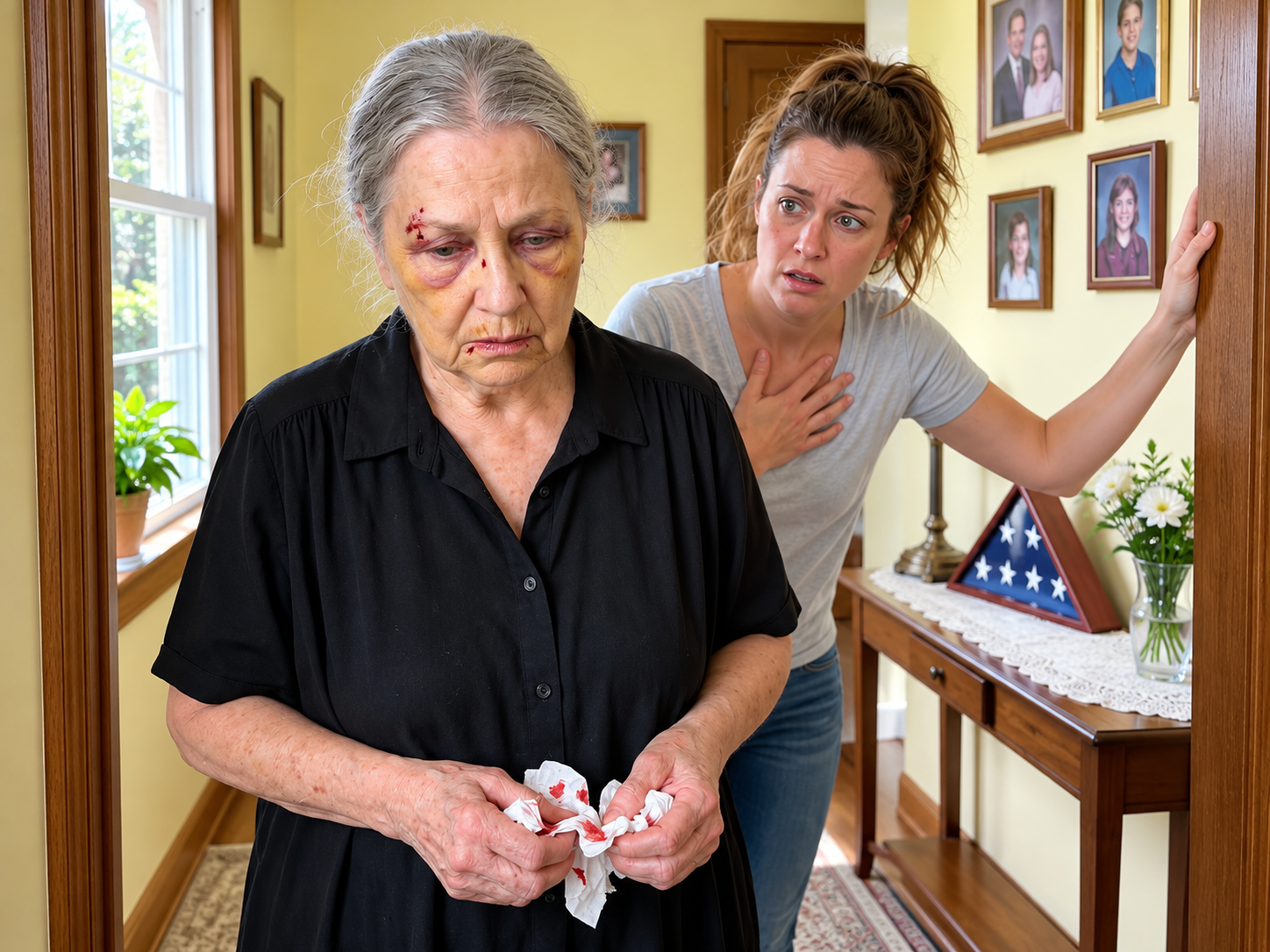
The first thing my daughter-in-law took from me was not the house. It was the certainty that I still belonged anywhere.
My son had been buried that morning.
The flowers at the cemetery were still fresh when I returned to the house, carrying the exhaustion of three sleepless nights in every step. My black shoes were damp from the wet grass, and a thin smear of cemetery mud marked the hem of my coat. I remember thinking only about getting upstairs, taking off the clothes I had worn to bury my only child, and sitting somewhere quiet.
Instead, Melissa was waiting for me in the kitchen.
She stood beside the long marble island with both hands resting against its edge. The house was unusually quiet. No television. No music. No clatter from the dishwasher. Even the old wall clock seemed louder than usual, its second hand ticking through the silence one beat at a time.
She looked perfectly composed.
Her hair was brushed smooth. Her face showed none of the exhaustion that had hollowed out mine. She had changed out of the black dress she wore at the funeral and put on a pale sweater and pressed trousers.
I stopped just inside the doorway.
“Where is everyone?” I asked.
“They left.”
Her voice was flat.
I nodded, thinking perhaps she meant the relatives.
Then she said, “You should pack your things.”
I thought I had misunderstood her.
“My things?”
“Yes.”
She pulled a sheet of paper from the counter and placed it between us.
I looked at it without touching it.
“What is this?”
“The house is mine now.”
My eyes moved slowly from the paper to her face.
“Neftalí has been dead for six hours.”
“I know.”
The answer was so cold that I felt something inside me go still.
For thirty years, that house had been part of my life. I had watched my son grow there. I had helped choose the curtains in the downstairs room. I had planted the lemon tree beside the kitchen window because he told me he wanted something living outside the glass.
It was not simply a building to me.
It was where my son had laughed as a boy.
Where he had learned to shave.
Where he had once fallen asleep at the kitchen table while pretending to finish his homework.
And now his widow was standing in that same kitchen telling me I needed to leave.
“I don't understand,” I said.
“You understand perfectly.”
“I just buried my son.”
“And I buried my husband.”
For the first time, something cracked in her expression.
Then it disappeared.
“I need the house to myself,” she continued. “This isn't going to work anymore.”
I stared at the paper.
There were legal terms on it, but my mind was too tired to make sense of them.
“Where am I supposed to go?”
She shrugged.
“You have the cabin.”
The word made me look up.
“What cabin?”
She sighed as though I were deliberately being difficult.
“The mountain property. Neftalí's old place.”
I remembered it then.
A small wooden cabin several hours from town, surrounded by forest and reached by a narrow road that became nearly impassable in winter. My son had mentioned it from time to time, usually saying he wanted to repair it someday.
I had never lived there.
“Neftalí never told me I was supposed to move there.”
“He doesn't have to tell you now.”
My fingers tightened around the paper.
“Melissa, I'm seventy years old. I have just lost my son. I can't simply drive into the mountains and live in some abandoned cabin.”
“You won't be living here.”
Her answer was immediate.
I looked toward the staircase.
“Let me stay for a few weeks. I'll find an apartment. I'll figure out what I'm going to do.”
“No.”
“Please.”
She looked at me with an expression I had seen before but never understood.
Not anger.
Not exactly.
Possession.
She was looking at the house as though she were afraid that if she let me remain another night, I might somehow reclaim something she believed was already hers.
“I said no.”
I swallowed.
“Neftalí wouldn't want this.”
Her eyes hardened.
“Don't use my husband against me.”
“I am not.”
“You always did.”
The words landed harder than I expected.
I had spent years trying not to stand between them. When they argued, I left the room. When Melissa complained that Neftalí spent too much time helping me, I told him to go home. When he wanted to buy me something, I told him I didn't need it.
I had believed silence was kindness.
Now I wondered whether my silence had only taught everyone that I could be pushed aside without protest.
Melissa turned toward the hallway.
“Two suitcases.”
“What?”
“Take two suitcases. Clothes, toiletries, whatever you need. The rest can be dealt with later.”
I looked at her.
“The rest?”
She nodded.
“You can't expect me to leave everything.”
“You're not leaving everything. You're leaving the house.”
She walked upstairs.
I remained in the kitchen alone.
For several minutes I could hear drawers opening and closing.
Then I heard my son's bedroom door.
That sound broke something in me.
I followed her upstairs.
“Don't go in there.”
She turned around.
“Why?”
“Because that room is Neftalí's.”
“He doesn't need it.”
“He's been dead for one day.”
“He's dead,” she said quietly. “And I have to live.”
I wanted to slap the wall.
Instead, I stood there with my hands shaking.
She opened his closet.
His shirts were still arranged the way he liked them, darker colors on one side, lighter shirts on the other. His winter coat hung behind the door. A pair of shoes sat beneath the dresser.
I reached for the coat.
Melissa caught my wrist.
“You don't need that.”
“It was his.”
“I know.”
I pulled my hand free.
“I want it.”
She stared at me for several seconds before letting go.
I took the coat and held it against my chest.
It smelled faintly of cedar and the soap he used.
For one terrible moment I could almost imagine he was going to walk through the doorway and ask why we were fighting.
Then I remembered the cemetery.
The closed coffin.
The priest's final words.
And the empty place where my son should have been.
I carried the coat downstairs.
Melissa followed.
She had already placed two empty suitcases beside the front door.
I stared at them.
“You prepared these before I came home.”
She didn't answer.
That was answer enough.
I packed slowly.
A few dresses.
Underclothes.
Medication.
A pair of shoes.
My son's coat.
The photograph from the mantel.
I reached for another photograph, one of Neftalí at sixteen, standing beside the lemon tree.
Melissa took it from my hand.
“That stays.”
I stared at her.
“Why?”
“It's part of the house.”
“It is my son.”
“It is a photograph.”
I felt the first sharp edge of anger break through my grief.
“You can have the walls,” I said. “You can have the furniture. You can have the silverware and the curtains and every room in this house. But you do not get to decide whether I am allowed to remember my own child.”
Her face tightened.
“Take the first photograph.”
I did.
Then she opened the front door.
Cold air entered the hallway.
I stood there with two suitcases and my son's coat.
She looked past me toward the driveway.
“The cabin is unlocked.”
“Does it have heat?”
“It has a fireplace.”
“Electricity?”
She hesitated.
“Sometimes.”
“Water?”
“There is a well.”
“Is it working?”
Another pause.
“I don't know.”
I stared at her.
“You're sending me somewhere you haven't even checked.”
She folded her arms.
“You'll manage.”
I wanted to tell her that she was cruel.
Instead, I said, “Why are you doing this today?”
Her answer was barely audible.
“Because if I don't do it now, I never will.”
That sentence stayed with me long after the car disappeared down the road.
The mountain road was already dark by the time I reached the cabin.
Rain had begun falling.
The windshield wipers struggled against it, squeaking across the glass while the headlights caught wet branches and empty stretches of road.
I had been driving for nearly three hours.
The cabin appeared suddenly between the trees.
It looked smaller than I remembered.
There was no porch light.
No light in the windows.
No smoke from the chimney.
I parked beside the house and sat behind the wheel for several minutes.
My hands were stiff around the steering wheel.
I could have turned around.
I could have driven back to town and checked into a hotel.
I could have called a lawyer.
I could have called anyone.
But I had no lawyer.
No plan.
No strength.
And no idea how much of the house was actually mine.
I carried the suitcases inside.
The front door groaned as I pushed it open.
The smell of damp wood filled the room.
There was an old chair beside the fireplace, one window with a cracked pane, and a narrow table covered in dust.
A small altar stood against the far wall.
I recognized it immediately.
It belonged to Neftalí.
He had made it himself when he was younger.
I had seen it once in our old house, years ago.
He had moved it here without telling me.
There was a framed photograph on it.
My son.
I walked toward it.
“Why didn't you tell me?”
The room gave no answer.
I touched the frame.
Dust covered the glass.
Then thunder rolled through the mountains.
The cabin seemed to shudder.
I lit the fireplace with trembling hands and sat beside it until the flames grew strong enough to warm the room.
For the first time that day, I cried.
Not at the cemetery.
Not in front of relatives.
Not when Melissa told me to leave.
I cried there, alone in a damp cabin my son had apparently prepared for some future I had never known about.
And underneath the grief was another feeling.
Something I couldn't name.
A suspicion.
Melissa had sent me away too quickly.
She had known exactly where to send me.
She had packed the suitcases before I arrived.
She had removed me from the house before anyone had even discussed the estate.
Why?
I looked at Neftalí's photograph again.
There was something about the cabin that bothered me.
Not the broken windows.
Not the lack of electricity.
Not even the cold.
It was the altar.
My son had personally brought it here.
And he had placed it against a section of floor that looked strangely newer than the boards around it.
I dismissed the thought.
I was exhausted.
Grief made patterns out of nothing.
I pulled Neftalí's coat around my shoulders and lay down on the old sofa.
Outside, the rain continued.
Inside, the fire cracked.
And beneath the cabin floor, something waited in the darkness.
I just didn't know it yet.
Click Here to continue read next: PART2: The Cabin Had Been Left to Rot, Yet My Son Had Placed One Precious Object Above a Floorboard That Did Not Belong There
My Son Was Barely Buried When His Widow Claimed Everything, and the Way She Sent Me Away Made Me Fear She Had Planned It
Part 1 of 8

