
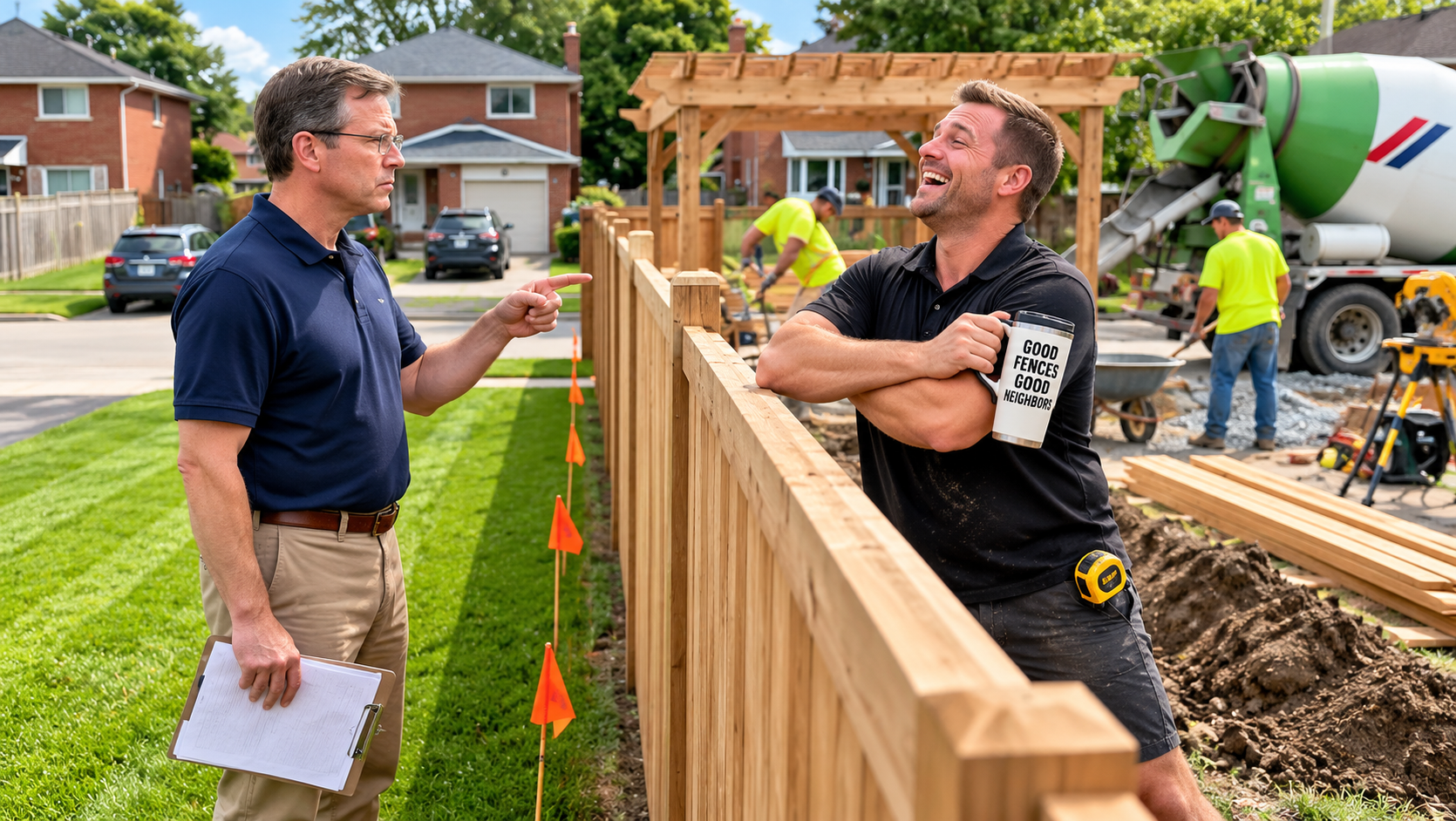
Years later, the neighborhood association announced plans to replace several old drainage easements.
Jason attended the meeting because his property was listed on the map.
The map was large.
It covered several blocks.
An engineer pointed out existing utility corridors, drainage routes, and historical access paths.
Jason recognized one of the old references.
It was the same subdivision document Carl had found years earlier.
After the meeting, Jason stayed behind.
The engineer noticed his interest.
"You've seen this before?"
"Yes."
Jason explained the old boundary dispute.
The engineer smiled.
"Then you might find this interesting."
He showed Jason an older survey drawing.
A handwritten notation appeared near the rear boundary.
It indicated that the strip had once been reserved as part of a drainage corridor during the neighborhood's original development.
Jason stared at it.
"Does this change anything?"
"No."
The engineer pointed to the current records.
"The easement was later abandoned."
Jason looked closer.
The abandonment date was decades earlier.
Long before he purchased the property.
Long before Tyler moved in.
Long before the fence.
"Then why is it still on this map?"
"Historical reference."
Jason thanked him.
He took a photograph.
That evening, he called Carl.
Carl sounded amused.
"You're still finding old documents."
"I apparently have a talent for it."
Carl laughed.
Jason sent the photograph.
Carl called back.
"This explains the strange wording in that old filing."
"How?"
"The original subdivision plan had several temporary reservations. Your strip was one of them."
"Temporary?"
"Yes."
"Then Tyler's argument about the old boundary was even weaker."
"Much weaker."
Jason sat quietly.
A final piece had fallen into place.
The old document had not merely been ambiguous.
It had been describing a temporary arrangement that no longer existed.
The current property boundary had been established later.
Tyler had apparently found an old reference without understanding what it meant.
Or perhaps he had understood enough to know it could be useful.
Either way, it explained why he had focused on historical use.
He had needed something to support the story he wanted to tell.
Jason put the photograph in his records.
He did not send it to Tyler.
There was no point.
The dispute had been resolved.
The discovery was valuable because it explained the past, not because it could reopen it.
That distinction became increasingly important to him.
People sometimes imagine closure as forgetting.
Jason had learned that closure was different.
It was remembering accurately without needing the past to change.
He remembered the morning he first saw the fence.
He remembered the tape measure.
Carl's orange flags.
Tyler's dismissive smile.
The contractor note.
The courtroom.
The garden.
Each detail remained.
None controlled him anymore.
That summer, the blueberry harvest was unusually large.
Jason filled several bowls.
Emma came home with her husband.
She looked at the bushes and laughed.
"You finally grew the garden I remember."
"Your grandfather's?"
She nodded.
"Exactly."
They spent the afternoon picking berries.
Her husband tried one.
"These are good."
"Don't encourage her," Jason said.
Emma laughed.
They sat beneath the maple afterward.
Jason told them about the old drainage document.
Emma listened.
"So the land had another history before all of this."
"Apparently."
"That's interesting."
"It is."
She looked around.
"Maybe that's why you kept finding things."
Jason smiled.
"Or maybe I was just unlucky."
"No."
She shook her head.
"You paid attention."
That stayed with him.
Paying attention had saved the property.
The first time, it had been noticing that the fence looked wrong.
Later, it had been noticing the paperwork.
Then the contractor note.
Then the old county records.
At every stage, the important thing was not confrontation.
It was attention.
He had learned to look closely before reacting.
That habit spread into other parts of his life.
He checked contracts.
Asked questions.
Read documents.
Stopped assuming that confidence meant correctness.
And, perhaps most importantly, he learned that peaceful people could still be firm.
The lesson did not make him suspicious.
It made him precise.
The following winter, Ben and Laura decided to sell their house.
They came over before listing it.
"We wanted to tell you first," Laura said.
Jason wished them well.
Ben smiled.
"The new buyers asked about the fence."
Jason laughed.
"Of course they did."
"I showed them the survey."
"Good."
"They're happy with it."
"Excellent."
Ben looked toward the garden.
"They also love the maple."
"Tell them they have to take care of it."
"I will."
When the new owners arrived, Jason repeated the same advice he had given Ben.
Check the boundary.
Check the setbacks.
Talk before building.
The new owners listened.
No drama followed.
The house changed hands.
The garden remained.
One afternoon, Jason found himself standing beside the fence thinking about how many people had lived around that line.
The original owners.
Tyler and Ashley.
Ben and Laura.
The new family.
Each had seen the same piece of land differently.
But the boundary had never moved.
That seemed almost philosophical.
Human beings changed.
Records changed.
Houses changed.
Landscaping changed.
But a legal line could remain exactly where it had been placed.
The line did not care who was angry.
It did not care who had more money.
It did not care who sounded more certain.
It simply existed.
Jason thought of Tyler.
For the first time, he felt something close to pity.
Not because Tyler had lost.
Because Tyler had spent so much effort trying to make a permanent thing yield to a temporary desire.
The larger yard had not made him happier.
The pool had not solved anything.
The dispute had cost him money.
It had damaged his marriage for a time.
It had forced him to sell a house carrying an uncomfortable history.
All for eight feet.
Jason looked at the garden.
The same eight feet now produced blueberries, flowers, shade, and memories.
The difference was not the land.
It was what someone chose to do with it.
He remembered Emma's old bowl.
Her purple fingers.
His father's patient smile.
The memories had been waiting for a place to return.
The disputed strip had become that place.
Years after the original conflict, Jason received one final message from Tyler.
It was an email.
Short.
No excuses.
No request.
No argument.
Tyler wrote that he had recently passed through the neighborhood.
He had seen the maple.
He wanted to say that the garden looked better than the yard he had once planned.
Jason read the message.
At the bottom was one sentence.
I should have left those eight feet alone.
Jason did not answer immediately.
He walked outside.
The maple was taller now.
Its branches stretched toward the evening sky.
The fence stood quietly behind it.
He returned to the house.
Then he wrote a short reply.
Thank you for saying that. I hope you're doing well.
He sent it.
That was all.
There was nothing else to settle.
Nothing else to prove.
The last unanswered question had finally been answered.
Tyler knew.
Jason knew.
The records knew.
And the garden stood where the fence had once tried to tell a different story.
Click Here to continue read next: PART8: When Jason Finally Looked Back Without Anger, He Understood Why Defending Those Eight Feet Had Changed Much More Than His Yard
The New Fence Looked Perfect From His Side, Until One Small Measurement Changed Everything I Thought I Knew
Part 7 of 8

