
The first Christmas after the court case was different.
Not because Chloe was absent.
She had been absent before.
It was different because nobody waited for her.
There was no extra place setting.
No discussion about whether she might call.
No speculation about whether she would send presents.
No younger daughter asking whether Mom remembered the date.
The family had finally stopped arranging itself around an empty space.
We decorated Jessi's house together.
The tree leaned slightly to one side.
Nobody cared.
Fiona hung lights too low.
Clara complained.
Lily moved them higher.
Someone broke an ornament.
Everyone blamed someone else.
I stood in the doorway holding a box of decorations.
Jessi walked past me.
“You're in the way.”
“This is my house?”
“No.”
“Then I can stand wherever I want.”
She laughed.
The younger girls threw a cushion at me.
It hit my shoulder.
I threw it back.
For several minutes, the living room became chaos.
It felt wonderful.
Later that evening, we ate dinner.
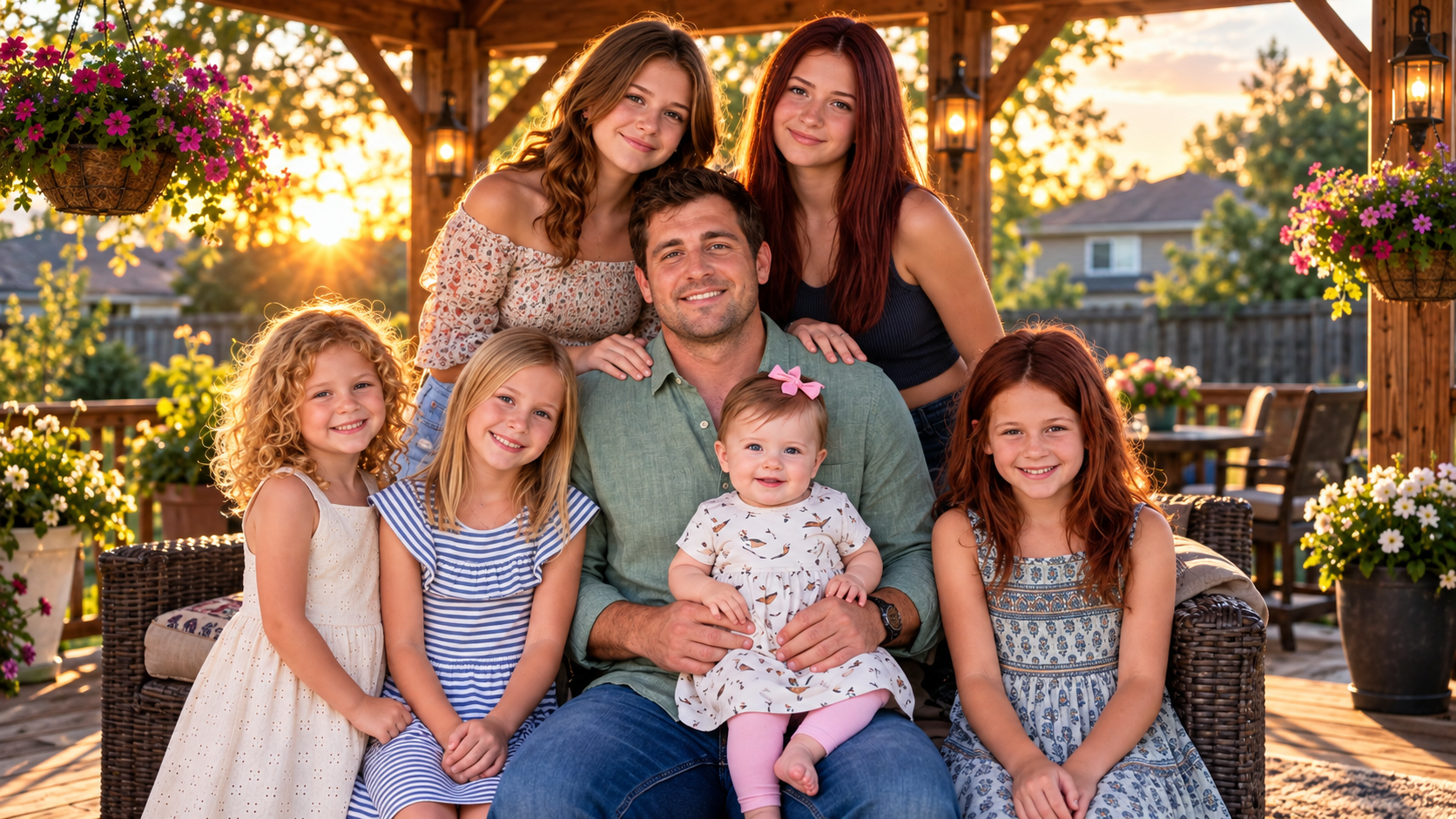
Six daughters.
Their husbands and partners.
A few grandchildren.
Too many chairs.
Too much food.
Not enough quiet.
I looked around the table.
The family had grown.
The little girls Chloe had left behind were now mothers, wives, professionals, entrepreneurs, and women with responsibilities of their own.
And somehow, they had carried kindness forward.
That mattered more to me than anything else.
After dinner, Jessi stood.
“I want to say something.”
Everyone quieted.
She looked at me.
“Dad, when Mom left, I thought something was wrong with us.”
The room became still.
“I thought maybe we weren't enough.”
She swallowed.
“I spent years wondering why she chose another family.”
Her sisters listened.
“Then I realized she didn't choose a better family.”
Jessi looked around the table.
“She chose a different life.”
She paused.
“And we chose ours.”
Nobody spoke.
“I used to think our story was about what Mom did.”
She smiled.
“Now I think it's about what Dad did next.”
My throat tightened.
Jessi continued.
“He didn't make us hate her.”
She looked toward her sisters.
“He didn't tell us we had to forgive her.”
Then she looked at me.
“He just stayed.”
Fiona wiped her eyes.
“Don't make me cry.”
“You're already crying.”
“Indoor allergies.”
Everyone laughed.
The speech ended without applause.
Instead, the sisters began hugging one another.
I stayed seated.
I had never liked being the center of attention.
But that night, I allowed myself to receive it.
Not because I believed I had been perfect.
I hadn't.
There were moments when I had been exhausted and impatient.
There were mornings when I had forgotten things.
There were nights when I had wondered whether I could keep going.
There had been mistakes.
Plenty of them.
But I had stayed.
That was what mattered.
After Christmas, Chloe wrote again.
She had found work.
Not glamorous work.
A regular office position.
She rented a small apartment.
She was paying the remaining judgment through wage deductions.
She did not complain about it.
Instead, she wrote that working again had changed her.
She had to wake early.
She had to budget.
She had to take public transportation.
She had to say no to things she once considered necessities.
For the first time in years, she was living without someone else absorbing the consequences of her choices.
Jessi read the letter.
“She sounds different.”
“Different how?”
“Less angry.”
“That may be a good thing.”
“She asks whether she can send birthday cards.”
“What do you think?”
Jessi considered it.
“I think the cards can come.”
“Will you read them?”
“Maybe.”
That became their arrangement.
Chloe could write.
The daughters could decide whether to respond.
No forced reconciliation.
No staged family photographs.
No pretending fifteen years had not happened.
Just small opportunities.
One card.
One letter.
One honest conversation at a time.
The following summer, Fiona became engaged.
She asked me to help choose the venue.
We visited several places.
At one, she looked around the ballroom and laughed.
“Too fancy.”
“Why?”
“Because Mom would approve.”
I looked at her.
She smiled.
“Sorry.”
“You don't have to apologize.”
“I know.”
She touched my arm.
“I just don't want anything about my wedding to be about her.”
“It won't be.”
And it wasn't.
Fiona chose a simple outdoor ceremony.
The reception was held under a tent.
There were fewer than one hundred guests.
No spectacle.
No performance.
Just people who genuinely belonged there.
Before the ceremony, Fiona found me alone.
“You nervous?”
“A little.”
“Why?”
“Because I'm your father.”
She laughed.
“I'm the one getting married.”
“I know.”
She adjusted her dress.
Then she said, “Do you think Mom should come?”
I waited.
This was her decision.
Not mine.
“What do you want?”
“I don't know.”
“Then don't decide today.”
She nodded.
“I think I want her to know about it.”
“That can happen without her attending.”
She smiled.
“You always do that.”
“Do what?”
“Give us room to choose.”
I looked at her.
“You deserve that.”
She hugged me.
Chloe did not attend.
Fiona sent her a photograph afterward.
That was enough.
Over the next few years, the family changed again.
The daughters moved.
Careers advanced.
Children were born.
Homes were bought.
There were arguments and reconciliations.
There were ordinary family problems that had nothing to do with Chloe.
That was perhaps the clearest sign that the wound was healing.
Their lives were becoming bigger than the event that had once defined them.
One evening, Jessi called me.
“Dad, Mom asked me something.”
“What?”
“She wants to know whether you hate her.”
I was silent.
Then I answered.
“No.”
Jessi seemed surprised.
“Really?”
“I don't hate her.”
“Do you forgive her?”
“That isn't the same question.”
She understood.
“I don't know what to tell her.”
“Tell her I don't hate her.”
She waited.
“Anything else?”
“Yes.”
“What?”
“Tell her I hope she's okay.”
Jessi was quiet.
Then she said, “I think she'll appreciate that.”
“Maybe.”
The conversation ended.
I thought about Chloe for a while.
There had been a time when her name could ruin my entire day.
Now it was simply a name.
That was freedom too.
Not forgetting.
Not pretending.
Just no longer being controlled by the memory.
Years earlier, she had believed I was poor because I could not buy her the life she wanted.
She had measured everything in cars, vacations, clothes, houses, and social status.
I had measured everything differently.
Could my daughters trust me?
Did they feel safe?
Did they know they were loved?
Would they call me when something went wrong?
Would they come home when they were happy?
Those were the things that mattered.
One afternoon, Jessi visited me with her children.
They ran through the house.
The same hallway where six little girls had once raced to the kitchen.
The same kitchen where I had burned pancakes.
The same porch where I had once stood wondering whether our family would survive.
Jessi watched her children playing.
“Do you ever think about how different this house sounds now?”
“Yes.”
“What do you think?”
I smiled.
“I think it sounds alive.”
She leaned against the doorway.
“Mom once told me Dad ruined her life.”
I looked at her.
“What did you tell her?”
“That she had been wrong.”
“Why?”
“Because you didn't ruin her life.”
Jessi looked toward the children.
“She made her own choice.”
I nodded.
“And so did we.”
There it was again.
Choice.
For fifteen years, Chloe's choice had shaped everything.
But eventually, my daughters made choices of their own.
They chose education.
Work.
Love.
Family.
Forgiveness when they wanted it.
Distance when they needed it.
And none of those choices required my permission.
That was the greatest thing I could have given them.
Not money.
Not a perfect childhood.
Not protection from every hurt.
The ability to stand on their own.
The ability to decide who belonged in their lives.
The ability to walk away from people who harmed them without becoming cruel themselves.
That evening, after Jessi left, I sat alone on the porch.
The sun went down slowly.
I remembered the night Chloe left.
The suitcases.
The baby.
Her final words.
For years, I had imagined that night as the moment my life broke.
Now I saw it differently.
It was the night my life changed.
The difference mattered.
A broken life ends.
A changed life continues.
Mine had continued.
And it had brought me here.
Click Here to continue read next: PART8: Fifteen Years Later, the Family She Left Behind Had Become Something She Could Finally See Clearly, Even If She Could Never Reclaim It
Fifteen Years After Walking Away, She Returned Smiling—and My Daughter Quietly Decided to Give Her the Welcome She Had Earned
Part 7 of 8

