
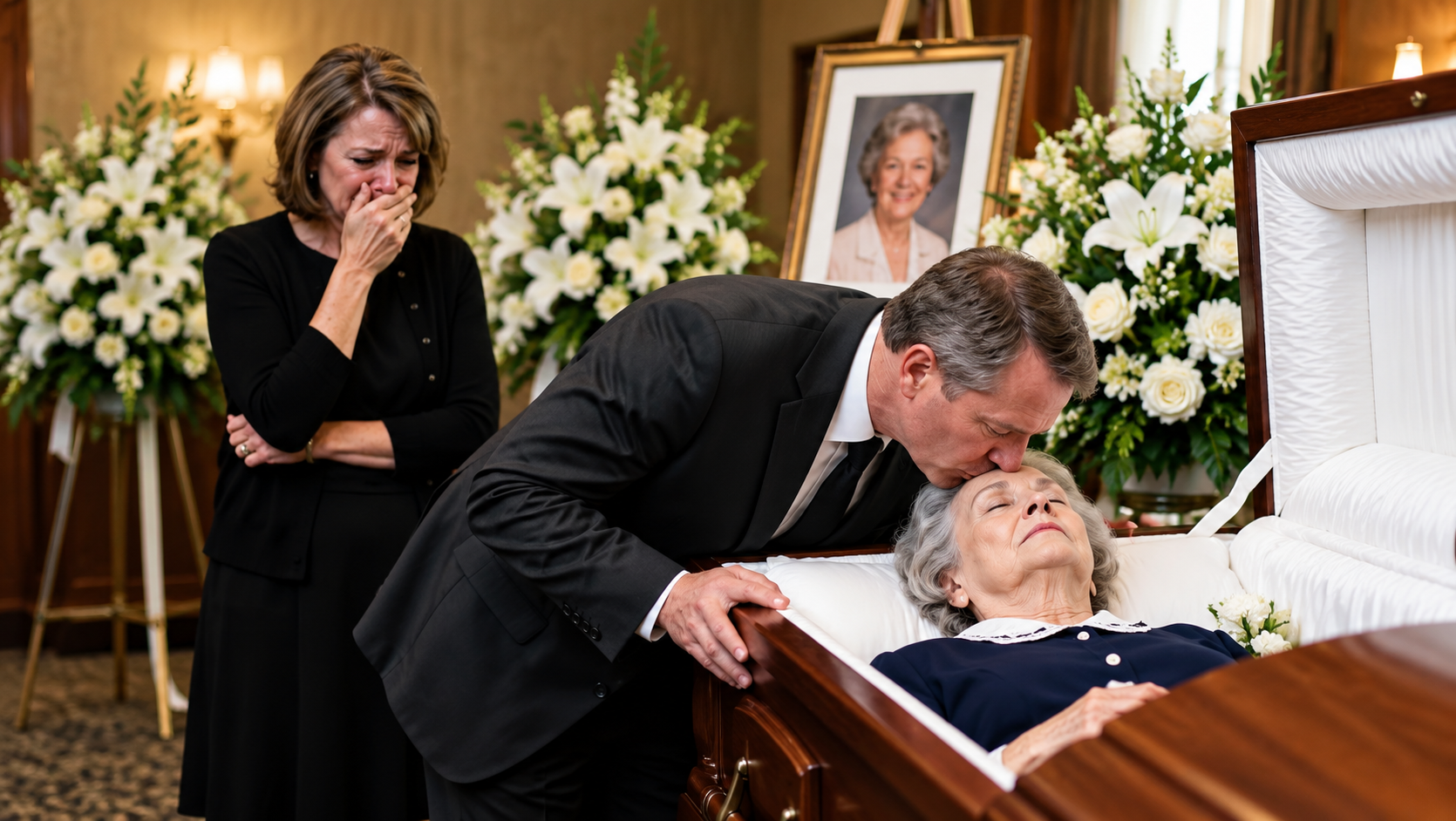
My husband disappeared during my mother’s funeral, and when I found him, he was standing alone beside her coffin, speaking to a woman who could no longer answer him. I stopped outside the half-open door before he noticed me. His voice was low, almost conversational, but the words were unmistakable. “I kept it, Margaret. All these years.” He paused, then added something that made my stomach tighten. “Nobody found out. It’s still under the red maple.” I stood frozen in the hallway, listening to the man I had married twenty-seven years earlier talk about a secret I had never known existed.
My name is Sarah, and until that afternoon I had believed I understood the strange relationship between my husband and my mother. They did not like each other. That was the simple explanation I had carried for most of my adult life. Joe considered my mother controlling and judgmental. My mother thought Joe was too confident, too careless with his words, and not nearly as dependable as I believed him to be. They were never openly cruel in front of me, but the air changed whenever they occupied the same room. I had learned to notice it and then pretend I hadn't.
My mother, Margaret Hollis, had always been a woman who preferred things that could be maintained. She liked clean counters, balanced accounts, sharpened garden tools, and promises that were kept exactly as spoken. After my father died of a heart attack when I was twelve, she raised me alone while building a financial consulting business from almost nothing. She never remarried. Instead, she poured her energy into work, the house on Birchwood Lane, and the garden behind it. She believed that neglected things eventually became difficult things.
The garden was her pride, although she would never have called it that. Roses lined the southern fence. Tomatoes crowded the vegetable beds every summer. Old perennials appeared each spring as reliably as if they had signed contracts with her. But the tree she cared about most was a red maple near the rear of the property. It had been planted twenty-seven years earlier, around the time Joe and I were preparing to marry. My mother had once told me she wanted something there that would outlive her. I had smiled at the sentiment and never thought to ask what she meant.
Joe and I had met when I was twenty-five and he was twenty-eight. We had been together less than a year when I first brought him home for dinner. My mother cooked roast chicken, potatoes, and green beans from the garden. Joe brought flowers. Everyone behaved politely. Yet by dessert, something had shifted. My mother had become quieter, while Joe seemed determined to fill every silence. Neither argued. Neither insulted the other. Still, I remember looking from one face to the other and thinking that something had happened without me noticing.
I asked my mother about it later. She wiped a plate with a dish towel and said, “He's different from what I expected.” When I asked whether that was bad, she shook her head. “I didn't say that.” Then she changed the subject. I accepted the answer because I was twenty-five, deeply in love, and already imagining the shape of my life with Joe. At that age, warnings that were not explicit enough could be mistaken for interference. My mother knew me well enough to understand that.
The wedding came the following year. My mother smiled for photographs and helped arrange every detail, but I noticed that Joe avoided being alone with her. When she offered him a drink, he declined. When she asked him a harmless question, he answered carefully. I assumed they were both making an effort for my sake. That assumption became the explanation for everything that followed. Holidays were manageable. Birthdays were manageable. Family dinners were manageable as long as Joe and my mother were never left together for too long.
Seven years into our marriage, I heard them speaking sharply in the kitchen. I had been upstairs looking for a sweater when my mother's voice carried through the stairwell. “You know exactly what you did.” Then silence. I waited for Joe to answer, but he didn't. I stood there with one hand on the banister and felt something I still cannot explain: a strong desire not to know. I could have walked downstairs. I could have asked them both what she meant. Instead, I went back upstairs and closed the bedroom door.
That decision stayed with me longer than I understood. It became one of those invisible arrangements families make without admitting they have made them. My mother never explained. Joe never volunteered anything. I never asked again. Over time, the unanswered question became part of the furniture. We stepped around it during Christmas dinners and birthday celebrations. We stepped around it while raising our daughters, Nora and Caitlin. We stepped around it when my mother complained that Joe had forgotten to call, and when Joe complained that my mother was trying to manage our household from three streets away.
Nora was twenty-four now and living in Portland. Caitlin was twenty-one and finishing college several hours from home. They had grown up believing their grandmother and father simply had incompatible personalities. They knew there was tension, but they had never seen anything that made them question their father's character. Joe had been a steady father. He coached soccer, fixed broken bicycles, attended school concerts, and worked long hours as a finishing carpenter. He came home when he said he would. When people asked about our marriage, I always described it as solid.
My mother died in March after being diagnosed with pancreatic cancer the previous November. She had four months to prepare for death, and she used those months exactly as I expected. She revised her will. She organized her papers. She labeled boxes. She made arrangements for the house. She spoke to Nora and Caitlin privately. She even wrote instructions about which plants should be given away and which should remain. I sat beside her bed during her final week and tried to absorb the fact that the woman who had always seemed impossible to exhaust was becoming smaller every day.
The last conversation we had was unfinished. She held my hand and looked at me with an expression I had never seen before, something between determination and regret. “There's something I need you to know,” she said. I asked what it was. She opened her mouth, then stopped. Her breathing had become shallow. I leaned closer. She tried again. “I wanted to tell you the truth.” I asked, “What truth?” But she was already drifting away from the conversation. She never answered. Those were the last complete words she said to me.
At the funeral, Joe behaved exactly as a husband should. He stood beside me during the service. He spoke quietly to relatives. He carried the flowers when I could not manage them. At the reception, he kept checking whether I needed anything. For several hours, I was grateful simply to have him there. Then I noticed he was missing. I assumed he had gone outside, but when I walked down the hallway toward the viewing room, I heard his voice. The door was partly open. I recognized his tone immediately, though I could not understand why he was speaking to my mother's body as if they had unfinished business.
“I kept our secret,” he said. My hand tightened around the edge of the doorframe. He continued in a whisper. “No one ever knew. It stayed buried.” Then he said the words that changed everything. “It will stay under the red maple forever.” I stepped backward before he could see me. My heart was beating so hard that I could hear it in my ears. I returned to the reception room and picked up a cup of tea, although I had no intention of drinking it.
For the rest of the afternoon, I watched Joe differently. He moved among relatives with the same calm expression he had worn for years. He laughed once at something my uncle said. He thanked a neighbor for coming. Nothing about him looked suspicious. That almost made it worse. I kept thinking about the red maple and my mother's insistence that it remain untouched. Years earlier, when its roots damaged part of the walkway, Joe had casually suggested removing it. My mother had looked at him for several seconds before saying, “That tree stays.”
I had thought she was being sentimental. Now the memory felt like a door opening. After everyone left, I drove to Birchwood Lane alone. The house looked wrong without my mother inside it. The porch light was still on because I had left it burning two nights earlier. Her gardening gloves remained beside the back door. A pair of pruning shears sat on the workbench. Everything looked paused rather than abandoned. I walked behind the house and stood beneath the maple. Its branches spread over me, bare except for the first small signs of spring.
I found a shovel in the garage. For several minutes I simply held it, wondering whether I was about to destroy the last ordinary explanation I had for my family. Then I carried it outside. The soil around the maple was hard, threaded with roots. I dug slowly at first, then with more urgency. Dirt collected beneath my fingernails. My shoulders began to ache. More than once I stopped and wondered whether Joe had said something else. Maybe I had misunderstood him. Maybe there was an innocent explanation waiting beneath the tree.
The shovel struck metal.
The sound was sharp enough to stop me instantly. I crouched and cleared the dirt with my gloved hands. A narrow metal container emerged from the earth, sealed against moisture and wrapped in old plastic. It was not large. It was not something someone would bury accidentally. I carried it onto the porch and stared at it for nearly a minute before opening it. Inside was a folder protected by another layer of plastic. My hands were trembling by then.
The first page was a police report dated August 14, 1996.
The name printed near the top was Joseph Beaumont.
My husband.
The charge concerned an assault against a woman named Clare Ashby. The report described an argument in a bar, an escalation, and a physical attack that left Clare with a broken nose. I read the page once. Then again. The case had never reached prosecution. Beneath it was a letter from my mother addressed to Clare. It had been written only weeks after the incident. I sat on the porch with the folder open across my knees, staring at my mother's handwriting, and finally understood why she had spent twenty-seven years watching Joe as though she were waiting for something.
Click Here to continue read next: PART2: The Documents Beneath the Maple Explained My Mother’s Silence, but One Handwritten Page Forced Me to Question What She Had Been Protecting
At My Mother’s Funeral, I Heard My Husband Whisper a Secret That Made Twenty-Seven Years of Family History Suddenly Look Different
Part 1 of 8

