
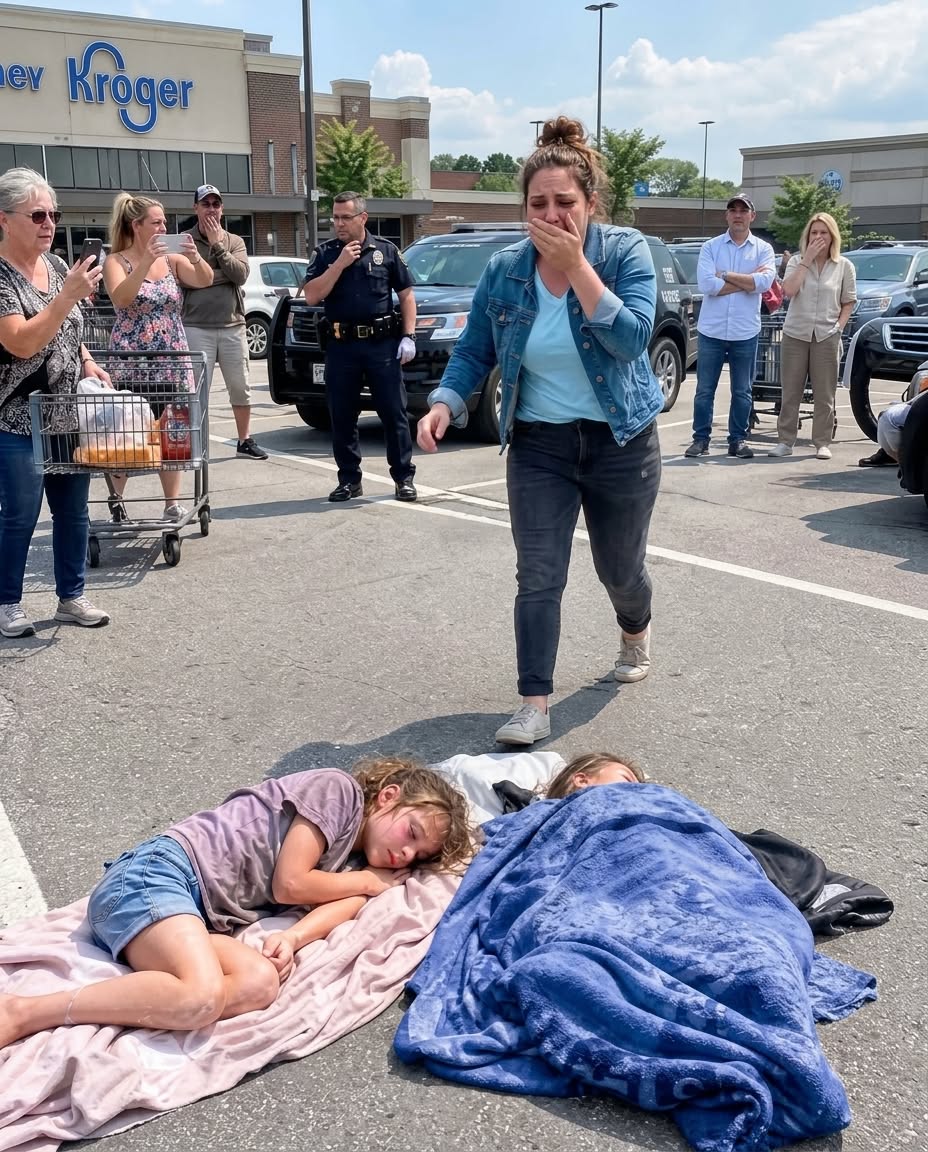
The first thing I noticed was the blanket.
It was stretched across the back seat of an aging blue sedan parked at the far edge of the supermarket lot, where the streetlights were weaker and almost nobody bothered to park. At six in the morning, the grocery store had only just opened, and the asphalt still held the damp chill of the night.
I had stopped there because I needed coffee and a few things for breakfast. I almost walked past the car without looking twice. Then I saw the small pair of sneakers arranged beneath the back seat.
They were children's shoes.
Something in my chest tightened.
I slowed down and looked through the passenger-side window. A little boy was curled beneath the blanket, his knees tucked toward his stomach and one arm wrapped around a stuffed green dinosaur. Noah. My five-year-old grandson.
Then I saw the driver.
Delilah was asleep with her head against the window, her brown hair falling across her cheek. She looked thinner than I remembered. Not dramatically thinner. Just enough that a mother notices immediately.
I stood there for several seconds, trying to understand why my thirty-one-year-old daughter and her little boy were sleeping in a supermarket parking lot.
Delilah had never been careless with money. She worked hard. She had always been the kind of person who made lists before doing anything important, who remembered birthdays, paid bills early, and worried about whether other people were comfortable.
Seeing her there made no sense.
I tapped lightly on the glass.
Her eyes opened instantly.
The reaction frightened me more than the situation itself.
She didn't wake slowly. She jerked upright, her shoulders stiffening, her eyes darting toward the parking-lot entrance before settling on me. For one brief second, she looked terrified.
Then she recognized me.
“Mom.”
Her voice was barely audible.
I opened the passenger door after she unlocked it, and cold air rushed into the car. Noah shifted beneath the blanket but didn't wake.
“What are you doing here?”
Delilah looked down at her hands.
That was when I knew she had been hoping I wouldn't find her.
She wiped beneath one eye with the heel of her palm and tried to give me a smile. It was a poor attempt. Her lips moved, but the expression never reached her face.
“I didn't know where else to go.”
I looked toward the back seat.
“How long have you been here?”
She hesitated.
That hesitation answered the question before she did.
“Three nights.”
Three nights.
I stared at her.
“You and Noah have been sleeping in this car for three nights?”
She nodded.
The supermarket suddenly seemed very loud. Shopping carts rattled near the entrance. A delivery truck reversed somewhere behind the building, its warning alarm sounding at regular intervals. People walked past carrying grocery bags without giving us more than a passing glance.
My daughter sat beside me as though she were ashamed of being discovered.
“Delilah, what happened?”
She swallowed.
“Evan told me to leave.”
I felt the anger arrive quietly.
Not explosively. Not yet.
“Evan told you to leave the house?”
“He and Judith.”
I knew exactly who she meant.
Judith Mercer was Evan's mother, and for years I had tried to maintain a polite relationship with her. I had never trusted the way she spoke to Delilah, but my daughter always insisted things weren't as bad as they sounded.
Now I looked at Delilah's exhausted face and wondered how long she had been protecting everyone except herself.
“What did you do?”
She looked almost offended by the question, then immediately softened.
“Nothing, Mom.”
“Then why did they put you out?”
Her eyes filled with tears.
“Because I wouldn't apologize.”
I waited.
Delilah took a shaky breath.
“Noah spilled orange juice.”
I thought I had misunderstood her.
“Orange juice?”
She nodded.
“He knocked over a glass. It got on a rug Judith had bought. She started yelling at him.”
My hands tightened around the edge of the seat.
“And you said something.”
“I told her to stop.”
“What did Evan say?”
“He came home angry.”
Delilah looked toward Noah.
“He told me that if I couldn't respect his mother, I could leave.”
I stared at my daughter.
Then I looked through the windshield at the empty rows of parking spaces.
Years earlier, I had bought a three-bedroom house for Delilah and Evan. I had sold a piece of inherited land to make it possible. I remembered handing Delilah the keys and watching her cry.
She had hugged me so tightly that day.
“You don't know what this means, Mom.”
I had known.
I wanted her to have a stable home. I wanted Noah to grow up somewhere safe. I wanted to give my daughter something permanent.
I had also kept the deed in my own name.
At the time, it had seemed like a sensible precaution.
Now, sitting inside that cold sedan, I understood that decision differently.
“Delilah,” I said quietly, “why didn't you call me?”
She stared at her lap.
“I didn't want to cause problems.”
That sentence hurt.
Not because she had failed to call me, but because she had apparently learned to think of her own suffering as an inconvenience.
“You sleeping in a car with your son isn't causing problems for me.”
“I know.”
“No, you don't.”
She finally looked at me.
“You are my daughter. Noah is my grandson. You don't need permission to come home.”
Her face crumpled.
She covered her mouth so she wouldn't wake him.
I reached across and took her hand.
Her fingers were cold.
“We're leaving,” I said.
“Mom—”
“We're leaving.”
She didn't argue again.
I drove them home.
Noah woke when we pulled into my driveway. He looked around sleepily, then noticed me.
“Grandma?”
“Yes, sweetheart.”
“Are we staying here?”
I glanced at Delilah.
She looked down.
“For a little while,” I told him.
He accepted the answer without another question.
Children sometimes understand more than adults realize.
Inside, I made scrambled eggs and toast. Noah ate as though he hadn't had a proper breakfast in days. Delilah barely touched her plate.
Afterward, I ran a bath for Noah and found him clean pajamas. He emerged with wet hair and immediately asked whether he could sleep in the guest room.
“Of course.”
He carried his dinosaur with him.
A few minutes later, the house became quiet.
Delilah went upstairs to shower.
I remained at the kitchen table.
The coffee in front of me grew cold.
I kept thinking about the car.
The blanket.
The shoes placed neatly beneath the seat.
The dinosaur held against Noah's chest.
Three nights didn't explain those details.
People who suddenly end up sleeping in a car usually throw themselves into whatever space they can find. But Delilah had arranged that back seat carefully.
It looked practiced.
That realization made my stomach turn.
When Delilah came downstairs, she was wearing one of my old sweatshirts. Her hair was still damp.
She sat across from me.
Neither of us spoke.
I waited until she had wrapped both hands around a fresh cup of coffee.
Then I said, “Start from the beginning.”
She looked at me.
“This time, don't protect Evan. Don't protect Judith. And don't protect me from the truth.”
Her eyes dropped to the table.
For several seconds, all I could hear was the refrigerator humming.
Then she nodded.
“The problems started after Noah was born.”
I leaned back.
She told me Judith had gradually begun spending more time at the house. At first, she said, it had seemed harmless.
Judith would rearrange furniture.
She would criticize the way Delilah cleaned.
She would make suggestions about Noah and then become offended if Delilah didn't follow them.
Whenever Delilah objected, Judith accused her of being disrespectful.
And Evan always defended his mother.
“So I stopped arguing,” Delilah said.
I didn't interrupt.
She explained how small things became routine. Judith would enter rooms without knocking. She would make decisions about Noah without asking. She would complain that Delilah was too sensitive.
Evan would tell Delilah to let it go.
Eventually, letting things go became the price of peace.
Then Delilah left her teaching job to care for Noah.
Evan had agreed to the decision at the time.
But later, he began using his income as a weapon.
He reminded her that he paid the bills.
He called the house his.
He spoke as though the money he earned had somehow erased the fact that I had purchased the property.
“You knew the house was mine,” I said.
Delilah nodded.
“I knew.”
“But you stopped believing that.”
She looked away.
“I guess I did.”
I understood then that the problem wasn't simply that Evan had been cruel.
He had repeated something often enough that my daughter had begun accepting it as reality.
Then she told me about the rug.
Noah had been playing near the kitchen when he knocked over the glass.
Orange juice spilled across the rug.
Judith screamed.
Not corrected him.
Not scolded him.
Screamed.
Delilah stepped between them.
“She was frightening him,” Delilah whispered.
“What did you say?”
“I told her she wasn't going to speak to him that way.”
“And then?”
“Evan came home.”
She rubbed her thumb against the coffee mug.
“I thought he'd listen.”
He hadn't.
Instead, he demanded an apology.
Delilah refused.
That was the first time in years she had refused.
Judith began carrying Delilah's belongings toward the front door.
Evan stood there and told his wife she could leave if she was unhappy.
Delilah waited for him to stop.
He didn't.
“What did Noah do?” I asked.
She looked down.
“He cried.”
My throat tightened.
“And Evan?”
“He didn't care.”
She told me she left with Noah.
She expected Evan to call.
He didn't.
One day passed.
Then another.
Then another.
No call.
No message.
Nothing asking where his son was sleeping.
I sat very still.
“Did he ever contact you about Noah?”
“No.”
That answer settled heavily between us.
I looked toward the hallway where my grandson had disappeared earlier.
Something had changed inside me.
This was no longer simply about my daughter's marriage.
It was about a child who had watched his mother be thrown out of his home and a father who hadn't bothered to ask where he was.
I reached across the table.
Delilah took my hand.
“I should have left sooner,” she whispered.
“You left when you were ready.”
“I should have known.”
“You knew something was wrong. You just didn't know how far it had gone.”
She squeezed my fingers.
Then she looked at me in a way I hadn't seen before.
Fear returned to her face.
“Mom.”
“What?”
“There is something else.”
She reached toward her purse.
I watched her fingers disappear inside.
Then she pulled out a thick bundle of papers.
She placed them carefully on the table between us.
I looked at the documents.
Then at my daughter.
She whispered, “I didn't know who else to show them to.”
Click Here to continue read next: PART2: My Daughter Finally Told Me Why She Had Been Forced Out, but the Papers Waiting on My Kitchen Table Changed the Meaning of Everything
I Found My Daughter and Grandson Asleep in a Car, and the Fear on Her Face Told Me This Was Far Worse Than a Family Argument
Part 1 of 8

