
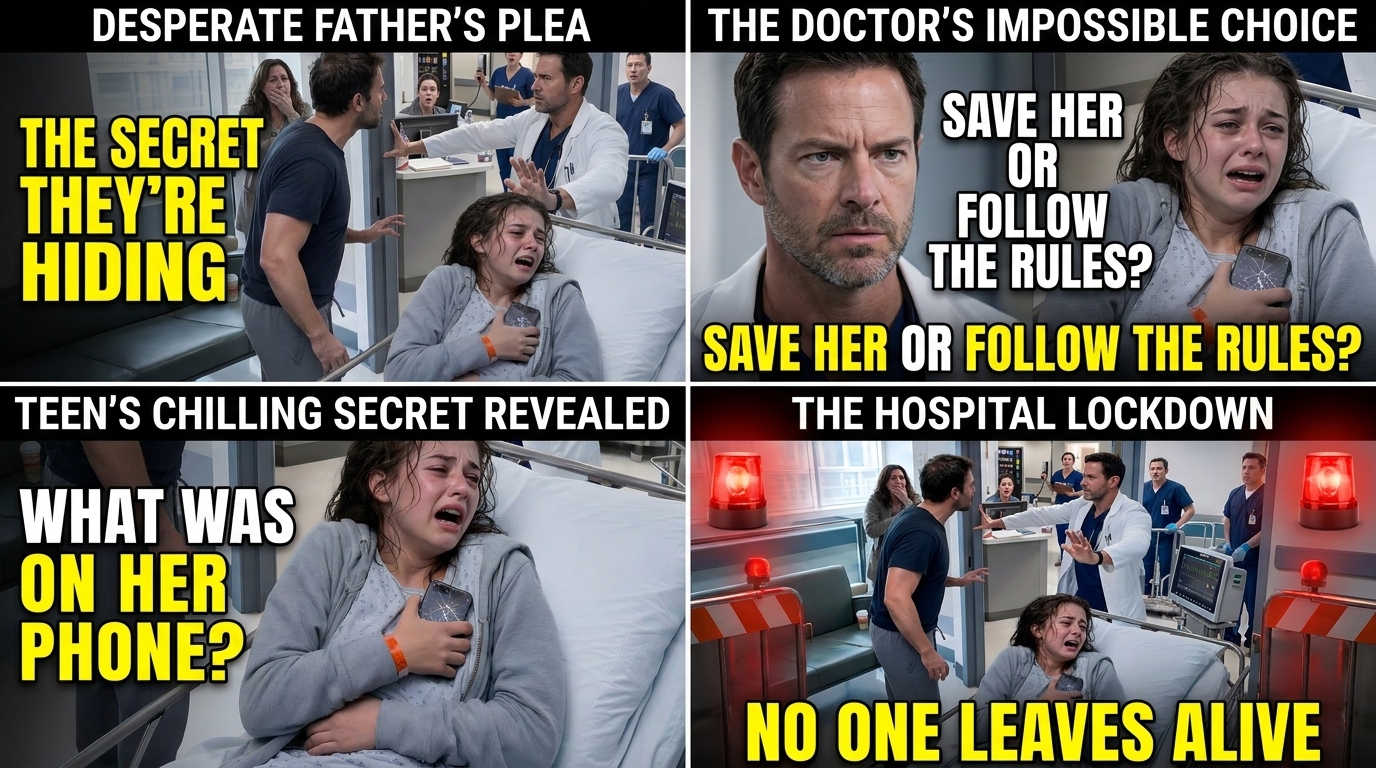
Michael stared at Sarah as though she had spoken a language he had never heard before.
“No?” he repeated.
Sarah stood in the hallway with her hands trembling at her sides.
“No,” she said. “She is not safe with you.”
The words were quiet.
They did not need to be louder.
The nurse moved toward Emily's bed.
Security arrived moments later.
Two officers in dark uniforms approached Michael without rushing. One raised a hand when Michael tried to advance.
“Sir, please step back.”
Michael looked around.
He seemed to be searching for someone who would understand him.
The receptionist lowered her eyes to the paperwork.
The nurse was entering notes into the chart.
The doctor remained between Michael and the treatment room.
No one stepped toward him.
That appeared to unsettle him more than the security officers did.
“This is a family matter,” Michael said.
The doctor shook his head.
“Your daughter is a minor receiving emergency treatment.”
Michael pointed at Sarah.
“She is causing this.”
Sarah almost laughed.
Not because it was funny.
Because the accusation was so familiar.
For years, Michael had told her she caused every problem he created.
If he was angry, she had provoked him.
If Emily cried, Sarah had spoiled her.
If money was tight, Sarah had spent too much.
If the house was tense, Sarah had made it tense.
He had built an entire version of their family in which he was always reacting and everyone else was always responsible.
But the hospital was different.
Here, statements were written down.
Times were recorded.
Symptoms were measured.
People asked questions and waited for answers.
Michael could not simply declare the truth and expect everyone to accept it.
The doctor looked at Sarah.
“I need to document what you've told us.”
Sarah nodded.
The nurse printed the threatening message.
She recorded the time.
The security officer documented when Michael had been prevented from entering the treatment area.
Sarah watched the process.
It was strangely powerful.
For years, Michael's behavior had existed mostly in memory.
Now pieces of it were becoming evidence.
A timestamp.
A text.
A medical examination.
A frightened child.
A witness.
Michael saw the papers.
“You're actually doing this?”
The doctor looked at him.
“Yes.”
Michael's face hardened.
“You're destroying my family.”
Sarah looked at him.
“No.”
He stared.
“You did that.”
The words surprised even Sarah.
Michael's mouth opened.
Nothing came out.
The doctor returned to Emily.
“We need to take her to surgery.”
Sarah hurried to the bedside.
Emily looked exhausted.
Her skin was pale against the hospital pillow, and the IV tubing ran from her hand toward the bag beside the bed.
“Mom?”
“I’m here.”
Emily's fingers closed around hers.
The grip was weak.
“Are you mad at me?”
Sarah bent down.
“No.”
“I didn't want to tell you.”
“It's okay.”
“I thought he'd hurt you.”
Sarah closed her eyes for a moment.
There it was.
The truth she had not understood.
Emily had not only been afraid for herself.
She had been trying to protect Sarah.
A child had been carrying a responsibility that belonged to an adult.
Sarah pressed her forehead gently against Emily's.
“You never have to protect me from him again.”
Emily's eyes filled.
“You promise?”
“I promise.”
The nurses began moving the bed.
Sarah walked beside her.
Michael called from the corridor.
“Sarah!”
She did not turn.
“Sarah, you're making a huge mistake!”
She kept walking.
The operating room doors opened.
Emily's fingers slipped from hers.
“Mom.”
Sarah stopped.
“I’m right here.”
“Don't let him come in.”
“I won't.”
The doors closed.
Sarah remained standing there.
The silence afterward was unbearable.
She sat in the waiting area.
Her hands wrapped around a paper cup of coffee she never drank.
Her phone kept vibrating.
Michael called.
Then texted.
Then called again.
The messages changed quickly.
First came anger.
Then accusation.
Then denial.
Then apologies.
You misunderstood.
She fell.
You are ruining this family.
Answer me.
Sarah did not answer.
She stared at the phone until the screen went dark.
A hospital social worker approached her shortly after sunrise.
“My name is Denise,” the woman said. “I'm part of the social work team.”
Sarah nodded.
Denise sat across from her.
“What do you need right now?”
Sarah looked at her.
The question seemed almost impossible.
No one had asked her that in years.
“What do you mean?”
“I mean what would help you and your daughter be safe after she leaves here?”
Sarah looked down at her hands.
“I don't know.”
“That’s okay.”
The woman waited.
Sarah finally said, “I don't think we can go home.”
Denise nodded.
“Then we won't assume you have to.”
Something in Sarah loosened.
They began making a plan.
Sarah gave a statement.
She explained what had happened over the previous days.
She told Denise about Michael refusing medical care.
She described his behavior at home.
She talked about the control over money.
She talked about Emily's fear.
She admitted what she had not wanted to admit.
“I should have known.”
Denise shook her head.
“You knew something was wrong. You acted when you understood how serious it was.”
Sarah looked at her.
“I waited three days.”
“And you brought her here.”
The distinction mattered.
Sarah did not feel absolved.
She felt seen.
The nurse brought printed copies of the messages.
The doctor documented Emily's injuries separately from her medical diagnosis.
The threatening text was preserved.
The time of Michael's arrival was recorded.
The hospital's security report was added.
Every piece became another brick between Michael and the story he wanted to tell.
Michael tried to control that story anyway.
He told staff Sarah was unstable.
He claimed Emily was clumsy.
He insisted the bruises had harmless explanations.
He said the text had been misunderstood.
But each explanation collided with something that could be checked.
A timestamp.
A photograph.
A medical note.
A witness.
A message.
Facts did not need to shout.
They only needed to remain.
At 8:11 that morning, the surgeon came toward Sarah.
She stood so quickly the coffee cup nearly fell from her hand.
“How is she?”
“She made it through.”
Sarah covered her mouth.
“The appendix had ruptured. The infection was serious.”
She closed her eyes.
“But she is alive,” the surgeon continued.
Sarah began crying.
The surgeon put a hand on her shoulder.
She could not stop.
The relief did not feel gentle.
It came like something breaking loose inside her chest.
When she was finally allowed into recovery, Emily looked smaller than fifteen.
Her hair was damp against her temples.
A hospital bracelet circled her wrist.
The room was quiet except for the machines.
Sarah touched her hand.
Emily opened her eyes.
“Is he here?”
“No.”
Emily's face softened.
Not into happiness.
Not yet.
Something more fragile.
Relief.
Sarah sat beside her.
“You're safe.”
Emily closed her eyes.
Sarah watched her breathe.
For the first time in years, she did not listen for Michael's footsteps.
She did not calculate how long he might stay angry.
She did not think about whether dinner would be ready.
She did not wonder whether she had said the wrong thing.
She simply sat there.
And stayed.
The next days were ordinary in ways that almost felt sacred.
There were forms.
Phone calls.
Hospital meals.
A borrowed charger.
Medical instructions.
A social worker's card.
Police questions.
Emily slept for long stretches.
When she woke, Sarah was there.
When she needed water, Sarah brought it.
When she was afraid, Sarah did not tell her she was overreacting.
Michael continued trying to reach them.
Sarah changed her number.
She stopped responding.
She began to understand that silence could mean something different when it was chosen rather than imposed.
The first time she nearly answered his call, her hand hovered over the screen.
Habit pulled harder than she expected.
Then she remembered Emily on the bathroom floor.
Don't tell Dad.
Sarah let the phone ring.
She did not answer.
A few days later, Emily was strong enough to talk more.
The social worker sat with them.
Emily spoke slowly.
She described things Sarah had never known.
Some incidents were recent.
Some were older.
Some were so ordinary that Sarah had almost missed their meaning.
Michael had frightened her into silence.
He had hurt her and then warned her not to tell.
He had convinced her that speaking would make everything worse.
Sarah listened.
She did not interrupt.
She did not defend herself.
When Emily finished, Sarah reached for her hand.
“I believe you.”
Emily looked at her.
That was all she needed to hear.
Weeks later, they sat together on Sarah's sister's back porch.
Emily had a blanket over her knees.
Her recovery was going well, though she tired easily.
A cup of ginger tea cooled on the table.
The afternoon was quiet.
For several minutes, neither spoke.
Then Emily asked, “Did you know?”
Sarah looked at her.
“About what?”
“That he was hurting me.”
Sarah took a long breath.
“I knew he scared us.”
Emily waited.
“I didn't know everything.”
The truth hurt.
But it was the truth.
Emily looked toward the yard.
After a while, she said, “I didn't want you to be alone.”
Sarah's throat tightened.
“You were never supposed to worry about that.”
“I know.”
Sarah squeezed her hand.
“No. I need you to really know it.”
Emily nodded.
Sarah looked across the yard.
She thought about the bathroom.
The hidden money.
The hospital doors.
The orange band around Emily's wrist.
The text message at 4:29.
She had spent years believing safety meant keeping the peace.
Now she knew better.
Safety was not silence.
Safety was being able to tell the truth without fearing what would happen afterward.
Click Here to continue read next: PART4: When They Returned for the Things Michael Had Controlled, Sarah Discovered How Much Courage Can Hide Inside an Ordinary Quiet Decision
By the Time Michael Called Her Dramatic, Emily Had Already Become Too Weak to Stand Without Holding the Wall
Part 3 of 8

