
Mara did not accuse anyone.
She knew better.
The missing key was evidence, not proof.
Ben photographed the cabinet.
The investigators were notified.
Every staff member was questioned.
No one admitted taking the key.
The clinic remained open, but access was restricted.
Mara moved the most sensitive records to a secure location.
The animals stayed where they were.
She refused to make them feel the fear that the humans were carrying.
Lena, however, had changed.
She no longer slept deeply.
Whenever a door opened, her head lifted.
Nori remained beside her.
Tiger sometimes watched them both from across the room.
Mara wondered whether the animals recognized something before people did.
The next afternoon, Grace called.
“I remembered something.”
Mara answered immediately.
“What?”
“The handler's name.”
“Who?”
Grace gave it again.
Mara sat down.
It was Thomas Reed.
Thomas had worked as an independent animal transport coordinator for years.
He had delivered rescued animals to Mara's clinic.
He had helped move equipment during the East Ridge investigation.
He had even testified briefly during the original case.
Mara had trusted him.
Daniel had too.
“Are you certain?”
“Yes.”
“Why didn't you say his name yesterday?”
“Because I was afraid.”
“Of Thomas?”
“Of what he could prove.”
Grace explained that Thomas had signed several transport documents under Northstar's authority.
He had also handled animals marked T-16 through T-18.
Mara remembered him.
Always polite.
Always calm.
Always carrying paperwork.
The kind of person nobody noticed twice.
Ben arrived while Mara was still on the phone.
She told him.
He frowned.
“Then we don't call him.”
“I know.”
“We watch.”
“I know.”
The investigators arranged surveillance.
Thomas continued his routine.
He delivered supplies to clinics.
He attended veterinary conferences.
He visited a private kennel.
Nothing appeared unusual.
Then he drove to Pine Hollow.
The abandoned rehabilitation center.
Mara watched the footage.
Thomas entered through the side gate.
He stayed for twenty minutes.
When he left, he carried a plastic box.
Investigators entered later.
They found a room that had been recently cleaned.
But dust on the floor showed the shape of several cages.
There had been animals there.
Mara visited the building.
The air smelled stale.
One wall contained scratches.
Small.
Repeated.
She touched them.
“Cats.”
Ben nodded.
A camera was found above the doorway.
The investigators recovered its storage card.
The footage showed several animals being brought inside.
One was T-17.
Another was T-18.
Mara recognized the markings.
They were alive.
The footage was dated six months earlier.
The animals had been transferred elsewhere.
The destination was Thomas's private property.
The investigators obtained a warrant.
The property was searched.
They found no animals.
But they found carriers.
Blankets.
Medication.
And a notebook.
Thomas had written the animals' numbers.
Beside T-17:
“Behavior stable.”
Beside T-18:
“Memory deterioration.”
Beside another code:
“Candidate for renewed treatment.”
Mara felt sick.
The research had continued.
Not as a large laboratory.
As a network of private locations.
Small enough to avoid attention.
Mobile enough to disappear.
Investigators searched financial records.
Northstar had paid Thomas through consulting companies.
The payments were disguised as transport fees.
The evidence was finally becoming undeniable.
Thomas was arrested.
During questioning, he denied knowing about illegal experiments.
He admitted transporting animals.
He claimed Northstar had told him the animals were part of a legitimate rehabilitation program.
The investigators asked about T-17 and T-18.
Thomas refused to answer.
Then they showed him the notebook.
His lawyer objected.
Thomas became silent.
The investigators searched again.
This time they found a hidden room beneath his garage.
There were no animals.
Only records.
Hundreds of pages.
Mara was called to identify the medical terminology.
She recognized many names.
Some belonged to animals she had treated.
Others belonged to animals she had never seen.
The records stretched back twelve years.
The network was larger than anyone realized.
Daniel read one page.
“This is the original protocol.”
Helen looked over his shoulder.
“No.”
“What?”
“This version was never approved.”
Mara looked at Helen.
“Why?”
“Because it involved human neurological markers.”
Silence.
The animals had been used to study memory.
But the company had been looking for something that could eventually be applied to human medicine.
That did not excuse the animal experiments.
It explained why the research had attracted so much money.
Mara looked at the documents.
The central scientific question was legitimate.
The methods were not.
The distinction mattered.
The investigators needed to show exactly where legal research ended and misconduct began.
The hidden records provided that line.
There were consent forms.
There were falsified reports.
There were payment schedules.
There were instructions to conceal adverse results.
There were lists of animals selected because of unusual memory responses.
Tiger's name appeared near the top.
So did Lena's.
Nori's.
Jasper's.
Clover's.
Sam's.
And dozens more.
Mara stared at the list.
“We thought the five were exceptional.”
“They were,” Helen said.
“But there were others.”
“Yes.”
“Some may still be alive.”
Helen nodded.
That became the new priority.
Find them.
The investigators created a national alert for the animal identification codes.
Shelters were contacted.
Veterinary clinics received photographs.
Private rescues were asked to check old records.
Within weeks, reports began arriving.
A dog with T-17.
A rabbit with T-18.
A cat with a faded blue mark.
Some reports were false.
Others involved unrelated animals.
Then one was confirmed.
A dog named Bruno.
He lived with an elderly couple in another county.
The family had adopted him years earlier.
He had a scar near his shoulder.
His original microchip had been replaced.
But his old veterinary record contained the code T-17.
Mara traveled with investigators.
Bruno was gentle.
He approached her slowly.
Then he sniffed her hand.
Mara knelt.
“Hello, Bruno.”
The dog looked at her.
Then he turned toward Daniel.
Daniel was standing several feet away.
Bruno froze.
His tail moved once.
Daniel whispered, “I know you.”
Bruno walked over.
He pressed his head against Daniel's chest.
Daniel closed his eyes.
Mara looked away.
The moment was private.
Bruno had remembered him.
The elderly couple were frightened.
They thought someone might take their dog.
Mara explained that nobody was removing Bruno from their home.
The purpose was documentation and protection.
They agreed to genetic testing.
The results confirmed the connection.
Bruno was another survivor.
The list grew.
Four.
Then seven.
Then eleven.
Not all were alive.
But enough were.
The original program had not involved five animals.
It had involved dozens.
The five at Mara's clinic had simply become the most visible.
That discovery changed the case completely.
Northstar could no longer describe the matter as an isolated historical incident.
There was a continuing pattern.
The court ordered preservation of all records connected to the identification system.
Mara testified again.
This time she spoke about the animals she had treated without knowing their history.
She described how easily an ordinary veterinary visit could erase the connection between an animal and its past.
“An incomplete record isn't harmless,” she said.
“If the missing information changes who can claim the animal, then the missing information changes the animal's future.”
The statement became part of the official record.
After the hearing, Daniel approached her.
“You were right.”
“About what?”
“Records.”
Mara smiled.
“Don't tell anyone.”
He laughed.
For the first time in months, the tension lifted.
Then his phone rang.
It was Eli.
Daniel answered.
“What's wrong?”
Eli said something.
Daniel's smile disappeared.
He looked at Mara.
“It's Tiger.”
They drove back immediately.
Tiger was standing near the entrance.
He was staring at the parking lot.
A vehicle had stopped outside.
A familiar white van.
The driver did not get out.
Tiger began scratching the floor.
Once.
Twice.
Three times.
Then he stopped.
Mara looked at the van.
The side door opened.
A man stepped out.
Thomas was supposed to be in custody.
This man was not Thomas.
He walked toward the clinic carrying a small cardboard box.
He stopped at the gate.
Then he looked directly at Mara.
“I have something that belongs to Daniel.”
Click Here to continue read next: PART12: The Stranger Brought a Box Daniel Had Never Seen, and Inside It Was the Missing Link Between the Old Experiments and the Animals Still Waiting
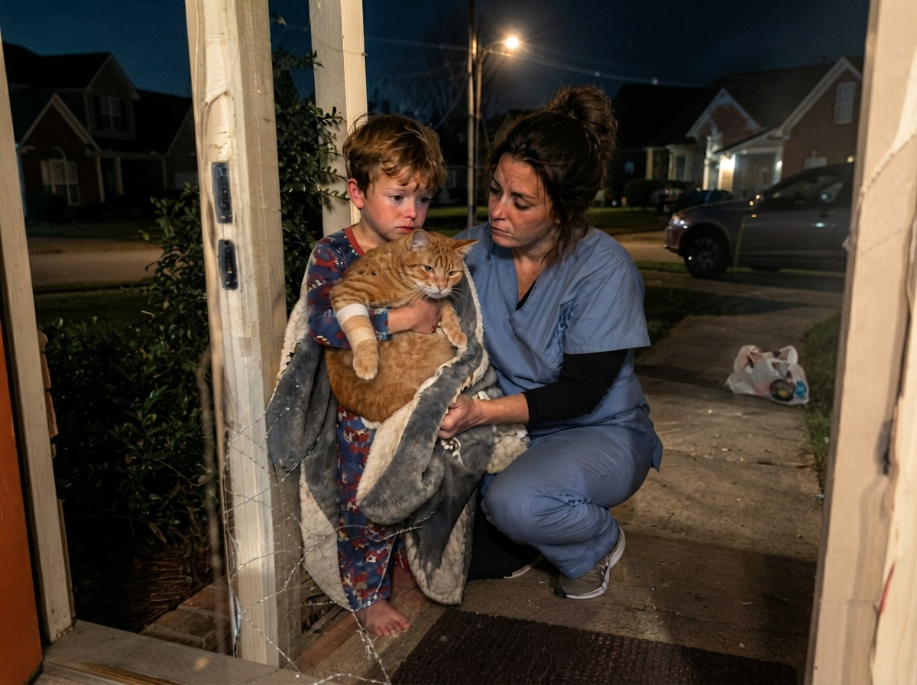
At Nearly Midnight, the Boy Arrived Barefoot With a Trembling Cat in His Arms, and One Detail Made Dr. Mara Question Everything
Part 11 of 16

