
NOTE: This final part delivers the emotional resolution by showing the family's long-term consequences, Ben's adulthood, the lasting boundaries with Richard and the grandmother, and the meaning of truth after years of secrecy.
The house was quiet after Ben left for college.
For the first few weeks, I kept expecting to hear his footsteps upstairs.
I would buy too much food.
I would set out an extra glass.
I would hear a sound in the hallway and turn around.
Then I would remember.
He was gone.
Not lost.
Not frightened.
Not hiding.
Growing.
That difference mattered.
Daniel handled it better than I did.
He told me that children were supposed to leave eventually.
"I know."
"You've said that six times."
"I know."
He smiled.
"Then why are you still looking at his empty room?"
"Because I'm his mother."
"Fair."
We laughed.
Life continued.
Ben called often.
He told us about classes.
Friends.
Bad cafeteria food.
A professor he admired.
He rarely mentioned the lake.
That was okay.
The lake belonged to the past.
One weekend, he came home unexpectedly.
He was standing at the front door with a backpack.
I nearly cried.
"You didn't tell us you were coming."
"I wanted to surprise you."
"You did."
Daniel hugged him.
We spent the afternoon together.
At dinner, Ben told us he had been volunteering with a youth organization.
"What do you do?"
"Mostly listen."
I smiled.
"That's important."
He nodded.
"A lot of kids just need someone to believe them."
I looked at him.
He didn't know how deeply those words affected me.
Maybe he did.
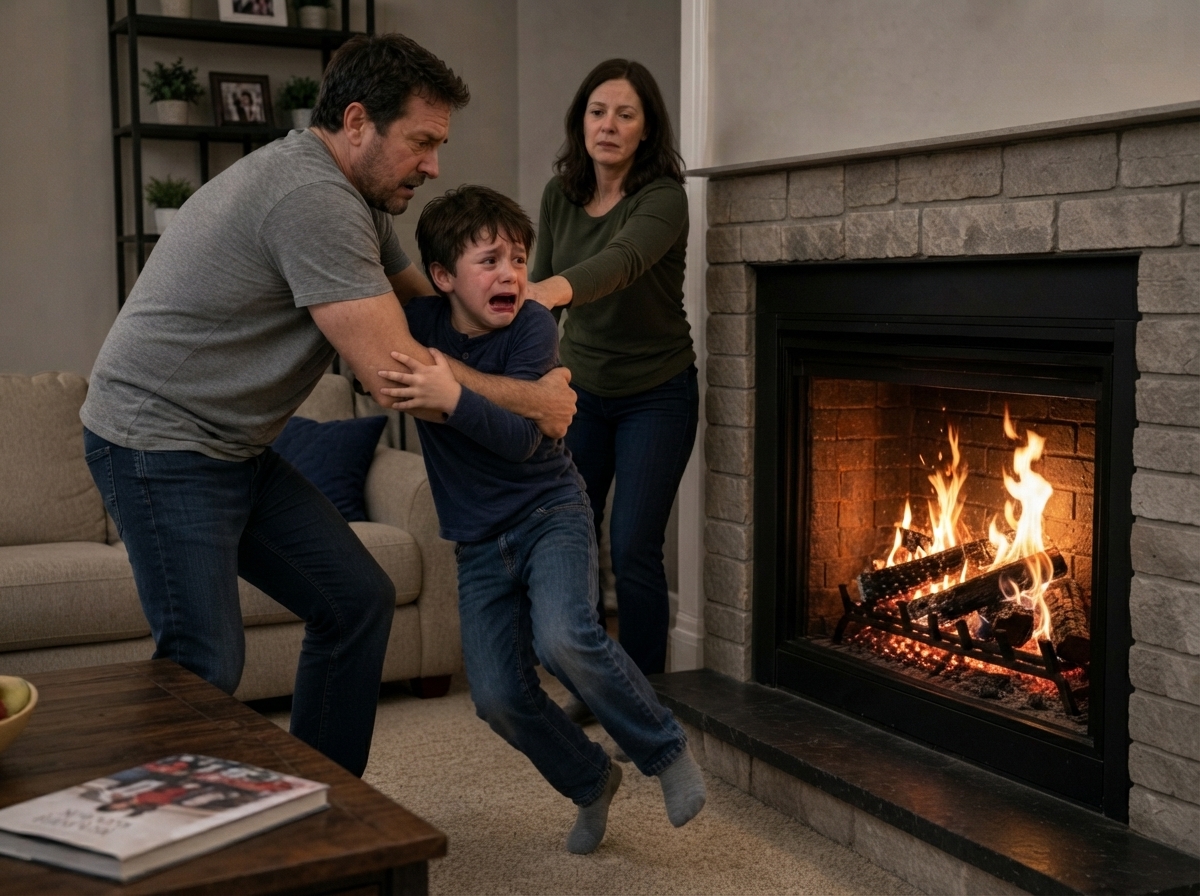
After dinner, we sat around the fireplace.
Ben looked at the old photographs.
"Do you still have everything?"
"Some things."
"The lake picture?"
"Yes."
He picked it up.
"I remember this."
"You were little when you first saw it."
"I know."
He studied the photograph.
Then he smiled.
"It's weird."
"What?"
"That something so important happened here, and now it just looks like an old picture."
"That's what time does."
"Does it make you sad?"
"Sometimes."
"Does it make you angry?"
"Sometimes."
He nodded.
"Me too."
Then he put the photograph down.
"But I'm glad you told me."
"Why?"
"Because I learned something."
"What?"
"People don't become trustworthy because they say they love you."
I looked at him.
"They become trustworthy because their actions match their words."
Daniel smiled.
"That's pretty wise."
Ben shrugged.
"I had good teachers."
I laughed.
The years had changed him.
But the frightened boy was still part of him.
The difference was that he no longer had to live as that boy.
He understood what had happened.
He had processed it.
He had learned that fear could be acknowledged without becoming a permanent identity.
That mattered more to me than anything else.
Richard's health eventually declined.
Daniel visited more often.
I did not.
Not because I hated him.
Because my relationship with him remained different.
One afternoon, Daniel returned from a visit.
"He asked about you."
"What did you say?"
"That you're okay."
"That's true."
"He said he regrets everything."
I looked at him.
"Does he?"
"I think so."
"That's his burden now."
Daniel nodded.
"He knows."
That was enough.
My mother lived nearby.
She visited often.
She and I had rebuilt something that looked different from our old relationship.
There were still subjects we approached carefully.
But she no longer avoided the difficult ones.
One afternoon, she asked me whether I wished she had told me the truth when I was seventeen.
"Yes."
She nodded.
"Me too."
"Why didn't you?"
"I thought fear was temporary."
"And secrecy?"
She looked at me.
"Secrecy became permanent."
That sentence stayed with me.
It was true.
Fear can pass.
A secret can become a habit.
A habit can become a family tradition.
And suddenly, children are inheriting silence they never chose.
We had broken that tradition.
Our children would not inherit it.
Years later, Ben graduated.
He stood on the stage in a dark gown.
Daniel and I sat together.
My mother sat beside us.
Richard was too ill to attend.
Ben looked toward the audience.
For a second, his eyes found ours.
He smiled.
I cried.
Afterward, he hugged us.
"I'm done."
"Not quite."
He laughed.
"Mom."
"You still have to find a job."
He groaned.
Daniel laughed.
Normal.
Beautifully normal.
That evening, we went home.
The fireplace was burning.
Ben sat in the same place where he had once cried.
He looked around.
"Nothing changed."
"Everything changed."
He smiled.
"That's true."
We talked late into the night.
He told us about his future plans.
He wanted to work with children.
Maybe counseling.
Maybe teaching.
He wasn't sure.
But he knew one thing.
"I want kids to know they can talk."
I squeezed his hand.
"That's a good goal."
He looked at me.
"You know why?"
"Why?"
"Because when I was eight, I thought keeping a secret was the only way to stop someone from getting angry."
I remembered.
"Then you told us."
"Yes."
"And everything changed."
He nodded.
"I think that's why I want to help other kids."
My eyes filled with tears.
The boy who had once begged us not to let his grandfather take him outside had become an adult who wanted frightened children to know they could speak.
That was the ending I never could have imagined.
Not because the past disappeared.
Because something good grew from what we learned.
The family continued changing.
Richard eventually passed away.
Daniel was there.
He cried.
I stayed beside him.
I didn't feel hatred.
I didn't feel forgiveness in some perfect, complete sense.
I felt sadness.
For the man he had been.
For the family he could have had.
For the years lost to fear.
After the funeral, Daniel said, "I don't know what I'm supposed to feel."
"You don't have to know."
He nodded.
"I loved him."
"I know."
"I hated what he did."
"I know."
"Both are true."
"Yes."
That was our language now.
Both can be true.
The phrase became almost a family motto.
Someone can love you and hurt you.
Someone can apologize and still face consequences.
Someone can change without erasing the past.
Someone can be forgiven without being trusted completely.
And someone can be remembered honestly without being idealized.
Those truths made our family stronger.
Years later, we returned to the lake one final time.
Ben came with us.
He was an adult.
He walked beside me.
The water was calm.
The trees had grown taller.
The dock had been rebuilt again.
He looked at the shore.
"Do you still remember?"
"Yes."
"Does it hurt?"
"Not like it used to."
He nodded.
We stood quietly.
Then he said, "I'm glad you didn't let fear stop you from bringing me here."
"So am I."
He smiled.
"Do you think Grandpa knew what would happen?"
"No."
"Did Grandma?"
"No."
"Did you?"
"No."
He looked at the water.
"Maybe nobody knows what one decision will change."
"That's true."
We sat near the shore.
Ben skipped a stone.
It bounced three times.
He laughed.
I smiled.
The lake was ordinary.
It had always been ordinary.
People had brought their fear to it.
People had brought their secrets.
People had brought their mistakes.
But the water had never asked for any of them.
That realization felt strangely peaceful.
On the drive home, Ben asked whether I still had the photograph of the lake.
"Yes."
"Keep it."
"I will."
"Why?"
"Because it reminds me of your grandfather."
He nodded.
"Good."
"Does that bother you?"
"No."
He looked out the window.
"I don't want to remember him only for what he did."
I looked at him.
"Why?"
"Because then I'm letting the worst thing he did become his whole story."
I smiled.
He had learned the hardest lesson.
Accountability did not require hatred.
And compassion did not require denial.
When we returned home, Ben helped me put the photograph into its frame.
We placed it beside the fireplace.
Not hidden.
Not displayed like a monument.
Just there.
Part of the family history.
Then Ben hugged me.
"Thanks for telling me the truth."
I closed my eyes.
"You're welcome."
"No."
He pulled back.
"Thank you for trusting me with it."
That sentence broke something open inside me.
For years, I had thought protecting children meant keeping painful things away from them.
Now I understood something more nuanced.
Children need protection from information they are not ready to carry.
But they also need protection from lies that teach them to distrust themselves.
There is a difference.
Ben had been old enough for the truth when we finally told him.
And when he was frightened, we listened.
That was what mattered.
The story did not end with the lake.
It ended with what came afterward.
A child learned to speak.
Parents learned to listen.
Adults learned to accept consequences.
A family learned that love without honesty could become a cage.
The fireplace eventually went out.
The house became dark.
Ben went upstairs.
Daniel locked the front door.
I stood for a moment in the hallway.
I remembered the boy crying beside the fireplace.
I remembered the first night we realized he was afraid.
I remembered the lake.
The photograph.
My father's letter.
My mother's confession.
Richard's apology.
The endless conversations.
The difficult boundaries.
The small acts of rebuilding.
Then I looked at the staircase.
No frightened child was hiding there.
No secret waited behind the door.
No one was asking us to protect them with a lie.
The house was simply quiet.
And this time, quiet felt safe.
I turned off the light.
Before going upstairs, I looked once more at the photograph beside the fireplace.
The lake was still.
The sky was clear.
Nothing in the picture showed what had happened there.
Maybe that was fitting.
A photograph could preserve a place.
It couldn't preserve the whole truth.
People had to do that.
We had finally done it.
We had told the truth.
We had accepted what it cost.
We had repaired what could be repaired.
We had protected the people who needed protecting.
And we had learned that forgiveness was not the same as forgetting.
The past would always be part of our family.
But it no longer decided who we were.
My son had once begged us not to let his grandfather take him outside.
Years later, he walked confidently into the world on his own.
And that was how I knew we had finally broken the cycle.
The End
Read more original stories on Feel Every Story.
My Son Suddenly Began Fighting Us Beside the Fireplace, and the Fear in His Voice Made Me Wonder What Had Happened Before We Came Home
Part 8 of 8

