
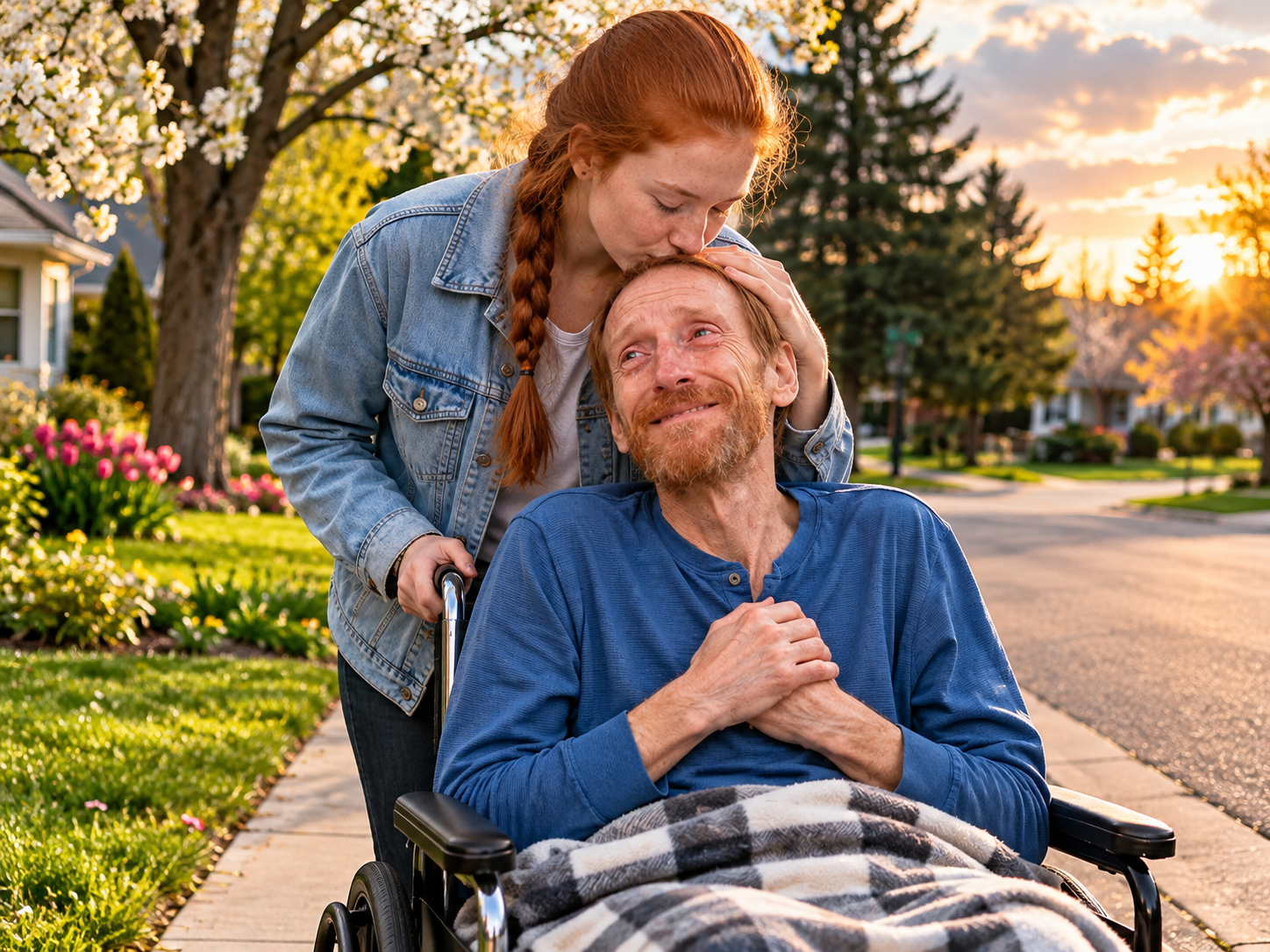
The doctor had barely finished speaking when David stopped squeezing my hand.
“Stage four,” he said quietly. “There is no treatment that can cure it now. We need to concentrate on keeping him comfortable.”
I heard the words, but for several seconds they refused to become real. Outside the consultation room, someone laughed near the nurses’ station. A cart rattled over the polished floor. The ordinary sounds of the hospital seemed almost insulting.
“How much time?” I finally asked.
The doctor hesitated before answering.
“Perhaps weeks. Possibly a few months. It’s difficult to say.”
David nodded as though they were discussing someone else.
I turned toward him. His face looked thinner than it had that morning, the skin beneath his eyes gray with exhaustion. Fifteen years of marriage had taught me the smallest changes in his expression. I knew when he was irritated, amused, worried, or pretending not to be worried.
That day, he was frightened.
He just refused to admit it.
On the drive home, rain streaked the windshield. Neither of us spoke much. I kept one hand on the center console, close enough that David could reach it without taking his eyes from the road.
He placed his fingers over mine.
“I’m sorry,” he said.
“For what?”
He looked ahead.
“For making you go through this.”
I squeezed his hand.
“You don't get to apologize for being sick.”
He gave me a faint smile, but it disappeared almost immediately.
At home, our children ran toward him before he had even removed his coat. Their voices filled the hallway. David bent down carefully and hugged them both, pretending the movement did not hurt.
I watched from the kitchen doorway.
That was my family.
At least, I believed I knew exactly who belonged in it.
For the next few days, we tried to continue normally. We ate dinner together. The children argued over the television remote. I answered messages from relatives and arranged David’s medications. He spent more time resting in the bedroom, and I learned to recognize the difference between ordinary sleep and the deep exhaustion that came with his illness.
But something else had changed.
David had become secretive.
Not dramatically. He did not lock doors or hide his phone. Instead, he would go quiet in the middle of a conversation. Sometimes I caught him staring at the ceiling long after everyone else had gone to bed.
One night, I lay beside him and touched his shoulder.
“What are you thinking about?”
“Nothing.”
“David.”
He turned toward me.
“I’m tired.”
“That isn't what I asked.”
He looked at me for several seconds.
Then he pulled me closer.
“Just stay here.”
I did.
But I could feel the distance between us even while his arm was around me.
Three weeks later, hospice care had been arranged at home. The hospital bed stood near the window, surrounded by medicine bottles, folded blankets, and the small things people bring when they know someone may not leave the room again.
That afternoon, David asked me to close the bedroom door.
“Why?”
“Please.”
I shut it.
He struggled to sit upright. I helped arrange the pillows behind his back.
Then he reached beneath his pillow and pulled out a photograph.
The picture was old. The edges were softened from years of handling.
A girl stared back at me.
She looked about sixteen.
She had dark hair, serious eyes, and an expression that made her seem older than she was.
“Who is she?” I asked.
David held the photograph between both hands.
“Her name is Grace.”
I waited.
He swallowed.
“I need you to adopt her.”
For a moment, I wondered if the medication had affected his thinking.
“What?”
“Grace. She's sixteen. I need you to bring her into our family.”
I stared at the photograph.
Then at my husband.
“You want me to adopt a girl I've never met?”
“Yes.”
“Why?”
His eyes filled with tears.
“Because when I'm gone, she needs someone.”
“That doesn't answer me.”
“I know.”
“David, who is she?”
He looked away.
“Please trust me.”
A strange coldness spread through my chest.
“Trust you with what? A child? A legal adoption? A girl you've apparently known long enough to have her photograph hidden under your pillow?”
He closed his eyes.
“I'll explain.”
“When?”
“Soon.”
The word landed badly.
Soon.
He had been saying it for weeks.
“Is she your daughter?”
His eyes opened.
“No.”
The answer came too quickly.
I watched his face.
“You hesitated.”
“I didn't.”
“You did.”
He rubbed his forehead.
“She isn't my daughter.”
“Then who is she?”
“I can't explain everything yet.”
My voice dropped.
“David, you are dying.”
“I know.”
“And you're asking me to make a permanent decision about a sixteen-year-old girl while refusing to tell me the reason.”
“I am asking you to help someone who needs a home.”
“You're asking me to trust a secret.”
His jaw tightened.
“Please.”
I wanted to be angry. I was angry.
But looking at him in that bed made anger difficult to hold.
He had lost weight. His wedding ring hung loosely on his finger. The man who had once carried both children at the same time now needed help standing.
So I looked again at the girl in the photograph.
“What happens if I say no?”
David's eyes filled with tears.
“She'll lose the only family she has.”
I hated that sentence.
Because it worked.
A week later, Grace arrived on a wet Tuesday afternoon.
She stood on our porch holding a faded backpack in one hand and a plastic bag in the other. Rain had darkened the shoulders of her jacket.
She looked at the house before looking at me.
“You're Mrs. Carter?”
“Yes.”
She nodded.
“Mr. Carter said I could call you—”
She stopped.
“Call me whatever you're comfortable with.”
Her fingers tightened around the backpack strap.
“I don't want to cause trouble.”
“You won't.”
Behind me, our children were already peering around the hallway corner.
My daughter stepped forward first.
“Hi.”
Grace gave her a nervous smile.
“Hi.”
“Do you like chocolate?”
Grace blinked.
“What?”
“We have cookies.”
My son appeared beside her.
“Mom, you said she could have the blue room.”
“I know.”
He looked at Grace.
“It's the one with the window.”
Grace smiled for the first time.
“Thank you.”
I stepped aside.
“Come in.”
She entered carefully, as though the floor belonged to someone else.
That evening, the house felt different.
Not bad.
Just crowded with things nobody was saying.
Grace helped clear the dinner plates without being asked. She answered questions politely. She told the children she liked reading and drawing. When my son asked whether she played video games, she laughed softly.
For a few hours, she seemed like an ordinary teenager.
Then I passed David's bedroom.
The door was partly open.
I heard him laughing.
It was the first genuine laugh I'd heard from him in months.
I stopped.
Grace sat beside his bed.
She was holding his hand.
David looked at her with an expression I had never seen before.
Not guilt.
Not fear.
Something gentler.
Something that frightened me more.
Grace looked up and noticed me.
She immediately released his hand.
“Sorry.”
“You don't need to apologize.”
David's smile faded.
“I was just telling her about the lake.”
I nodded.
“Okay.”
I walked away.
But the image followed me.
Over the next several days, I began noticing patterns.
Grace and David spoke quietly when they thought I wasn't listening. Conversations stopped when I entered rooms. Sometimes David asked her to close the bedroom door.
Once, I heard Grace whisper, “I can't keep lying.”
David answered, “Just a little longer.”
I stood outside the hallway, frozen.
A minute later, I walked away before either of them saw me.
That night, I asked him directly.
“What are you hiding?”
He stared at the blanket.
“Nothing that will hurt you.”
“That isn't an answer.”
“I need more time.”
“You don't have more time.”
He closed his eyes.
“Please.”
I left the room.
In the kitchen, Grace stood at the sink washing a glass.
She had heard us.
She kept her eyes down.
“I’m sorry,” she whispered.
“For what?”
“I don't know.”
That answer stayed with me.
Three days later, David was taken back to the hospital.
He never came home.
The funeral passed like a dream.
People arrived carrying flowers and food. Relatives spoke in lowered voices. Friends told stories about David that made me smile even when I wanted to cry.
Grace stayed near our children throughout the service.
She never demanded attention.
When someone asked who she was, I answered before she could.
“She’s family.”
The word surprised me.
I wasn't sure whether I meant it.
That night, after everyone left, I returned to the bedroom alone.
David's side of the bed was untouched.
His glasses remained on the nightstand.
A book lay open where he had left it.
I sat on the mattress and stared at the empty pillow.
Fifteen years of marriage had ended, but the questions he had refused to answer were still alive.
Around midnight, I heard the bedroom door open.
Grace stood in the doorway.
She was holding a small wooden box.
Her face was pale.
“He told me to give you this.”
I sat up.
“When?”
“He said the day after his funeral.”
My stomach tightened.
“What is inside?”
Grace shook her head.
“I don't know everything.”
“Then why are you bringing it to me now?”
“Because he made me promise.”
She stepped closer and placed the box on the bed.
“He said you deserved to know.”
I stared at the box.
For the first time since David's death, I felt something other than grief.
Fear.
I reached toward the lid.
Grace whispered, “Once you open it, nothing between you and him will ever look the same.”
I lifted the lid.
Click Here to continue read next: PART2: The Box He Left Behind Contained Photographs That Turned My Suspicion Into a Question I Was Afraid to Ask
The Photograph Beneath His Pillow Made Me Wonder Why My Dying Husband Was Asking Me to Welcome a Stranger Into Our Family
Part 1 of 8

