
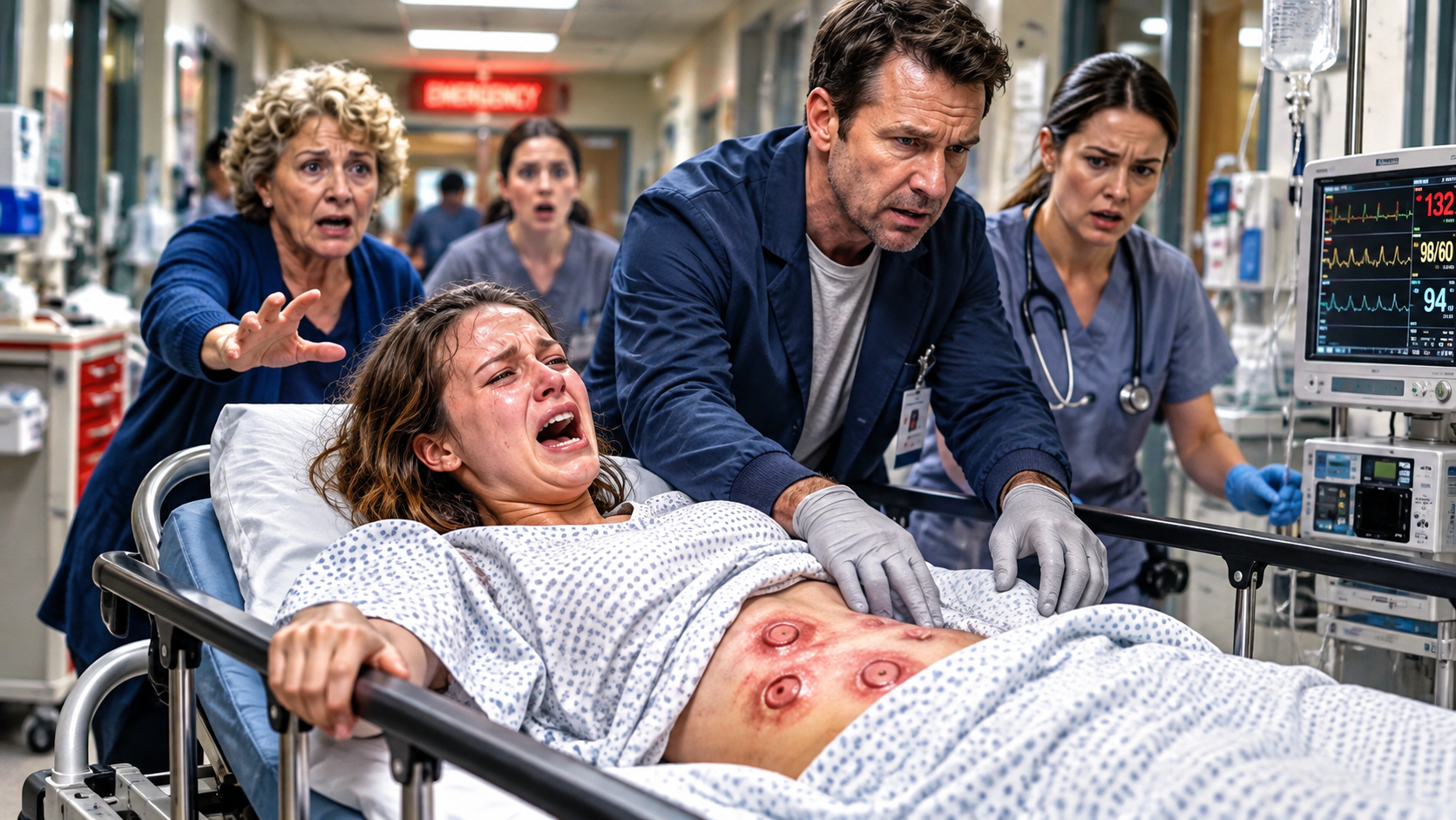
At 3:18 in the morning, Sarah Bennett woke to the sound of someone trying not to cry.
She lay still for several seconds, listening. The house was dark except for the thin strip of yellow light beneath the bathroom door. A pipe clicked somewhere inside the wall. The refrigerator hummed in the kitchen. Then came another muffled sound from behind the bathroom door, followed by the scrape of something against porcelain.
Sarah pushed herself out of bed.
She already knew it was Emily. Her fifteen-year-old daughter had been sick for nearly three days, but Sarah had spent most of those days telling herself that the illness would pass. Teenagers got stomach bugs. Teenagers got fevers. Teenagers complained when they felt awful. It did not necessarily mean something was seriously wrong.
But this sound was different.
She crossed the hallway barefoot and stopped outside the bathroom. The smell of cheap hand soap reached her before she opened the door, mixed with bleach and the sour heat of fever.
Emily was bent over the sink.
Her gray hoodie hung crookedly from one shoulder. One hand gripped the edge of the porcelain while the other pressed hard against her stomach. Her knuckles were nearly white. Her hair had fallen over her face, and when she lifted her head, Sarah saw how pale she looked beneath the fever flush.
“Emily?”
Her daughter wiped her mouth quickly.
“I’m okay.”
The answer came too fast.
Sarah stepped closer. “You don't look okay.”
“I just need to sit down.”
Emily lowered herself onto the closed toilet lid. She kept one arm wrapped around her middle, as if letting go would make the pain spread.
Sarah crouched in front of her.
“How bad is it?”
Emily hesitated.
That hesitation frightened Sarah more than the answer might have.
“Bad,” Emily finally whispered.
Before Sarah could respond, footsteps sounded in the hallway.
Michael appeared in the doorway.
He did not ask how Emily was feeling. He looked at the clock on the wall, then at Sarah, his expression already tightening.
“What now?”
Sarah glanced at him. “She’s getting worse.”
Michael sighed.
It was a small sound, but Sarah knew it well. It meant he had already decided that whatever was happening was inconvenient, exaggerated, or somehow caused by someone else.
“She’s been sick for three days,” Sarah said.
“And?”
“And she’s in a lot of pain.”
Michael leaned against the doorframe. “She always gets dramatic when school gets stressful.”
Emily's eyes dropped to the floor.
Sarah noticed.
She had noticed that reaction many times before, though she had rarely allowed herself to think about it for more than a few seconds.
Whenever Michael raised his voice, Emily became quiet.
Whenever he entered a room, she watched him.
Whenever he disagreed with something, Sarah often found herself reconsidering the decision before she had even finished making it.
For years, Sarah had called that keeping peace.
She had told herself that every family had difficult periods. She had told herself that Michael was under pressure. She had told herself that arguments only became worse when people pushed too hard.
So she had learned to soften everything.
Her opinions.
Her requests.
Her objections.
Eventually, even her instincts.
Michael looked at Emily again.
“If you take her to the emergency room every time she complains, you're teaching her that she can't handle anything.”
Sarah felt something tighten in her chest.
“She’s vomiting and has a fever.”
“She'll be fine.”
Emily looked toward the bathroom door.
Not at her mother.
At the hallway.
Sarah followed her gaze.
Michael had not moved.
“Go back to bed,” he told Emily. “You have school.”
Emily stared at him.
Sarah almost laughed from disbelief, but there was nothing funny in the room.
“She isn't going to school.”
Michael's eyes shifted toward Sarah.
“Don't start.”
Those two words had once been enough to stop her.
They weren't anymore.
Sarah stood.
“We need to get her checked.”
Michael straightened. “At three in the morning?”
“Yes.”
“No.”
Sarah looked at him.
For years, she had measured decisions by the same silent question.
Would Michael be angry?
The question had become so automatic that sometimes she heard it before she realized she was asking it.
Would he be angry if she spent money?
Would he be angry if she changed plans?
Would he be angry if she disagreed?
Would he be angry if she said no?
Now she looked at her daughter and saw that Emily was asking herself the same question.
Would Dad be angry?
That realization landed heavily.
Emily had not inherited Sarah's habit.
Sarah had taught it to her by example.
The bathroom became very quiet.
Then Emily suddenly bent over again.
A moment later, something pink appeared in the sink.
Sarah froze.
She did not know exactly what she was seeing, but she knew she had waited long enough.
“We're going.”
Michael's jaw tightened.
“I said no.”
Sarah turned toward him.
“And I'm saying yes.”
He stared at her as though she had broken some rule neither of them had ever spoken aloud.
“You're overreacting.”
“Maybe.”
“You're going to waste everyone's time.”
“Maybe.”
“You'll pay for it yourself.”
Sarah looked at him.
“That isn't the point.”
Michael's face hardened.
“Then what is?”
Sarah glanced down at Emily.
Her daughter was shaking.
Sarah reached for her hand.
“The point is that she's sick.”
Emily's fingers closed around hers.
It was such a small movement that Michael might have missed it.
Sarah did not.
They helped Emily back toward her bedroom. She walked slowly, one hand against the wall. Sarah noticed how carefully she moved, as though each step required calculation.
When Emily reached the bathroom doorway, her knees suddenly buckled.
Sarah caught her before she hit the floor.
“Emily!”
Michael took one step forward, then stopped.
Emily's cracked phone slipped from her hand and landed on the carpet.
Her eyes opened halfway.
“Mom?”
“I've got you.”
Emily swallowed.
“Don't tell Dad.”
Sarah felt the room tilt.
“What?”
Emily's voice was barely audible.
“Please.”
Sarah looked at Michael.
He was standing only a few feet away.
Something inside her finally stopped making excuses.
Emily wasn't afraid of the hospital.
She was afraid of going home afterward.
At 4:06, Sarah pulled a small envelope of emergency cash from between stacks of clean towels in the linen closet. She slipped it into her purse, grabbed Emily's hoodie, and helped her toward the back door.
She did not switch on the hallway lights.
She did not announce where they were going.
She did not ask Michael whether he agreed.
For the first time in years, Sarah acted before calculating his reaction.
Outside, the air was cold enough to make Emily shiver.
Sarah helped her into the passenger seat.
“Can you sit?”
Emily nodded.
Sarah closed the door and hurried around to the driver's side.
Her hands shook when she started the car.
For several minutes, neither of them spoke.
Streetlights passed over Emily's face as they drove. She leaned against the window, eyes closed.
Then she whispered, “He's going to be furious.”
Sarah kept both hands on the steering wheel.
“I know.”
“He'll say you made me go.”
“I know.”
“He'll get worse.”
Sarah looked at her daughter.
“Listen to me.”
Emily opened her eyes.
“We're going to the hospital. We're going to let them help you. Whatever happens after that, we will deal with it.”
Emily looked away.
“You promise?”
Sarah swallowed.
“I promise.”
But she knew, even as she said it, that a promise meant more than getting Emily through the next few hours.
At the emergency department, fluorescent lights made everything look painfully clean. The waiting room was nearly empty. A television played silently above the reception desk.
A nurse approached them.
“What brings you in?”
Sarah explained the fever, vomiting, and abdominal pain.
“How long?”
“Three days.”
The nurse looked up.
“Three days?”
Sarah nodded.
Something in the nurse's expression changed.
Emily was given an orange identification band and taken through intake.
The medical paperwork reduced her suffering to a few phrases: abdominal pain, fever, persistent vomiting.
Sarah stood beside her while a nurse checked her temperature and blood pressure.
Then a doctor came in.
He examined Emily carefully.
When his hand pressed lightly against the lower part of her abdomen, Emily cried out.
The doctor immediately pulled his hand away.
“All right,” he said quietly. “We're going to take this seriously.”
Sarah felt her throat tighten.
Blood tests were ordered. Then an ultrasound.
As staff moved around the room, Sarah noticed something she wished she could unsee.
A man's voice sounded from the hallway.
Emily's fingers instantly tightened around Sarah's sleeve.
Her eyes moved toward the doorway.
The doctor noticed.
He said nothing at first.
He simply watched Emily.
Then he looked at Sarah.
“Could I speak with your daughter privately?”
Sarah hesitated.
Emily looked at her mother.
Then nodded.
Sarah stepped outside.
Her phone began vibrating.
Michael.
She ignored the first call.
It came again.
Then again.
Finally, messages appeared.
Where are you?
Another arrived almost immediately.
If you took her to the hospital, you're going to regret it.
Sarah stared at the screen.
For years, fear had told her to calm things down.
To wait.
To explain.
To avoid making matters worse.
But standing beneath the harsh hospital lights with her sick daughter behind a curtain, Sarah understood something she should have understood much earlier.
Doing nothing was also a decision.
And she had already seen where that decision had led.
Twenty minutes later, the doctor stepped out.
He closed the curtain behind him.
Sarah stood.
“What is it?”
The doctor's expression was serious.
“Emily needs surgery.”
Sarah gripped the back of the chair.
“What?”
“She has a severe infection. The appendix appears to be involved, and we believe it has become complicated.”
Sarah struggled to breathe normally.
“How dangerous?”
“If you had waited much longer, it could have become life-threatening.”
Sarah closed her eyes.
Three days.
Three days of fever.
Three days of vomiting.
Three days of pain.
And three days during which Emily had been learning that asking for help might make things worse.
Sarah opened her eyes.
“What happens now?”
“We prepare her for surgery.”
Sarah nodded, though her knees felt weak.
Then the doctor added, “There is something else I need to ask you.”
Sarah looked at him.
“Is Emily safe if her father comes here?”
The question seemed to stop time.
Sarah could hear the distant squeak of a hospital cart.
She could hear the monitor inside Emily's room.
She could hear her own breathing.
For years, she had avoided answering that question in her own mind.
Now someone else had asked it aloud.
Before she could speak, a voice came from behind the curtain.
“Mom?”
Sarah turned.
Emily was awake.
Her face was pale against the pillow.
And she was looking toward the hallway with unmistakable fear.
Click Here to continue read next: PART2: The Doctor Asked One Question Sarah Had Avoided for Years, and Her Daughter’s Answer Made Silence Impossible
At Three in the Morning, a Mother Finally Heard the Fear Beneath Her Daughter’s Pain and Stopped Waiting for Permission
Part 1 of 8

