The man Dante had summoned returned seven minutes later, although it felt much longer. His name was Marco, and I recognized him from the way the other men made room when he approached. He had a broad face, a small scar beneath his right ear, and the careful manner of someone who knew how to deliver bad news without attracting attention.
He bent beside Dante and spoke quietly.
“The car was approached by a woman wearing a delivery uniform. She told the driver she'd been sent from the house to collect something from Sophia's bag.”
Dante's face became unreadable.
“Did she take anything?”
“No. The driver asked for identification. She walked away.”
“Did anyone follow her?”
“We have people checking the street. The cameras caught her entering a vehicle two blocks away.”
“Plate?”
“False registration.”
Dante stared at the table. He was controlling his voice, but I could see the muscles working along his jaw.
“Was Sophia's bag in the car?”
“Yes, sir.”
“Bring it inside. Don't let anyone else touch it.”
Marco nodded and left.
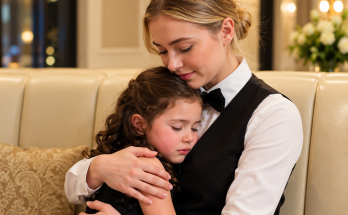
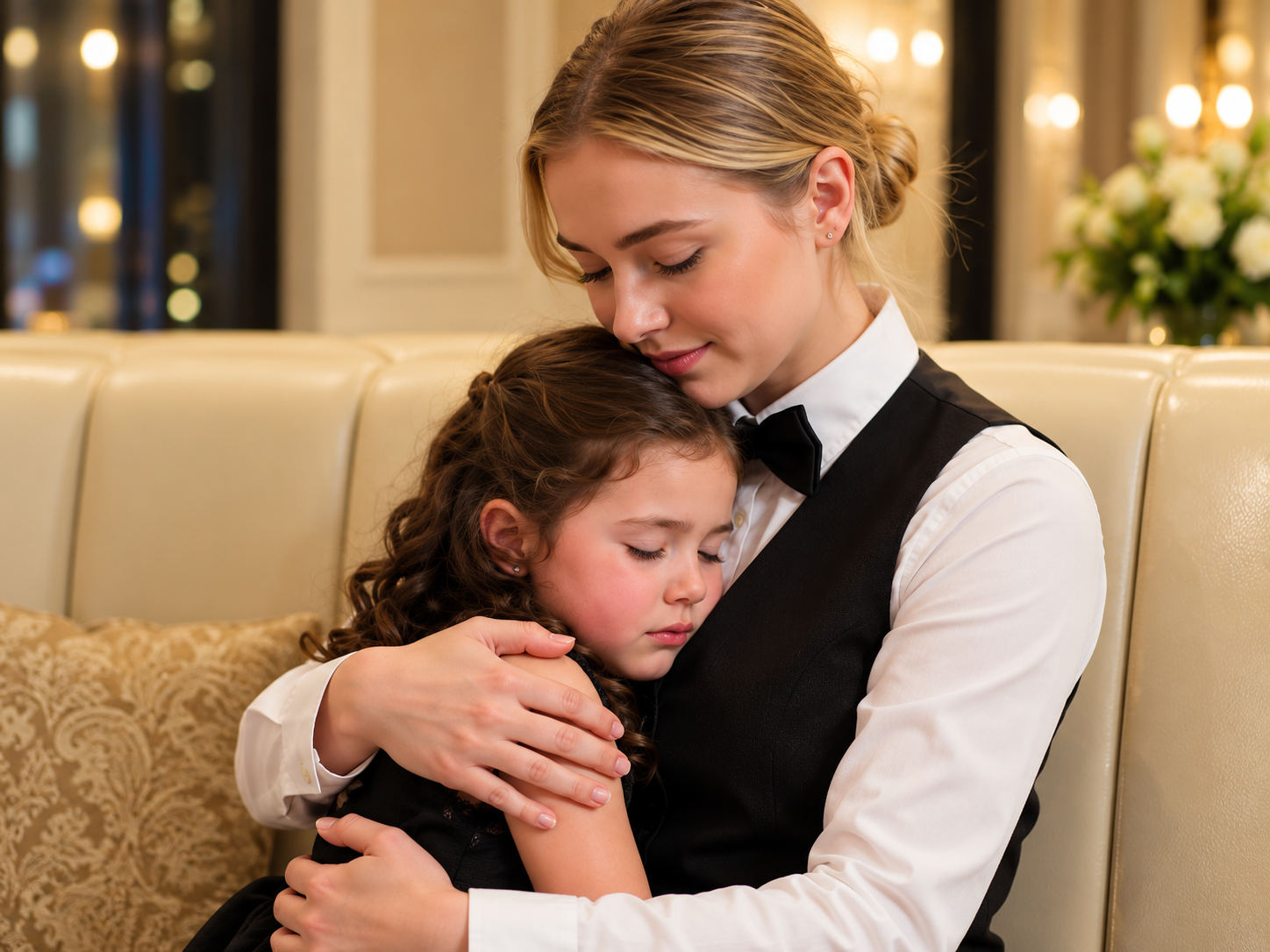
I glanced down at Sophia. Her breathing remained steady, but I had become painfully aware of how vulnerable she was. She had spent three days in a house where her mother had vanished, then been brought to a restaurant where strangers whispered about her family. Now someone had tried to collect her belongings under false pretenses.
“Is she in danger?” I asked.
Dante's gaze returned to me.
“I don't know.”
“You should tell her what you know when she wakes up.”
He looked almost offended. “She's five.”
“She already knows something is wrong. Not knowing why may be worse.”
For a moment, I thought he would tell me to mind my own business. Instead, he leaned back and rubbed both hands over his face.
“You speak very freely for someone who has just met me.”
“I'm scared enough that I can't afford to pretend otherwise.”
That answer seemed to surprise him.
He glanced around the dining room. The customers were attempting to resume their meals, but the effort was strained. Tony had retreated into the kitchen, where he stood near the pass with his arms folded tightly across his chest. Every few seconds, he looked toward our booth.
“I should probably ask you to leave,” Dante said.
“Probably.”
“But she hasn't slept properly in three days.”
I did not answer.
He looked down at his daughter. “I can't remember the last time I saw her this peaceful.”
The words carried no accusation. They were an admission he seemed to be making reluctantly, even to himself.
I shifted slightly to ease the ache in my shoulder. Sophia's head moved, and Dante's entire body tensed. When she settled again, he looked almost angry at his own reaction.
“Do you have children?” he asked again, more quietly this time.
“No. I was raised by my grandmother.”
“Your parents?”
“My mother died when I was young. My father wasn't around much before that.”
He seemed to recognize that I had no intention of offering the details.
“I'm sorry.”
“Thank you.”
My grandmother had been the one who taught me to bake, to mend a torn hem, and to recognize when someone needed company more than advice. She had also taught me that people who were frightened sometimes became difficult to be around. It did not mean they were cruel. It meant their fear had nowhere else to go.
I had seen that in Sophia's eyes when she reached for me.
Marco returned carrying a small pink backpack. He placed it on the table and stepped back.
Dante unzipped the main compartment. Inside were a folded sweater, a picture book, a little stuffed rabbit, and a plastic container holding two untouched crackers. He examined the contents with the precision of a man searching for a hidden weapon.
Then he found a folded piece of paper tucked into the side pocket.
His fingers stopped.
“What is it?” I asked.
He opened it.
The note was brief, written in a hand that looked hurried.
Dante read it once, then again. The color drained from his face.
“What does it say?” I whispered.
He folded the paper and put it inside his jacket.
“Nothing you need to worry about.”
I stared at him. “You asked me to be honest with you.”
“And I am telling you not to worry about something that isn't your responsibility.”
“That's not the same thing.”
His eyes hardened, but the argument ended when Sophia stirred.
Her eyelids fluttered. She made a faint, frightened sound and lifted her head from my chest. For an instant, she seemed disoriented. Then she saw Dante and froze.
“Sweetheart,” he said gently. “I'm here.”
Sophia's mouth trembled.
Dante moved his hand toward her cheek, slowly enough that she could see him coming. She recoiled and pressed herself against me.
The movement was small, almost involuntary.
But I saw Dante's face change.
He withdrew his hand.
“It's all right,” he said. “I won't touch you.”
Sophia stared at him with wide, exhausted eyes. Her fingers closed around my apron again.
I felt the weight of the moment settle between us. Dante could have ordered me to hand her over. He could have frightened the entire room into helping him. Instead, he sat still while his daughter clung to a waitress she had known for less than an hour.
“Would you like some water?” I asked her.
She did not answer, but her eyes moved toward the glass on the table.
I reached for it and held it where she could see. “You can have a little if you want.”
Sophia hesitated, then accepted the glass with both hands. She took one small sip and returned it to me.
Dante watched as though she had just performed a miracle.
“Would you like to sit beside your dad?” I asked.
Sophia's face tightened.
“You don't have to,” I added. “We can sit here for a little longer.”
She nodded faintly.
Dante looked down at his hands.
“What happened to her?” I asked once Sophia had settled again.
He did not answer immediately.
“Her mother left the house three days ago,” he said. “She told the staff she needed time away. She said she would contact me when she was ready.”
“Did she take anything?”
“Clothes. Her personal things. Some documents.”
“And she left Sophia?”
“Yes.”
His voice was flat, but his fingers had begun to tremble again.
“Was there an argument?”
“There were arguments before she left.”
“About what?”
“Things between adults.”
I held his gaze. “That doesn't mean Sophia didn't hear them.”
He looked away.
I knew I was approaching territory that was none of my business. But the child beside me had spent days unable to sleep, and her father was still speaking as though the details could be separated neatly into adult matters and children's feelings.
“Has anyone explained to her that her mother is gone for now?” I asked.
“I told her Isabella needed to travel.”
“Did you tell her when she'd be back?”
“I told her soon.”
“Do you know that?”
Dante's silence was answer enough.
Sophia began twisting one of the strings on my apron. Her breathing quickened, and I lowered my voice to distract her.
“Would you like to see something?” I asked.
I reached into my pocket and found the small paper flower I had folded from an unused order slip during a quiet moment earlier that evening. I had made it absentmindedly while waiting for the kitchen to prepare a dessert order.
I placed it on the table.
Sophia stared at it.
“It's not very good,” I admitted. “The petals keep coming apart.”
She touched one edge with her fingertip.
Then, unexpectedly, she gave a tiny, breathy sound that might have been the beginning of a laugh.
Dante looked up so quickly that his chair shifted.
Sophia's expression closed again, and she turned her face toward my shoulder.
I wished he had not reacted so visibly. The little sound had belonged to her. It did not need to become evidence of anything.
Dante seemed to understand. He lowered his eyes and pretended to examine the menu.
After a few minutes, Sophia looked toward him again. She did not move away from me, but she watched him with a wary concentration that made my chest ache.
“Your dad loves you,” I told her softly. “You don't have to talk to him right now. You can take your time.”
Dante heard me. His mouth tightened, but he said nothing.
Marco approached once more and leaned down to whisper in his ear. Dante listened, then nodded.
“What happened?” I asked when Marco left.
“We identified the vehicle. It's connected to a company that used to provide transport for my household.”
“Does that mean the woman was sent by your wife?”
“No. It means someone used a vehicle with a connection to my household. We don't know who arranged it.”
He paused.
“That's the problem with making assumptions. They become dangerous very quickly.”
It was the first thing he had said that sounded like a lesson he had learned rather than a rule he expected others to follow.
A few minutes later, he asked whether I would consider helping Sophia settle at home the following afternoon. He explained that the pediatrician had recommended a calm environment and that the household staff had been unable to persuade her to sleep in her own room.
I stared at him.
“You want me to come to your house?”
“Only if you're willing. You can bring someone with you if that makes you more comfortable. I'll arrange transportation, or you can meet us there. Nothing will be expected of you beyond what you're comfortable doing.”
“I'm a waitress, Mr. Russo. I'm not a therapist.”
“I know.”
“I can't make her speak.”
“I know that, too.”
“Then why me?”
He looked at his daughter, who had begun to trace the paper flower's folded edges.
“Because she chose you,” he said. “And I don't know how to ask her to choose me again without making her more afraid.”
For the first time, I saw him recognize that his own desperation might be frightening the child he wanted to comfort.
I thought about my rent, my exhausting shifts, and the envelope under my mattress that held the beginnings of my bakery fund. Getting involved with the Russo family was the opposite of the careful life I had been trying to build. I had no desire to become entangled in a private crisis surrounded by men who communicated through whispers and guarded entrances.
But Sophia looked up at me, clutching the paper flower in her small hand.
“I'll come for an hour,” I said. “If she becomes distressed, I'll stop. And I won't lie to her about where her mother is.”
Dante studied me for a moment.
“Agreed.”
He reached for his daughter, then stopped himself.
“Sophia,” he said gently, “would you like to go home?”
She looked at him, then down at the flower.
After a long pause, she nodded.
Dante did not try to lift her. He waited until I asked whether she wanted him to carry her or whether she preferred to walk. She shook her head and remained in my arms.
He accepted it, though the disappointment in his face was unmistakable.
As we prepared to leave, Marco returned with another message. He handed Dante a phone and murmured a few words.
Dante read the screen.
His expression changed so completely that I felt Sophia tense against me.
“What is it?” I asked.
He turned the phone facedown.
“Someone has contacted my housekeeper,” he said. “They claim to know where Isabella is.”
“Who?”
“We don't know yet.”
“Do they want money?”
Dante looked at me.
“No. They want me to bring Sophia somewhere tomorrow.”
My arms tightened around the child.
“Then you shouldn't go.”
His gaze held mine for a long moment.
“I wasn't planning to.”
But the way he said it made me understand that the message had touched something he had been trying to conceal: not only fear for his daughter, but the possibility that someone knew more about his wife's disappearance than he did.
And now they were using that uncertainty to reach him through Sophia.
Click here to continue reading: PART 3: The Woman Who Claimed to Know Isabella’s Whereabouts Set a Meeting Dante Could Not Ignore, but Sophia’s First Words Changed the Stakes
Manhattan’s Most Feared Crime Boss Found His Daughter Sleeping in a Stranger’s Arms, and His First Question Changed Everything
Part 2 of 50